


The snake, the saw and the stock market: why your reaction to a downturn can do more damage than the fall itself.
Stock Market Falling? Why Panic Selling Can Cost You More Than the Drop
By Tom Worthington
This article is published on: 25th November 2026
There is an old story about a snake that slithered into a carpenter’s workshop.
As it moved across the floor, it accidentally brushed against a saw and received a small cut.
The snake immediately assumed the saw had attacked it.
So, naturally, it did what any completely rational investor—I mean, snake—would do.
It panicked.
It turned around and bit the saw.
Unfortunately, biting a saw is rarely an effective long-term strategy.
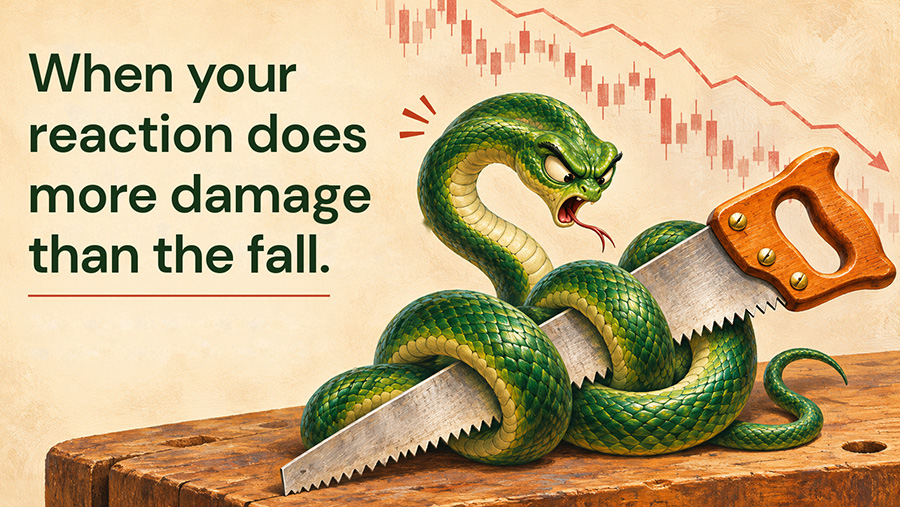
The saw cut the snake’s mouth.
Now thoroughly convinced that the saw was its mortal enemy, the snake escalated matters. It wrapped its entire body around the saw and squeezed as hard as it possibly could.
The harder it squeezed, the deeper the saw cut.
Eventually, the snake died from wounds that were almost entirely caused by its reaction to the original cut.
Which brings us rather neatly to the stock market.
Markets have suddenly fallen sharply. Screens are red. Headlines are dramatic. Financial television has rediscovered the words “panic”, “rout”, “crash” and “billions wiped off”—because apparently “markets occasionally go down” doesn’t sell enough advertising.
And understandably, investors become nervous.
But this is precisely when we should remember our unfortunate snake.
The market falling is the saw.
Selling everything because the market has fallen can be the snake biting it.
And selling a carefully constructed long-term portfolio after a significant decline can be the equivalent of wrapping yourself around the saw and squeezing.
Why Panic Selling Turns a Temporary Fall into a Permanent Loss
The market doesn’t know you’ve sold.
It isn’t offended.
It doesn’t apologise.
It certainly doesn’t say:
“Fair enough, Dave. You’ve suffered enough. We’ll wait until you’ve bought back in before recovering.”
Instead, you’ve potentially turned a temporary decline in value into a permanent realised loss.
That’s an important distinction.
If your house temporarily falls in value by 10%, you don’t immediately put it on the market at 10% less just to make absolutely certain you’ve secured the loss.
If Tesco announces 20% off steaks, nobody runs screaming from the shop shouting:
“SELL THE STEAKS! THEY’RE COLLAPSING!”
Yet when investments become cheaper, otherwise perfectly sensible human beings occasionally develop exactly this instinct.

Imagine walking into a car dealership:
“Good news, sir. The car you wanted yesterday for €100,000 is now €85,000.”
“GOOD GOD. Get me out of here. I’ll come back when it’s €110,000.”
That would be a peculiar purchasing strategy.
Yet emotionally, that’s remarkably close to what investors can find themselves doing.
Should You Sell Your Investments When the Market Falls?
None of this means markets cannot fall further. They absolutely can.
Nor does it mean every investment should automatically be held forever. Portfolios should be reviewed, investments can become unsuitable, circumstances change and genuine reasons to sell exist.
But fear itself isn’t an investment strategy.
The important question isn’t: “What did the market do today?”
It’s: “Has anything changed about why I own this portfolio and what I’m trying to achieve?”
If your objectives, time horizon and financial circumstances remain broadly the same, making a major long-term decision because of a few frightening days in the market can be precisely the wrong response.
Corrections are uncomfortable.
Volatility is uncomfortable.
Watching your portfolio temporarily fall in value is definitely uncomfortable.
But discomfort and danger aren’t necessarily the same thing.
Sometimes the best investment decision available is also the least exciting:
Do nothing.
Don’t bite the saw.
Definitely don’t try to strangle the saw.
And perhaps don’t open your investment app seventeen times before breakfast either.
Markets will continue doing what markets have always done: rising, falling, frightening people, exciting people, occasionally behaving as though they’ve consumed six espressos and forgotten to take their medication.
Our job isn’t to win an argument with the market.
It’s to make sure that, unlike the snake, we don’t turn a market movement into something considerably worse through our own reaction to it.
What to Do When the Stock Market Is Falling
So when markets become volatile, by all means review the portfolio.
Question it.
Stress-test it.
Speak to your adviser.
But before hitting SELL, remember one very unfortunate snake.
Sometimes the thing that hurts us most isn’t the saw.
It’s how hard we decide to squeeze it.