Tel: +34 93 665 8596 | info@spectrum-ifa.com | LinkedIn Facebook

Viewing posts categorised under: France

Why do I need a Financial Adviser?

By Philip Oxley
This article is published on: 21st April 2021

21.04.21

Top 10 reasons!

As 2021 progresses and hopes of a better year than the last increase, I thought I would write about a question that arises for me occasionally in social situations. From time to time, I am asked, “Why do I need a financial adviser?”, or sometimes it’s simply an assertion, “I don’t see the point of having a financial adviser”. My usual response is to give a brief overview of what I do, however, depending on the circumstances, I don’t always offer a thorough response and then subsequently regret not having taken the opportunity to fully outline the benefits offered from the work my peers and I do.

I appreciate that in terms of popularity and reputation, my industry is not at the top of the pile – sometimes being undermined by the disturbing stories of people being scammed (particularly in the field of pensions), and also a small minority of advisers who are exposed as either not qualified/licensed to operate, or who fail to act in the interests of their clients.

However, I know from the feedback that my colleagues and I receive from many of our clients that the work we do is appreciated and valued by many – sometimes for quite different reasons. So, I thought I would outline the benefits of why, if you do not currently have an adviser, you might want to consider exploring whether your finances could benefit from professional advice and ongoing support.

This list is not meant to be exhaustive and I have tried to avoid a generic list, instead drawing upon feedback and anecdotal evidence from individuals – some clients, some not…yet! Hopefully, my list provides a selection of reasons why I believe the work we do can be of significant value to many.

1. Saving money/growing money

The fundamental purpose of my role is to help my clients save money, and to grow and protect the money they already have. Such savings can be made through lower fees, reduced currency exchange risk, tax-efficient investment structures, and ensuring the best pension scheme for the client is selected. These same actions can also have a positive effect on the growth and protection of a client’s money. By choosing the right investment, an impact can be made on reducing inheritance tax liability for loved ones. Furthermore, if the worst happens to you, by selecting the best pension structure, you can ensure that your loved ones can be beneficiaries of your entire pension, in accordance with your wishes.

2. Greater choice of options

Of the financial solutions that I can offer my clients, few (if any), are available through banks or insurance companies – schemes offered directly through these organisations are usually the company’s own in-house products. I am not suggesting that these options are not suitable, but the advantage of using a financial adviser is the breadth of choice and the ability to select the best available products that most accurately suit the individual. Also, whilst some financial products are available directly to the consumer, many are not and can only be provided in conjunction with professional advice.

3. Sounding board

Sometimes in life, it is nice to have someone to discuss important matters with. People often turn first to their spouse or partner, friends, and sometimes work colleagues. I often speak to people who believe that they have their financial affairs in good order, but they value having a professional and independent “financial health check” to confirm that they are on track, or to provide an objective perspective on some of the areas that might need some attention.

4. Acting as your better conscience (or encouraging people to do what they know is right!)

Let’s be honest, most people enjoy spending their money – whether it’s on their home (often, but not always, a good investment), clothes, food, entertainment, cars (virtually guaranteed to be money-losing, unless classic/vintage cars are your thing!), and holidays.

It is not always easy to take a portion of your regular income and set it aside for the medium to long term, and of course, not everyone has the luxury of having a surplus at the end of each month.

However, a good comprehensive financial review doesn’t just analyse your assets (e.g., pensions, investments, savings, property), and liabilities (e.g., mortgage, credit card debts, car, and business loans), but also reviews your income/expenditure and your long-term wants/needs, to help assess whether there is the capacity to save, and how much.

A good financial adviser will encourage you to think about the long term and help you to take the right steps towards financial security.

why do i need a financial adviser

5. “I have no money to invest” / “I can’t afford to use a Financial Adviser”

This is a response I occasionally hear, however, irrespective of financial situation – whether the individual’s money is invested in their business or home, or they live on a low income – I am always happy to conduct a financial review. I can usually share some valuable insights, even if the person does not subsequently become a client. Do not let these reasons put you off speaking to an adviser – my confidential financial reviews are free of charge, and there is no obligation to accept my advice (although, I am pleased to say, most people do!).

6. Protection and risk

Many people associate financial advisers with pensions or investing/growing wealth. However, a crucial part of good financial planning is about protecting any wealth that you already have, and making contingency plans for all possible disruptive events that might come your way. When conducting a confidential financial review, I always ask if such matters have been considered, and whether arrangements are in place to provide financial protection in all eventualities. Life insurance is not always necessary, but a will is essential – I can put people in touch with English-speaking professionals in France who can assist in both these areas.

7. No time

For those whose lives are extremely busy (I think many of us can relate to this category!), they simply do not have the time (and/or inclination – see point 9!) to look after their financial affairs. Often people know they should be devoting at least some attention to their long-term financial security, but just never seem to get around to taking action. Sometimes, these people are well-informed and know very clearly what their financial objectives are, but do not have time to implement their plans and would rather a professional undertake this work on their behalf.

8. Retirement planning

In this area, the work we do is not just about advising individuals on the importance of saving for the future or selecting the best scheme for their individual needs.

For British nationals living in France who have private pension schemes in the UK, a proper analysis should be conducted to decide if it is best to leave their pension schemes where they are, move them to a UK-based SIPP, or possibly offshore into a QROPS. There is no one correct answer and I am not going to get into the detail of this now – it was the subject of my last article!

The second critical element of this work is to forecast what level of income someone will require in their retirement once other sources of income reduce or cease, and to then plan how that need will be met through rigorous financial planning.

9. No interest in financial affairs

Of course, this is one that I struggle to understand! I have a relative, who will remain anonymous, who encapsulates the example perfectly. This is someone who is financially comfortable, but genuinely finds the subject of savings/investments (or anything to do with managing their money), of absolutely no interest – to quote, “Boring”!

As long as their money is secure and providing some growth, then they will quite happily entrust as much of the decision making as possible to their financial adviser. The key to this working is to get to know the individual very well, understand their risk profile, and be clear on the circumstances of when they wish to, or must, be consulted on decisions.

10. Knowledge/expertise

The final reason to use a Financial Adviser (and I accept this is obvious, but I needed a tenth!), is for the knowledge and expertise they can offer on available products (relevant to the country in which they work). The good ones will ensure that they thoroughly understand their clients, establish solutions that align with the individual’s aspirations, risk profile, and ethical stance. It is important that your adviser is permanently based in France, works for a French company, and is properly licensed with the relevant regulatory authorities. Above all, make sure they are someone you feel a connection with, who understands you, and who you feel confident in establishing a long-term working relationship with to support your financial goals.

In conclusion, last year was incredibly challenging for many people – both financially and emotionally – and whilst some of the restrictions we have all lived within have eased, realistically, it will be some time before life resumes with some sense of normality. Whilst everyone’s health – physical and mental – must always take priority, I honestly believe that knowing that your money is protected and growing tax efficiently, and that you have taken the necessary steps towards your long-term financial security, is one less thing for you to worry about and makes a small but important contribution towards peace of mind.

Big brother is watching… or might be

By Katriona Murray-Platon
This article is published on: 2nd April 2021

02.04.21

After the fun and festivities of March (or those that could be had in current circumstances) it’s time to get down to serious tax work in April. The tax forms and dates of submission have not, at the time of writing, been released so that will have to wait until next month’s Ezine but usually the forms are available around the second week of April. If this is your first year of declaring in France you will have to go to the tax office to get the paper forms to complete. After submitting your first paper return you should then be given details to allow you to log on to your online account and do future returns online. The paper returns you will need are usually the 2042, sometimes the 2042 pro if you have professional income, the 2047 for all foreign source income and the 3916 for bank accounts and assurance vies (section 7 of the form).

The 3916 has recently been amended to take into account the new information that needs to be declared. Make sure you tick box 8UU for bank accounts and 8TT on the 2042 form to flag the fact that you have foreign assurance vies.

Under Article 1649 AA of the French Tax Code, those tax payers who have foreign assurance vies must declare the policy number, the amount of the investment, the start date of the policy and the duration of the contract or investment, any top ups or payments or reimbursements of premiums made during the tax year and, if relevant, the amount of any withdrawals or the surrender value,

Article 344 C of the Tax Code has now added new requirements concerning the information for foreign assurance vie policies which are:

  • The identification of the policy holder: name, forename, address, date and place of birth,
  • the address of the head offices of the insurance company or similar institution and, if relevant, the subsidiary which grants the cover,
  • the person covered by the policy, its reference numbers, the nature of the risks covered,
  • the amount covered by the policy and the duration of this cover,
  • the dates of any amendments to the contract, total or partial withdrawals, which have taken place during the calendar year.

Our policy providers are aware of this new law and will send out the relevant information for you to add into your tax returns or attach as a document online.

Those who have regular at home services and pay via CESU usually receive a tax credit for these expenses, 60% of which is paid in January. From June 2021 the tax office will be trialling a new system of immediately paying the tax credit for home help for those employers in Paris and the Northern departments who use the CESU system, before progressively rolling out this system across the whole country in 2022.

declaring your assets

According to a study from the US bureau of Labor Statistics in 2015 which looked at the number of jobs a person held between the ages of 18 and 50, the average person will have had 12 jobs. This is during a span of 32 years, so therefore the the number is likely to be higher for a person’s entire lifetime. This means that you are likely to have several pensions with several pension providers without knowing the value, investment strategy, performance or fees on these investments.

France has clearly realised this situation as well. Retirement plans for French companies are held by insurance companies, so when you leave the company you may not continue to receive information on what rights you have accrued. Now, thanks to new legislation, insurers must send the information on file to a centralised body. If you are or have been an employee in France you can go to the website info-retraite.fr to be informed of what rights you may have. The new law also requires employers to communicate a statement of the retirement products to those leaving the company. When I left my job in Paris I had a PEE (Plan d’Epargne Entreprise or company savings policy) which I had done nothing with. I was advised that as I was no longer an employee of the company this was just being eaten up by fees. I closed it down and reinvested the money into two assurance vies for my sons which are now growing nicely.

tax what to declare france

The Spectrum IFA group offer a free review of your pensions. We will help you obtain the relevant information from your pension providers and prepare a free report on your current pension plans and their benefits and whether they can or should be combined into one self investment pension plan or qualified overseas pension scheme. As I often say to clients, I agree with the many eggs in baskets principle but it is better having your baskets on a shelf where you can see them rather than eggs hidden around the farm!

If you have an SCI remember to put the 4th May in your diary (may the fourth be with you!) as this is the deadline for the income tax return for SCI companies that are not subject to corporation tax. This is also the deadline for accountants to file the income statements for those with industrial and commercial businesses (BIC), non commercial businesses (BNC) and agricultural businesses (BA). The deadline is extended to 19th May for online declarations. As yet the other tax filing deadlines are not known.

In the finance law for 2020 (article 154) a new law allowed the tax and customs authorities to use certain data published on the internet (Law no 2019-1479 of 28.12.19). The decree implementing this data mining provision was published in the Official Law Journal on 13 February 2021 (no 2021-148 of 11.02.21). This means that the tax authorities are allowed, experimentally and for only three years, to use information published by tax payers on social media (Facebook, Instrgam etc), sales sites (Ebay, Leboncoin etc) and other networking sites such as Airbnb and Blablacar. After researching, analysing and modelling fraudulent behaviour, the tax authorities can then use this data. They do not however have unlimited power, they are subject to the CNIL (National Commission for Freedom and Information Technology) and Parliament, to whom a report must be submitted in August 2022 and August 2023. The data mining can only be used to track non disclosed business activities and false declarations of off shore domiciles. Only “deliberately divulged” information can be collected and used, access to which does not require a password or subscribing to the website. Private posts or comments from third parties cannot be used. The data must be erased after 30 days if it isn’t going to result in an investigation. Data on sensitive subjects such as political views, religious beliefs and health information must be erased after 5 days on the same grounds. Whether this experiment will be extended or not remains to be seen but in the meantime it is another reason to be careful what you put out on publicly accessible social media.

If you have any questions or would like to speak to me about any of the points mentioned above please do let me know. Thank you to those who have got back in touch after reading my Ezine or have let me know that you are still enjoying reading these emails.

If you would like to receive my monthly ezine,
please sign up below

RISK Can you avoid this in financial terms?

By Occitanie
This article is published on: 26th March 2021

26.03.21

Welcome to edition number ten of our newsletter ‘Spectrum in Occitanie, Finance in Focus’, brought to you by your Occitanie team of advisers Derek Winsland, Philip Oxley and Sue Regan, with Rob Hesketh now consulting from the UK.

It seems remarkable, to me anyway, that we are already nearly a quarter of the way through the year. We still have the same problems to deal with, namely the fallout from Brexit and the continuing scourge of the Covid 19 virus, where the UK and France seem to be on diverging paths, both in terms of infections and vaccinations. With this in mind, we decided that it might be a good idea to talk today about risk, and how we might learn to live with it.

What is Risk?
Firstly, it is important to realise that risk is everywhere, and in various forms. In a sense it is like oxygen; without it, nothing happens. Sometimes you can see it, but most of the time you cannot. One thing that Covid 19 has taught us is that the very air that we breathe and the everyday items that we touch can kill us, and that is a sobering thought. The real definition of risk is the possibility that something bad might happen, either to you or because of something that you do; or even do not do. That is what makes risk exceedingly difficult to avoid. Often, we think of risk as taking a chance or a gamble, but sometimes a decision not to do something is just as risky.

Can I avoid Risk?
Yes, it is certainly possible to avoid some risks, but sometimes this has unintended consequences. If you do not eat, you cannot get food poisoning, but if you cut out that risk altogether, the end result is not positive. When it comes down to it, you have to accept risk. The real trick is calculating those risks and evaluating the likelihood of something bad happening. In investment terms, if you do not invest (and take some level of risk), you eventually run out of money. Unless of course you have a never ending and regular source of income – wouldn’t that be nice?

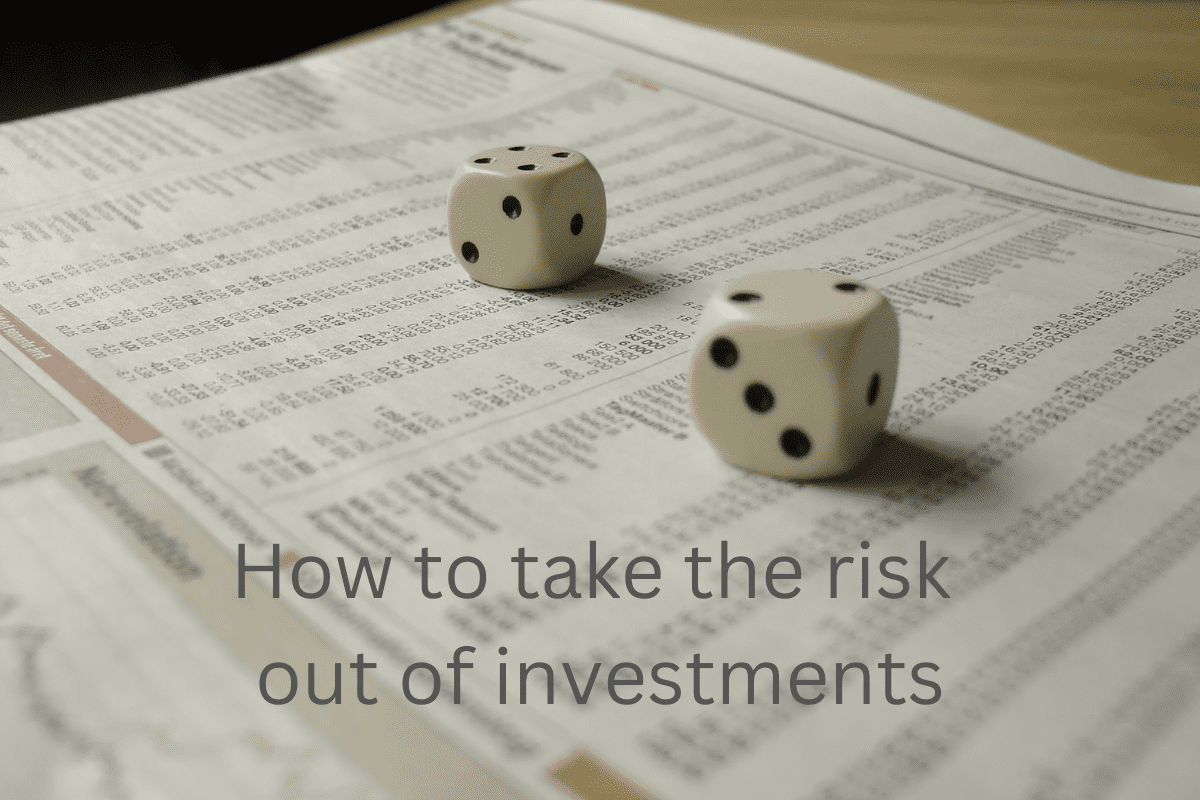
how to take the risk out of investments

What is Financial Risk?
Basically, the danger of losing some or all of your money. And it comes in all shapes and sizes. There is a bewildering array of types of risk that analysts use to make them sound clever. There are however some really big ones that you need to look out for, and here are what I consider to be the most important. Have a think about how you would rate them in order of importance.

Specific and Market Risk
Here we have in fact two slightly different risks. Specific Risk is the danger of investing in one individual share, fund, or bond. If you limit yourself in this way, you put yourself at far greater risk of loss. All your eggs are in one basket. Market Risk is the danger of losing money even if you have spread out your investments more widely. Whole sectors can suddenly dip and turn against you.

Institutional Risk
You may have the best investment portfolio in the world, but what if your chosen investment company goes bust due to mismanagement, or maybe a rogue trader? Think Equitable Life, or Nick Leeson at Barings Bank.

currency

Foreign Exchange Risk
One day we may have just one global currency. Then we will be able to forget the pitfalls of F/X risk. Until then we need to be very wary, especially we UK expatriate residents in the eurozone. In just twenty-one years the exchange rate between the pound and the euro has fluctuated between 1.75 and 1.02. That is a massive trading range. Big enough to put a huge dent in even the best investment performance. Worse still, it was not a linear move. It keeps on going up and down.

Inflation Risk
Remember 23% inflation rates in 1975? I do. Great for reducing the value of debt very quickly, but equally adept at destroying the value of savings and investments.

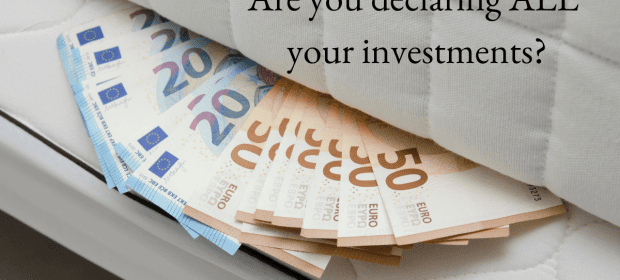
With all these dangers lurking at every corner, you may well be considering the mattress as a suitable home for your money. Forget it. Inflation risk will kill you, even if your house doesn’t burn down, taking the mattress and your savings with it.

The plain fact is that we all need to accept some level of risk. There is a risk/reward ratio; there is no gain without some degree of risk. The more risk you take, the more chance you have of seeing exceptional returns, but there is also more chance bad things can happen to your investment. The trick is to evaluate your true appetite for risk, and that is not as easy as it sounds. Left to his or her own devices, a single investor will tend to overestimate an appetite for risk and end up with a more aggressive portfolio than he or she feels comfortable with when a market ‘realignment’, sometimes referred to as a crash, happens a few months or years later.

how to take the risk out of investments

The truth is that we need someone to hold our hand and lead us through this risk minefield. If we try to navigate the minefield ourselves, we are likely to lose a financial limb or two, or even worse. There are various levels of help available to us

The most effective, in theory anyway, is the DFM, the Discretionary Fund Manager. He (or she) will sit down with you at the outset and ask you lots of clever questions which are designed to reveal your real appetite for risk (not just what you thought it was). You then pay a fee of around 1% of your portfolio each year for the DFM to invest your money for you and produce as good a return as possible without exceeding your risk pain threshold.

If you decide that you cannot afford a DFM, or maybe you have not got quite enough money for a DFM to offer his services to you, the next best thing is MAP, which stands for Multi-Asset Portfolios. They are offered by insurance companies or investment services providers. These funds are specifically designed to offer you investments that are graded for risk and ensure that your investments are spread out over many markets and sectors, thereby reducing your ‘specific’ risk. Both DFM and MAP investments can be held in what are known as ‘open architecture’ bonds within assurance vie policies in France.

Many of you will also be acquainted with the ‘closed architecture’ assurance vie offered by Prudential International. This assurance vie effectively combines the dual role of the DFM and MAP. Their PruFund range of funds is administered by Pru’s own in-house team of fund managers, and each fund is invested in a wide range of markets and sectors.

In essence then, my message is this; do not take on risk without knowing exactly what you are doing, but do not avoid investments. If you do not know exactly what you are doing, get a professional to do it for you. They are acutely aware of all kinds of risk, and how to use it proportionately. Your friendly local International Financial Adviser (that’s us by the way) is there to act as a conduit to guide you into safer investment waters.

Do not be afraid to ask for advice. It also happens to be free.

Please do not forget that, although we may be restricted on where we can travel at present, we are here and have the technology to undertake your regular reviews and financial health checks remotely. If you would like a review of your situation, please do not hesitate to get in touch with your Spectrum adviser or via the contact link below.

Occitanie@spectrum-ifa.com

Is your money safe under the mattress?

By Katriona Murray-Platon
This article is published on: 5th March 2021

05.03.21

March is my favourite month of the year, not least because I celebrate my birthday during this month and this year will be the end of my 4th decade. Traditionally it has always been a busy month because it is a great time for events and starting new projects. This month my colleagues and I will be attending another virtual property fair hosted by Your Overseas Home. The event we did last year was very good and lots of people were able to see our presentations and then chat to our advisers from the comfort and safety of their own homes.

By October 2021 I will have lived in France for 18 years continuously, but I first arrived for my Erasmus year in September 2001 making it 20 years since I started living in France. As you may know I am married to a Frenchman and I have adopted much of the French culture and way of life. But my husband and I have very different views in our attitude to risk and finances. My husband came from a farming background where money was hidden under the mattress, you only bought when you had the money and you insured everything that could be insured. My husband will take a 10 year extended guarantee on a toaster! I came from a background where it was common to use credit cards to fund Christmas and holidays and I went to university with a student loan.

What is the point of having money?

The idea that money is safe under the mattress or in the bank is no longer true. In France the traditional popular savings accounts such as the Livret A and LDD now only have an interest rate of 0.5%. The other misled belief that French assurance vie policy holders have is that Euro Funds are a good investment and a safe investment. Whilst it is true that Euro Funds are still one of the least risky investments after the traditional bank savings accounts, their performance continues to drop year after year. The average growth rate of the Euro Funds in 2020 is 1.2% which, once you deduct social charges (17.2%) and take into consideration inflation (0.5%), the net gain is only 0.5%. One of my own French assurance vie policies, which is 69% Euro Funds, has made an average of 1.6% over the seven years since it was created. The problem with French assurance vies is that they are not bespoke; they come with certain formulas, some that you can contribute to monthly, some that you cannot, and depending on your choice you cannot go lower than the prescribed amount in Euro Funds, no matter what your risk profile.

When I compare this with the range of product providers we can offer our clients and the choice of funds, the difference is astounding. Thank goodness that as English speakers we have access to better investment possibilities from as little as £20,000/€25,000. The average performance of my clients’ portfolios is around 3% after charges, with no social charges taken at source, and they have a lot of choice and flexibility regarding which funds they want and how much of that fund they want their investment to be in. They also have access to English speaking product providers, English speaking fund managers and their own English speaking financial adviser who is supported by the knowledge and experience of all of the Spectrum advisers.

I am fully integrated into French society and believe in adhering to many things about French society, but when it comes to finances there are differences between us that we cannot ignore so it is not in our best interest to invest in French financial products.

investing in tough times

The outlook this March is thankfully much better than last March. There is more good news for Prudential policy holders. At the end of February Prudential announced no changes to the Expected Growth Rate and upward Unit Price Adjustments in the PruFund Growth Sterling, PruFund Growth Euro and PruFund Cautious Euro funds.

For other funds and the markets in general the outlook is equally positive. “The combination of vaccine roll-out, substantial fiscal stimulus, and elevated consumer savings should drive a sharp recovery in economic and earnings growth,” said Ryan Hammond, a Goldman Sachs strategist, in a report this week.

Whilst mask-wearing and social distancing will still be necessary for some time to come, a lot of our friends and family members have been vaccinated, therefore reducing the risk to the most vulnerable. With the coming good weather, meetings and get togethers will be able to take place out of doors. As always, if clients are happy to arrange a face to face meeting, I look forward to seeing them for outside meetings in their lovely gardens. If however you prefer video meetings or phone calls that is also possible.

Wishing you all a bright, sunny and floral month of March!

Beyond Brexit… What comes next ?

By Occitanie
This article is published on: 4th March 2021

Welcome to the ninth edition of our newsletter ‘Spectrum in Occitanie, Finance in Focus’, brought to you by your Occitanie team of advisers Derek Winsland, Philip Oxley and Sue Regan, with Rob Hesketh now consulting from the UK.

In this our first newsletter of the year, it is appropriate we say a fervent goodbye to 2020 and look forward to what we all hope will be a better and much kinder year. Although we are heartily sick of hearing the B-word, we can’t let the passing of the UK’s exit from the European Union pass without addressing the question “where do we stand now?” We also invite our investment partners to give their views on the markets for the coming year.

Post Brexit Situation
As far as financial services are concerned, it is (at this stage) a no-deal Brexit. Financial services in the UK employs 1.1 million people, yet so far more time has been spent negotiating fishing rights than financial markets access between Europe and the UK. This financial services relationship between the two sides will be discussed and negotiated over the coming months. What does this currently mean for us expats? We have already seen:

  • Banks threatening to close down bank accounts, because they struggle to find solutions for the ongoing servicing of non-UK resident account holders.
  • Financial institutions no longer being allowed to ‘passport’ their services into Europe – UK based investment managers, and Independent Financial Advisers (IFAs) being just two examples of this. To continue to offer services, each must now open European offices and apply to be regulated through the relevant EU regulatory system
  • We’ve seen the application of duties to goods imported from the UK from online shopping, a totally new concept for most of us
  • The need to apply for a French Driving Licence

These are but a few of the bureaucratic changes brought about by Britain’s exit from the EU.

We have covered some of these Brexit consequences in previous editions of our newsletter, but there is perhaps a more serious implication for those who hold UK investment bonds.

Why are UK Investment Bonds a problem?
Prior to Brexit, as investment bonds issued in an EU country, UK bonds were treated in the same way as assurance vie policies, with only the gain element of the investment subject to income tax and social charges. How quickly your local tax office recognises that this situation has now changed will vary, but in time it is inevitable that questions will start to be asked regarding those withdrawals that you are taking to support your lifestyle.

Why should that bother me?
As a non-EU qualifying bond, your local tax office could, as a worst-case scenario, treat the whole of any withdrawal as taxable income unless the split between capital and gain can be proved. It is more likely, however, that withdrawals from UK bonds will still only be taxable on the gain element, but the taxpayer will no longer benefit from the favourable tax treatment that the assurance vie enjoys, such as the annual tax-free allowance of €4,600 (€9,200 for a couple) after 8 years and the preferential 7.5% rate of income tax. We urge all our readers to assess their current savings and investments, to ensure that they are all France tax compliant. We can help you with those assessments.

investment manager

What can we expect from investment markets this year?
We have invited one of our investment partners to give us their Investment Outlook for 2021. These are the views of Tilney Smith & Williamson that we would like to share with you.

A review of a tumultuous 2020
The investment landscape in 2020 has been dominated by the COVID-19 virus, lockdowns and unprecedented policy easing by Central Banks and governments around the globe. The US election and UK-EU negotiations provided further risks to markets. The pandemic led to a global economic shock that established new multi-generational records. For instance, UK GDP fell by over 11% in 2020, the biggest decline since the Great Frost of 1709 (1).

In financial markets (2), the MSCI All Country World equity index fell 32% in total return terms (including dividends) once COVID-19 new cases spread outside China, while government bonds outperformed as investors became more risk averse. The low point came on the 23 March prompting the Fed to say that it was prepared to buy US corporate bonds as part of a new round of quantitative easing (e.g., asset purchases). Global equities then went on to rally 63% from the trough, supported by – at various points – fiscal and monetary stimulus, economic recovery and hopes of a successful vaccine rollout, to close out the year up 15%.

The main winners of 2020 were ‘growth’ equities and direct COVID beneficiaries such as Big Tech, following widespread adoption of e-commerce and working from home practices. Long-term government bonds benefited from central bank asset purchases. In turn, gold gained from concerns about the debasement of the fiat currency system from money printing: the US created 21% more dollars in 2020 than existed previously. Despite the virus originating in Wuhan, China was one of the quickest economies to re-open and MSCI China equities rose 28%. China’s economy benefitted from lockdowns in the West, since services were restricted, but buying goods was not. China even managed to boost its share of global merchandise exports, driven by stimulus in the West creating demand. The biggest losing sectors were energy (-32%), real estate (-9%) and banks (-11%), with the COVID-exposed UK and Eurozone the laggards in geographical terms.

Be positive

Reasons to be optimistic in 2021

We maintain an optimistic outlook for equities for several reasons. First, the rollout of vaccines and a gradual opening up of economies from lockdowns should encourage households to run down savings rates to sustain consumption.

Second, we expect a synchronised broad-based global economic recovery that supports company earnings. The IMF forecasts that a record 79% of nearly 200 economies will experience growth higher than 3% (3) this year. Not only would this recover much of the lost output last year, but it adds support to consensus global Earnings per Share growth of 28% expected in 2021.

Third, central bank liquidity is still projected to remain highly accommodative. The ECB topped up its pandemic emergency purchase program by €500bn in December to €1,850bn and extended the horizon of net bond purchases to the end of March 2022 (4). In a major policy change in September, the Fed made clear that it intended to “run hot” with regards to maintaining easy monetary policy in order to achieve above 2% inflation (5). Morgan Stanley forecasts that the combined balance sheet of G4 central bank assets will rise by $3.4trn by the end of 2021(6).

The UK and Brexit
Despite the widespread recovery in global risk assets, all UK equity indices were laggards, handicapped by the ongoing Brexit uncertainties and a compositional skew towards value orientated economically sensitive businesses. Should current assumptions over a vaccine inspired economic rebound prove correct, it seems probable that this skew, allied to the removal of Brexit trade uncertainties, could give rise to some relative recovery in UK equity valuations. However, with the longer term balance sheet impact of the Covid lockdowns still to be fully understood, remaining focused on the fundamental quality of the businesses selected, even in an ostensibly cheap market remains paramount.

Investment Risk

Risks to the outlook
In terms of the risks, we continue to monitor: i) a sudden removal of accommodative policy, perhaps if inflation returns at a pace that exceeds central bankers’ expectations, ii) fears of another COVID-19 surge, or a disappointment in the effectiveness in vaccines/a mutation to a more virulent virus, iii) social unrest in the politically polarised United States, and iv) extended valuations in some sectors triggering a broader market rout.

As a reminder to our readers, Spectrum is a registered French company, regulated in France. We are not passported in from the UK, so for us it’s business as usual.

For those of you who still have investments in the UK, whether they be stocks and shares ISAs, investment bonds, pension funds or other investment portfolios, now would be a good time to review these and discuss with your provider as to whether they will be able to continue advising you in a post-Brexit world. Even if your UK provider will be able to continue advising you, they may not be familiar with the French taxation framework and the investments you hold may not be tax efficient in France. We can advise you on investment products that are suitable and tax-efficient for living in France and provide you with ongoing advice to ensure that your financial plan remains on track as your situation and attitude to risk change over time.

Please do not forget that, although we may be restricted on where we can travel at present, we are here and have the technology to undertake your regular reviews and financial health checks remotely. If you would like a review of your situation, please do not hesitate to get in touch with your Spectrum adviser or via the contact link below.

Occitanie@spectrum-ifa.com

We would love to hear from you with any comments and/or questions, as well as suggestions as to future topics for our newsletter. Please feel free to pass this on to any friends or contacts who you think might find it interesting.

Currency Exchange and the benefits of using a specialist provider

By Spectrum IFA
This article is published on: 2nd February 2021

02.02.21

Relying on a bank to transfer currency is an expensive option. Currency transfer specialists provide competitive terms, secure, swift transactions and a range of other benefits including regular payments, forward contracts and rate tracking alerts.

At The Spectrum IFA Group we work with Smart Currency Exchange to deliver the best possible rates, service and support for our clients.

Whilst nobody can predict exchange rate direction, the relative strength (or weakness) of the euro is relevant for most of us. I attached a weblink to Smart’s 2021 quarterly currencies forecast.

Smart Currency Exchange
Quarterly Forecast 2021

A historic Presidential election, Brexit deal and global pandemic sent currencies in directions that no one could have predicted in 2020.

Does that mean matters will settle down in 2021? We wouldn’t suggest you bet your transfers, your property budget and your future plans on that!

Fresh uncertainties for the year ahead bring new challenges for economies – and currencies – too. So, predicting the pound’s movements accurately can be a near-impossible task – even for the major banks.

I invite you to read this quarter’s currency forecasts, but with a strong suggestion that you do not base any decisions on them. Predictions for GBP/EUR range between 1.06 and 1.28 over the next 12 months!

Smart Currency Exchange

What’s in your Quarterly Forecast?

Post-Brexit special – what happens now?
Looking to buy a property overseas this year? What do you need to consider in a post-Brexit world? Our resources section can help.

New and improved tables and charts
How are economies coping in the midst of the pandemic? Our new charts and tables offer a deeper insight.

Expert analysis sections
Smart’s Senior Risk Management Analyst offers his insight and opinion – do you agree with him?

Your next move?
In this climate of uncertainty, how should you plan for the future?

For any further information on currency exchange, please contact your local adviser or please send an email to: info@spectrum-ifa.com

Financial Advisers in France
Financial Advisers in spain
Smart Currency Exchange

Looking back at 2020, looking forward to 2021

By Occitanie
This article is published on: 12th December 2020

12.12.20

Welcome to the 8th edition of our newsletter ‘Spectrum in Occitanie, Finance in Focus’, brought to you by Philip Oxley, Sue Regan, Rob Hesketh and Derek Winsland, your Spectrum team of advisers in the Occitanie.

2020 has been a year like no other we can remember. We have had a global health pandemic with tragically unprecedented levels of deaths in peacetime and significant changes for many people in relation to both their work arrangements and social lives, notwithstanding challenges in relation to individuals’ physical and mental health.

In the financial world, economies have suffered deep recessions and economic rebounds within the space of months. All financial markets plunged sharply in March, but many have recovered those losses, and more, with the US Dow Jones index recently breaching 30,000 for the first time ever. In the UK, the recovery of the FTSE 100 has been more muted and even with advances in the last few weeks, the index is still currently down about 15% from its starting point at the beginning of this year, although there are still a few weeks to the end of the year for the market to surprise!

cover 19

Vaccines
Perhaps the single most positive piece of news in 2020 has been the recent succesful trials of a number of Coronavirus vaccines. With approval granted by the MRHA, the UK’s medicines agency, for the Pfizer/BioNTech vaccine, there are 800,000 doses heading to the UK with care home residents and staff thought

to be at the top of the list of recipients, followed by the over 80s and healthcare workers.

There are many other vaccines in the pipeline with Moderna and AstraZenica/Oxford University vaccines thought to be close behind in the approval process. Vaccines from Johnson & Johnson and Novavax are both in the final Phase 3 of trials, China has at least three and Russia one, which are all undergoing trials currently.

Interestingly the storage conditions and price vary greatly, with the Pfizer/BioNTech vaccine requiring about -70°c conditions, dilution before administering and is thought to cost in the region of £25 per dose. The vaccine from AstraZeneca & Oxford University, however, can be stored at fridge temperatures for up to six months, with an estimated cost of about £3 per dose (because the company has committed to distributing the vaccine at cost, during the course of the pandemic). On the day the company announced the results of its trials, the markets somewhat cruelly knocked nearly 4% off the company’s share price! Some confusion over the vaccine dosage and efficacy results didn’t help, but supplying the vaccine at cost is not going to provide the profits boost that investors might have expected.

2020 elections

Politics
Politically, both Biden and Trump registered more votes each than any other US President in history. Whilst Biden undoubtedly won this contest (despite Trump’s protestations), Trump and his views clearly still resonate strongly with many Americans. Politics aside, the economy, employment and equity markets have actually had a particularly good run under Trump’s stewardship. However, the markets have also taken the Biden victory in their stride. Despite what was said during the heat of the election campaign, Biden is a moderate and the response of the markets shows that also to be the view of most investors. The markets’ reaction was also supported by the likelihood of a Republican Senate (still to be determined) which will act as a check on any of the more radical instincts of the new administration. Much of the world will welcome the likely return of US support for the World Health Organisation (WHO) and the Paris Climate Accord.

Closer to home, Boris Johnson’s stock has plummeted from a comfortable election winner only a year ago, to talk of grumbling amongst his own MPs. There has been speculation of possible moves against him by his own MPs, although if this dissention does snowball, it will probably not be until 2021.

President Macron has been busy on the world stage in recent months; although interpreting the polls would suggest the French people would rather he focused on domestic matters instead. His popularity has improved from lows seen previously, but the numbers who disapprove still outnumber those who approve of his presidency and polling on people’s voting intentions for the 2022 Presidential Election show him only a whisker ahead of Marine Le Pen. But with nearly 18 months to the end of the President’s term, much can still happen.

Brexit
As this article goes to press, negotiations are still ongoing between the UK and the EU. Many areas remain unresolved including fishing rights (which seems to be one of the key sticking points in the deal, particularly due to Macron who,according to press reports, is the chief instigator behind the EU’s tough negotiating stance) as well as many other aspects of the UK’s future relationship with the EU. One item that has been clarified recently, however, is in relation to French residents in possession of UK driving licences. It has been confirmed that these will need to be exchanged for French licences, but those affected have until 31 December 2021 to secure their new licence. UK nationals who have driving licences from another EU country do not need to make this switch.

QROPS
Remaining on the subject of Brexit, one of the “go to” financial products within the expatriate market for pensions has been the Qualifying Recognised Overseas Pension Scheme (or QROPS). Since its inception 14 years ago, HMRC figures indicate there have been over 130,000 transfers and the average transfer value in 2019/20 was £125,000. This useful financial planning product has an uncertain future after the end of this year. From 9th March 2017 transfers to and from a QROPS became liable to an Overseas Transfer Charge (OTC) of 25%, unless one or more of five conditions was met. One of those conditions was that the pension member was resident in a country within the European Economic Area (EEA) and the QROPS was established in a country within the EEA. This meant that whilst the QROPS remained an attractive proposition to many expatriates within the EU, the number of individuals who went ahead with a transfer to a QROPS and paid the OTC in the tax year 2019/20 was only 13, according to an article published by Canada Life. The UK left the EU on 31 January 2020 and also left the EEA (the EEA comprises all EU member countries plus Iceland, Liechtenstein and Norway). The transition period agreed in the Withdrawal Agreement requiring the UK to be treated as an EU and EEA member, and bound by the rules of both, expires on 31 December 2020. It seems that this may mark the effective end of the QROPS, although we wait to have this confirmed. Fortunately, an International SIPP is still available to those looking for favourable solutions for their UK pension schemes and this product can provide many of the advantages afforded by a QROPS.

2021 finances

2021
One of our favourite quotes about predicting the future in relation to the world of finance is from the late J.K. Galbraith, who was for many years the Professor of Economics at Harvard University. He famously said that “The only function of economic forecasting is to make astrology look respectable”. For that reason, we will focus on possible trends rather than predictions!

The positive vaccine news has already seen a surge in value to those stocks in sectors that have been battered for most of 2020 – leisure, transport, hotels, restaurants, cinemas etc. It is also likely that prices in banking stocks will stabilise or possibly recover further. Furthermore, it is probable that a lot of the old traditional stocks such as oil, industrials, consumables etc. will improve as we move into 2021. What is not so clear is whether those technology stocks, seen also as “stay at home” stocks (Facebook, Alphabet, Apple, Amazon, Microsoft, Netflix etc.) which have had a stellar 2020, benefitting from the impact of Coronavirus, will continue to power ahead or take a breather in 2021. With regard to some of those sectors that were hit badly this year (hospitality, cinemas, airlines etc.) it is also unclear whether the change in consumer behaviour seen this year is here to stay, in which case any recovery in these sectors may be limited in scope.

Gold, seen as a safe haven during this year’s turbulence, fell back sharply with news of vaccine progress, but has recently stabilised, whereas Cryptocurrencies have strongly advanced in value over this period. It is difficult to assess the future direction of either of these assets, but as the vaccines get rolled out and economies improve, the predictions earlier this year that gold could reach $3,000 per ounce seem unlikely, in the short term at least. What can be predicted with more confidence is that there will still be volatility in the markets, because whilst they have been buoyed by the vaccine news, in the “real economy”, the fallout has yet to be properly felt.

Unfortunately, rising unemployment is inevitable, as are tax increases at some point, to start to chip away at the mountain of debt that has accrued through increased government spending and falling tax receipts. There has been much talk about the shape of the recovery, e.g. “V”-shaped, “U”-shaped, “W”-shaped (reflecting a double-dip recession) or even a reverse square root (unfortunately not an available button on this author’s keyboard!). The answer seems increasingly that all of these may happen depending on the country, the market sector or the company.

What we would comfortably recommend however, is to stay invested in the markets. To conclude with another well known quote from Warren Buffett, now 90 years of age and considered one of the world’s most successful investors, “The stock market is a device for transferring money from the impatient to the patient”.

We wish all our readers a very happy and healthy Christmas and we hope 2021 will be a better year for all. We will be back in touch again next year.

If you have any comments or questions, as well as suggestions for future topics for our newsletter, we’d love to hear from you at occitanie@spectrum-ifa.com. Please feel free to pass this on to any friends or contacts who you think might find the content of interest.

UK bank accounts after Brexit

By Occitanie
This article is published on: 20th November 2020

20.11.20

Welcome to the seventh edition of our newsletter ‘Spectrum in Occitanie, Finance in Focus’, brought to you by Sue Regan, Rob Hesketh, Derek Winsland and Philip Oxley your Spectrum team of advisers in the Occitanie.

As we are approaching the end of 2020, to say that it has been an unusual year would be a gross understatement. Countries across the globe continue to adjust to life with Covid-19 and with the ongoing and ever-changing restrictions that the predicted second wave has brought with it. As this goes to ‘press’ we now find ourselves once again in a national lockdown in France.

Although it had taken a back seat since the virus outbreak, Brexit is once again at the forefront of the minds of UK expats living in the EU. Will there be a trade deal? Are we heading for a cliff-edge ‘No Deal’? It is almost unbelievable that we are still at this point in the deliberations with only eight weeks of the transition period to go.

UK Banks closed

UK Banks accounts after BREXIT
As the deadline approaches one issue that we are frequently being asked about lately by concerned clients, is that some UK banks have been writing to their customers resident in the EU putting them on notice that their UK bank accounts and credit cards will be closed either at the end of the year or, in some cases even earlier, as a result of Brexit.

Although some banks have already contacted some customers, it is apparent that only some types of account are affected and only in some EU countries. The two main banking institutions that have taken such action so far are Barclays and the Lloyds Banking Group, which includes Lloyds Bank, Halifax and Bank of Scotland. Many other banks have stated that they ‘currently have no plans to close customer accounts, but they are monitoring the situation’. Given that this could potentially affect all of us with ties to the UK banking system, we thought this would be a good topic to focus on this month.
So why are some banks closing UK expats’ accounts?

UK banks and other financial firms are currently allowed to trade as part of the European Economic Area (EEA), as all member countries use the same regulatory framework. This arrangement is known as ‘passporting’, and it is why Brits who have moved abroad have been able to use credit cards and banking services from UK-based banks, even though they’re no longer living in the country. However, once the Brexit transition period ends on 31 December, this passporting arrangement will no longer be in place – that is, unless a specific agreement to carry it on is reached as part of a Brexit deal. With no such deal confirmed, UK banks would have to attempt to negotiate and fulfil the stipulations from every EEA country’s regulator. All of them work differently and a continuation of providing services to UK expats will be more feasible for some banks than others.

The impact on each customer will vary depending on how their bank or financial institution currently operates, the product or service being provided, and the legal and regulatory framework in the country in which they are resident. In effect, this means that the situation is different for each financial service offered by each financial provider in each country; for some banks, offering certain products in certain countries simply won’t work. So, certain services and accounts may be withdrawn in some EU countries but not in others.

We understand that many banks are still trying to figure out a way of working in different EU countries after the Brexit transition period, while also waiting to see if a deal can be agreed between the UK and the EU. The Bank of England and the Financial Conduct Authority (FCA) have written to banks informing them that, if they do decide to close customer accounts, they must have plans in place to service their Europe-based customers properly through the process, taking into account how their actions might impact on customer’s individual circumstances and the alternative products available to them.

What should you do?
DON’T PANIC – there have been some dramatic headlines in the press about the issue, but it is important to stay calm. If you think you will be affected, you should not act in haste and repent at leisure. Give yourself time to work out what your options are.

CHECK THE FACTS CAREFULLY – whether or not you have had a warning letter from your bank, talk to them now and find out what they plan to do on Brexit day. If you still have a UK address, your account may not be closed.

CHECK YOUR SPECIFIC ACCOUNTS – you may find the types of savings products you hold are still permitted in France. Your bank should be able to advise you on this.

ARRANGE FOR PAYMENTS TO BE PAID DIRECTLY TO YOUR FRENCH BANK ACCOUNT – if you are in receipt of the UK State Pension, HMRC will pay this directly to your French account every month and, because of the volume of payments made, the exchange rate is extremely competitive. OK, so the GBP:EUR rate isn’t that great at the moment but at least you will be guaranteed continuity of income if you rely on this to fund your lifestyle in France. Some UK private pension providers will also pay pensions to foreign bank accounts, so it is worth speaking to your provider about this.

OPEN A NEW UK ACCOUNT – find a UK bank that is operating in France (such as HSBC and Santander) and check if you can meet their eligibility criteria for opening a new bank account and that the account will meet your needs. For example, does it require you to have a minimum income or deposit with them?

CONSIDER OPENING A STERLING OFFSHORE BANK ACCOUNT – we have a good connection with a very reputable bank, based in the Isle of Man, that offers accounts in a number of currencies including Sterling and Euros and which will accept regular payments in and direct debits out. If you would like details of the account, please contact your Spectrum adviser.

livret A

If you have savings on deposit in the UK that you use for your short-term liquidity or an ‘emergency fund’ and you have been told, or are concerned, that these accounts will be closed, there are a number of tax-free savings accounts available in France, which you should consider maximising, if you have not already done so, including the following:

THE ‘LIVRET A’ – which is currently paying a rate of interest of 0.5% per annum and is available to non-residents. The maximum permitted investment into this type of account is €22,950 per individual.

THE ‘LIVRET DÉVELOPPEMENT DURABLE (LDD)’ – this account is available to residents of France and the maximum investment permitted is €12,000 per individual. It is currently paying an interest rate of 0.5% per annum.

THE ‘LIVRET D’EPARGNE POPULAIRE (LEP)’ – this account is available to residents of France who are on low incomes. The maximum investment amount permitted is €7,700 per individual. The interest rate is currently 1% per annum. For example, in order to open a LEP account in 2020, your ‘revenu fiscal de référence’ in 2018 (as shown on your ‘avis d’imposition’ of 2019) must not have exceed €19,977 for a single person or €30,645 for a two-part household.

But it’s not just bank accounts that might be affected when passporting goes………….

Some UK financial services providers are informing their non-UK resident customers that they will not be able to provide them with advice on their existing UK based investments after 31 December and that ‘you should find a new adviser or cash in your investments’.

As a reminder to our readers, Spectrum in France is a registered French company, regulated in France, and we are not passported in from the UK, so as far as we are concerned, it’s business as usual.

For those of you who still have investments in the UK, whether they be stocks and shares ISAs, investment bonds, pension funds or other investment portfolios, now would be a good time to review these and discuss with your provider as to whether they will be able to continue advising you in a post-Brexit world. Even if your UK provider will be able to continue advising you, they may not be familiar with the French taxation framework and the investments you hold may not be tax efficient in France. We can advise you on investment products that are suitable and tax-efficient for living in France and provide you with ongoing advice to ensure that your financial plan remains on track as your situation and attitude to risk changes over time.

Please don’t forget that, although we may be restricted on where we can travel at the moment, we are here and have the technology to undertake your regular reviews and financial health checks remotely. If you would like a review of your situation, please do not hesitate to get in touch with your Spectrum adviser or via the contact link below.

We’d love to hear from you with any comments and/or questions, as well as suggestions as to future topics for discussion. Please feel free to pass this on to any friends or contacts who you think might find it interesting.

Occitanie@spectrum-ifa.com

Are you a UK IFA with Clients Living in Europe ?

By Spectrum IFA
This article is published on: 17th November 2020

17.11.20

ARE YOU UNABLE TO SERVICE THESE CLIENTS POST BREXIT?

UK IFA

At The Spectrum IFA Group we can look after your clients long term as licensed and regulated financial advisers operating in France, Spain, Italy, Portugal, Malta, Luxembourg and Switzerland.

The things you should know before you contact us for our help:

  • We specialise in financial planning for English speaking expatriates across western Europe
  • We are locally authorised in all jurisdictions in which we operate and across the entire EU (and Switzerland). Our regulatory status is unaffected by Brexit
  • We hold financial services licenses for both insurance mediation (Insurance Distribution Directive compliant) and investment advice (MiFiD compliant)
  • Established in 2003, we have 50 advisers and 12 regional offices
  • We work only with large, well known asset managers including Blackrock, Jupiter, Fidelity and Prudential. For clients with higher value portfolios we also use discretionary investment managers such as Rathbones, Smith and Williamson and Quilter Cheviot
  • As part of our terms of business, clients of The Spectrum IFA Group receive ongoing, long term service and support. All advisers live within easy travel distance of their clients
  • We are not an offshore broker. We do not use products from UK dependant territories (such as the Isle of Man or Channel Islands) as they can produce adverse tax consequences for clients living in Europe. We advise that you don’t use any of these structures for your clients if they are EU resident
  • We use only locally compliant products which are designed specifically for the jurisdictions in which our clients are based
  • We work on a transparent charging structure with all clients. Charges are deducted directly from the products and solutions we recommend. We do not invoice separately

As the end of the transition period is rapidly approaching we ask that you contact us as soon possible to allow time for us to complete any necessary restructuring of client assets.

If your clients are resident in the EU or Switzerland, or intending becoming resident, please feel free to contact us for a no obligation discussion to determine if we can look after your clients post Brexit.

You can contact us at info@spectrum-ifa.com

Or speak to the specific country managers in France, Spain or Italy

Click the relevant flag below

Spectrum IFA France
Spectrum IFA Spain
Financial Advisers in Italy

We don’t have a crystal ball but we know how to prepare for the unknown

By Alan Watson
This article is published on: 10th November 2020

10.11.20

For most of 2020, nobody in France has been able to escape the misery of the daily Virus update; even as I write this article, it gets worse by the day. From a financial planner’s viewpoint, and thinking of my family, long term Rhone-Alps based, it can spin one’s head wondering, “how much, and for how long, will our children be paying extra taxes and social charges to balance this black hole.”

President Macron has certainly not been slow in pressing his Eurozone political colleagues to secure a massive support package for France (so all those excessive Urssaf charges have clearly not been enough!) Did anybody analyse, offer some statistics as to how this will be paid back? If so, sorry I missed it, but we all know the harsh reality is payback time will be long and heavy.

Many of my clients in the Alps are either retired, considering it, or working hard in their business to secure a tidy financial future, not only for themselves, but for their families also. It’s a part of life’s pattern that many of us become beneficiaries of a family estate, and being a French fiscal resident, this brings up potential questions and complications, “what are the limits I can receive before the tax man becomes an unwelcome beneficiary?”, “my children deserve a portion of this, but the bank offers a derisory return, not even Eurozone inflation proof,”, “our young daughter dreams of studying in the US, how much will that cost?”

gifts

So how do we approach such matters ? You may be surprised and relieved to hear that the French fiscal system can be both generous and highly tax efficient when it comes to financial planning for ourselves and our families. For example, a gift of €100,000 can be made every 15 years from parents to children, free of tax and social charges, which could be used for that far off house purchase, a highly regarded study program, or even setting up a business. A lower, but still highly valuable, allowance of just over €30,000 applies for gifts between grandparents and grandchildren.

Currency is also an important consideration. French banks are always happy to offer short and long term saving vehicles. The wording of the contracts, terms, and fund choices, even for somebody who has spent over 30 years in European financial services, can be rather bewildering, plus they always insist on converting your Sterling to Euros, and currently this is not a sensible proposition. In the last year alone we have seen swings between the two currencies of 10%; the Pound is still a global currency and will return to its former glory, so a far better facility is to be able to choose your exchange date, then take advantage whenthe currency is stronger to move to your new Euro based need. This flexibility coupled to tax efficiency, could make a gift for your loved ones a very sensible and well planned move.

As a financial adviser, I meet many people in sometimes complex and misunderstood situations, “I have actually lived in France for the last two years, is it now time to declare fiscal residency?”, “My children have UK ISAs set up by their grandparents, so living here as a family, is this tax efficient?”

A no obligation meeting may help to unravel the complex French reporting system, and allow you to enjoy all the things that brought us here in the first place.