Tel: +34 93 665 8596 | info@spectrum-ifa.com | LinkedIn Facebook

The death of original content – The AI takeover

By Gareth Horsfall
This article is published on: 16th September 2026

Over the summer I have been seeing alot written about AI, most of which I take with a pinch of salt, but one headline that appeared in my inbox was the following:

Bot and AI overtake human-generated web traffic for the first time; we are in the age of the “Dead Internet”

According to data from Cloudflare, automated bot and AI agent traffic has surpassed human-generated web traffic for the first time in history, with 57.4% per cent of requests to websites it hosts being automated bot requests, while only 42.6% originate from human users.  Matthew Prince, co-founder and CEO of Cloudflare, expressed surprise at the speed of the transition from human-generated to computer-program-generated content.  He expected this would happen towards the end of 2027.

This, for me at least, is alarming.   Not because automated AI generated content will surpass human generated content, I think that was almost inevitable but because AI models are all fishing in the same pond.   I don’t know enough about how well AI can generate new creative ‘original’ ideas, but I am almost certain that it will never surpass the human capability to create and innovate, therefore it does leave you wondering to what extent the information we are getting from Chatgpt or Claude, or any other open source AI model, is just recycled from the same information which AI put there in the first place.   I am sure the more technologically advanced amongst you may be able to educate me on this point, but unlikey to convince me that the loss of original human generated content is not just a loss for us all, but also very dangerous when looking to make important decisions based on information which for all intents and purposes can be wrong.  The level of error in AI generated search results, for example, is something that worries investors in its longer term application.

(Please remember that my Ezine’s are human generated and researched (using minimal AI input)!

We must adapt

Having said all this above, we have no choice but to adapt.  Here is a good point to tell you a personal story about my own family name history.  I have written about this before but it is good to remind you of it, given the context.

My name is Horsfall!

For those of you who are familiar with industrial revolution history in the UK, you may be award of the Luddites.  In Huddersfield, where I am from, they were a group of people who worked in the textile industry and who were involved in the finishing of cloth by hand.  The introduction of machinery, which both streamlined the operation and made it much quicker, put their jobs and livelihoods at risk and as a result they organised themselves into groups who went around the mills destroying machinery.  In 1812, a man named William Horsfall (a direct line ancestor), a mill owner himself, and a vocal opponent of the Luddites, was also an advocate of installing machinery in his factories, to modernise, streamline and introduce efficiencies and greater productivity.     On his horse, coming back from the market one Tuesday morning, he was shot and killed by the Luddites.   This culminated in the death of the Luddites movement because the police immediately swooped in to avoid similar occurrences happening.   However, the term ‘a Luddite’ became synonymous with people who are opposed to technology, automation and modern working methods.   (If you want to see the full family story you can click HERE)

Personally, I don’t like AI in it’s present form (although I recognise it’s application in business to make things easier), but I know it’s here to stay and as Jensen Huang CEO of Nvidia recently said:

“You are not going to lose your job to AI, but you are going to lose your job to someone using AI”

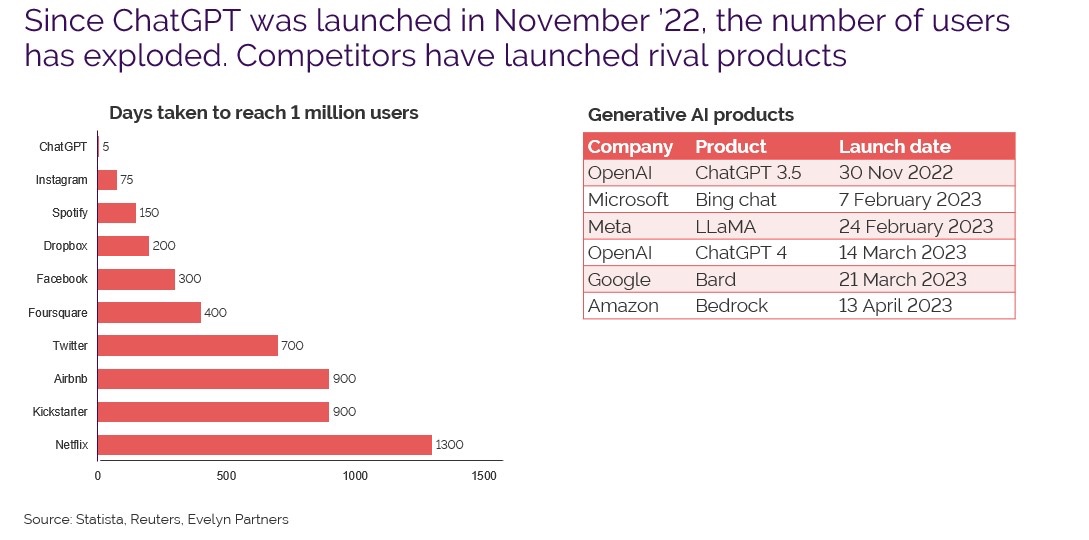
Here are a couple of interesting slides about AI, courtesy of our friends at Evelyn Partners Investment Management


Evelyn Partners Investment Management

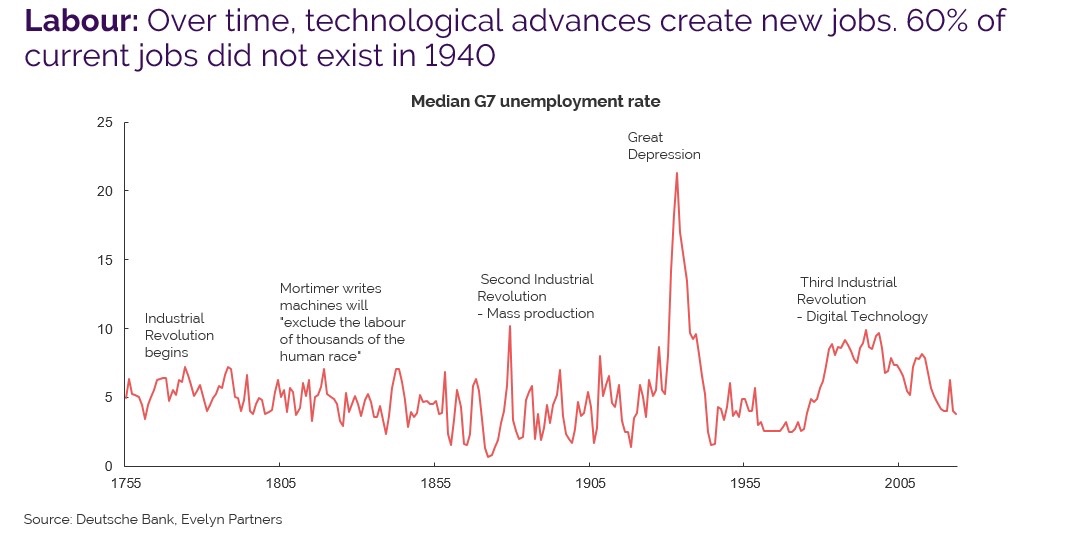
Jobs will change, but not be lost.

Jobs will change, but not be lost.

This slide particularly interests me because it goes to show the power of human ingenuity.   As we can see, apart from the great depression, unemployment levels have largely hovered around the 5% mark since the 1700’s, over which time we have seen the introduction of so many new technologies – in no particular order:  the train, car, aeroplane, the telephone, machines in factories, the radio, TV, the washing machine, going into space, the cell phone, computers, the internet, and now AI.

Influencing

I think one of the best examples of this human adaption is the job of the influencer.  10 years ago, internet influencers never existed.  Yet now, people are making millions from online ad revenue, quite often it is completely useless content, but which creates the clickbait required to generate income.  It is also becoming a life saver for certain sectors, such as farmers, to sell direct to the public instead of through distributors or to supermarkets.  The internet and now AI has, in a way, democratised the world of work in professions which, previously, had been reserved for a select few.  Now, more opportunites are available to the masses.

I have noticed this myself because in my efforts to understand the world of the land a little bit more, I have done a lot of research online and come across many people who have created Youtube or TickTok channels, producing short videos on the things they do on their land and the methods they use.    One development I have noticed is that when these influencers seem to reach a critical mass of followers, subscribers and likes, then they suddenly start appearing with tools sponsored by certain companies and they start writing books for sale.    It is well known that generating revenue through subscribers, followers etc is not going to a create a big and reliable long term income stream, but ancilliary product and services, sponsors and driving traffic through your website, seems to be the way to go.

Influencers – a job also at risk of AI

However,  the influencer space may also be a ‘job’ under threat, with the rise in automated traffic, as explained above, this presents challenges to their economic model. Bots do not click on ads, which raises questions about how content creators can generate revenue in an increasingly bot-dominated landscape.  As a potential solution they could charge bots for access to digital users’ content.   Like every other employment, it will have to adapt to a rapidly changing future.

What the jobless numbers can tell us about the growth in AI

I will finish my section on AI with this, because it really puts into context why AI, robotics and automation are going to play an increasingly large part in our lives.

At the beginning of August new jobless claims were announced in the USA.    New filings for unemployment benefits dropped to 187,000 for the week ending July 18 — a nearly 57-year low, and a much bigger drop than economists expected.  This is probably not a cyclical blip. It’s demographics finally showing up in the data.  Birth rates across the developed world — the U.S., Europe, Japan, China, South Korea — have been falling for decades, and it’s finally catching up.  Fewer young workers are entering the work force every year than are retiring from it.  This is basically a structural worker shortage, and jobless claims sitting near six-decade lows is exactly what you’d expect that shortage to look like on paper: a “low-hire, low-fire” economy where employers are desperate to hold onto the workers they already have. (I think about our friends in N.Italy who run a number of bars and they can never find trained staff and spend most of their time interviewing, hiring and firing.  It has become their biggest headache).   However, a labor shortage this bad can’t be solved through immigration, fast-enough, to mitgate your way out of a birth-rate collapse, and you definitely can’t train workers who don’t exist.

The only option left is productivity — which means robotics, automation, and AI aren’t optional anymore. They’re the only way to keep the economy growing when the number of available humans is shrinking.  That’s why capital is pouring into automation and AI — this is not an passing fad, this is the innovation cycle!

Is this an investment opportunity?

Many of you have quoted me headlines that there is an AI bubble just waiting to burst and that a market crash will be lead by over speculated AI stocks.   There is probably some truth in the fact that there are companies out there who have overly inflated valuations due to the hype around AI.  However, the question is whether a revaluation of these stocks alone would be enough to generate a full market crash, or maybe a correction.
Major innovation cycles have never been cheap, and they’ve never been non-inflationary. Every prior boom — the 1970s energy and productivity shock and others — was accompanied by a commodity repricing.  Building new infrastructure and new machines at scale means real demand for real materials.
Put it all together: a demographic worker shortage forcing an automation super-cycle,  requiring a huge amount of hard assets (commodities) to build it all out.   The smart money has already moved away from the speculative AI firms who may see a revaluation sometime soon, into the resource based companies who are going to be building the infrastructure to take us into this innovation era.

Article by Gareth Horsfall

If you live in Italy and or have financial interests in Italy you can contact Gareth Horsfall directly on: gareth.horsfall@spectrum-ifa.com to request more information about how he may be able to help you. Alternatively you can complete the form below and a message will be sent to him. If you would like to read more about Gareth's work you can follow his blog on tax and financial planning in Italy HERE

Contact Gareth Horsfall direct about: "The death of original content – The AI takeover"

    The Spectrum IFA Group is committed to building long term client relationships. This form collects your name and contact details so we can contact you about this specific enquiry. For further information, please see our Privacy Policy.