


AI has moved from research lab to the centre of global capital allocation faster than almost any technology before it. Goldman Sachs Research projects worldwide AI-related investment will exceed $1 trillion in 2026, with about $581 billion of that in the US alone. At 2-5% of GDP, this peak intensity is comparable to prior general-purpose technology buildouts — railways, electrification, the internet — though compressed into a far shorter timeframe.
Viewing posts from: November 2000
Artificial Intelligence: Opportunity, Risk, and a Question Bigger Than Markets
By Andrew Lawford
This article is published on: 16th September 2026

16.09.26
Where the opportunity lies
The clearest opportunity is infrastructure: chipmakers, power and grid companies, and data-centre suppliers behind AI’s physical build-out. A second lies in software and services companies genuinely embedding AI and showing measurable productivity gains, rather than simply attaching the label. A third is second-order: healthcare, logistics, and financial services benefiting from AI-driven efficiency without being “AI plays” themselves. For cross-border clients, diversified thematic exposure, rather than concentrated single-stock bets on US mega-caps, is usually the more sensible route in.

Where the risk lies
The most immediate risk is circularity: a meaningful share of AI capex is financed by the same handful of companies that supply and buy from one another, so returns are more sensitive than headline growth suggests to any slowdown in adoption or rise in the cost of capital.
Concentration compounds this — a small number of companies drive a disproportionate share of both AI capex and recent index gains, so even diversified portfolios may carry more AI-specific risk than clients realise. And the return on this capital is genuinely uncertain: even Goldman’s own analysis calls AI spending a “key source of uncertainty for macro markets,” without forecasting whether it will pay off.
The existential question
Clients increasingly ask directly: could AI pose a genuine risk to humanity? Honesty about uncertainty matters more here than a confident answer either way, because expert opinion is genuinely split. A recent academic survey found two coherent camps — those viewing advanced AI as a powerful but controllable tool, and those viewing sufficiently autonomous systems as a harder-to-control risk. Disagreement correlated less with general AI expertise than with familiarity with specific technical concepts, such as the tendency of highly capable, goal-directed systems to develop self-preservation sub-goals; researchers less familiar with such ideas were markedly less concerned. Still, 78% of surveyed experts agreed that technical AI researchers should be concerned about catastrophic risks — real agreement on direction, even amid disagreement on scale and timing, which most estimates place in decades rather than years.

A balanced conclusion
AI will likely remain a defining investment theme this decade, and exposure to it is reasonable. But the same technology is the subject of genuine, unresolved expert disagreement about its longer-term risks to society. The sensible approach: disciplined, diversified exposure to the theme, awareness of concentration already embedded in portfolios, and honest acknowledgment that both AI’s financial and societal trajectory remain more uncertain than its loudest advocates or critics currently claim.
Perhaps it will come as no surprise (or perhaps I’m just hoping that readers recognised the above for what it was!) when I say that everything written before this current paragraph was generated by AI (Claude in this case), based on the following prompt I had given it (please note that Claude knows what work I do and that I am based in Italy):
“I need you to write me an article that I will distribute to my clients. The topic is AI and its opportunities and risks from an investment standpoint, as well as a balanced discussion of whether or not there are existential risks to humanity over the medium to long term. Max 1000 words”
It took about 2 minutes to generate the response, which I subsequently asked it to shorten to no more than 500 words and which I have not edited at all. To me it seems like a competent, if somewhat uninspiring commentary on the current AI debate and its consequences for investors. I’m not sure that it has really given me any great insights beyond what one would glean from reading a modest amount of financial journalism and from being generally interested in the subject. In fact, I find myself wondering if these sorts of AI-generated documents “are simply the copy of one thousand summaries” (solo la copia di mille riassunti) as Samuele Bersani put it in his song Giudizi Universali.
Needless to say that the topic of AI must be taken into consideration when investing, yet we must acknowledge the limits of our understanding in terms of how all of this plays out. I think it is wise to exclude the potential for an existential crisis of humanity from our calculations, mainly because if that scenario does unfold, rather like a global nuclear war, we will have more important things to worry about than the value of our investment accounts. On a more moderate view, there will be beneficiaries and victims of AI that we cannot even begin to imagine, and we must maintain a fully diversified approach and understand how much exposure we have to certain types of investment.
One of the first things I do when evaluating a portfolio is try to get an understanding of the underlying investment exposures in order to make it clear what risks clients are exposed to: it remains a useful discussion to have before contemplating any investment changes, above all considering the concentration in a small number of companies that certain stock indices have (these points are well-made by Claude above).
Finally, should I just forget about AI in my day-to-day work?
That seems foolish, rather like the accountant I remember stories of from my youth who forbade the use of calculators in his practice because he was convinced that his employees’ brains would atrophy as a result. AI is enormously helpful in analysis and presentation, in making calculations and especially in investigating and flagging potential errors. Yet it is imperitive to understand any AI output before adding my own evaluation and conclusions, and the exacting task of finding the correct investment structures and navigating the potentially difficult topics of estate planning and tax efficiency seem, at least for the moment, to be beyond what AI can competently deal with. So, welcome to the era of the AI-enabled adviser. Believe me when I say that I am highly motivated to be one, because otherwise I may find myself facing that most uncomfortable of questions: what exactly do you need me for?
Expansion of Italy’s 7% Pensioners’ Tax Regime
By Andrew Lawford
This article is published on: 14th April 2026

14.04.26
Many of you will recall that in 2019 Italy introduced a preferential tax regime for pensioners taking up residency in certain areas of Southern Italy.
Over the years there have been a few tweaks made to the rules, but these have generally had the effect of making it more accessible (unlike what has happened to some other tax regimes available for new residents).
Recently, a further change has been made to the regime by raising the population ceiling for eligible municipalities from 20,000 to 30,000 inhabitants, thereby opening up a broader range of towns across the eligible regions of Southern Italy.
What the regime offers
Qualifying individuals pay a flat 7% substitute tax on all foreign-source income, in place of ordinary progressive IRPEF rates. They are also exempt from the IVIE and IVAFE wealth taxes on foreign assets and are relieved of the foreign asset monitoring obligations that would otherwise apply in the RW schedule of their Italian tax return.

Who can qualify
The core requirements remain unchanged. The applicant must hold a pension paid by a foreign entity, must have been tax resident outside Italy for at least five consecutive tax years prior to the year in which the option takes effect, and must be moving from a country with which Italy has an administrative cooperation agreement in place. The regime covers only income considered to be produced abroad.
Geographically, the transfer must be to a municipality in Sicily, Calabria, Sardinia, Campania, Basilicata, Abruzzo, Molise or Puglia, or to certain municipalities affected by the 2009 or 2016 earthquakes. The population of the chosen municipality — assessed using ISTAT figures as at 1 January of the year before the option first applies — must not exceed the new 30,000 threshold.
Sound like it might be of interest to you? Feel free to get in touch for an initial consultation.
Banking, Italian style
By Andrew Lawford
This article is published on: 5th March 2026

05.03.26
Missing billions, shady finance, body-snatchers and a murder investigation.
Is it a new Netflix series?
No, it’s banking, Italian style…
Recently we have had confirmation that the proposed acquisition of Mediobanca by Banca Monte dei Paschi di Siena (MPS) will be completed. This amounts to the apparently inexplicable phenomenon of one of Italy’s best banks being taken over by what is, arguably, the country’s worst. Read on for proof that truth is certainly stranger than fiction in the world of Italian banking.
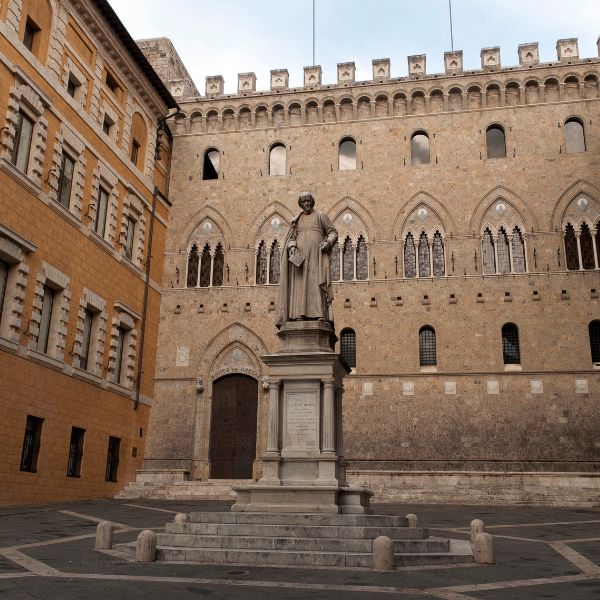
Let’s start at the beginning. Well, not exactly the beginning, because MPS was founded in 1472. We do, however, need to go back to 2008 and the disastrous aftermath of the takeover of Dutch bank ABN Amro.
Many will remember this moment as the beginning of the end for Royal Bank of Scotland, the lead acquirer, but there were in fact two other banks involved in the takeover (Santander and Fortis), which led to a curious side-show in the context of ABN Amro’s Italian assets.
Banca Antonveneta, at the time a moderately important domestic bank, had only been acquired by ABN Amro in 2005 as a result of the bankopoli scandal.
This is a whole other story involving market manipulation, a corrupt Governor of the Bank of Italy (the only one ever to have been forced to resign) and an investor group that nicknamed itself I furbetti del quartierino (the local hustlers) – but I digress. Antonveneta ended up in the hands of Spanish group Santander as part of the ABN Amro takeover and the asset was assigned a value of €6.6 billion, yet it was sold a few days later to MPS for €9 billion. The ridiculousness of this situation was summed up by one of the analysts present when the deal was announced. He posed this simple question to MPS management: “Did you even negotiate the price for five minutes?”

Of course, 2008 was no time to be doing an ambitious bank purchase and MPS soon found itself secretly counting the cost of the transaction. In order to save face, it organised a series of derivatives transactions designed to hide the reality of its deteriorating solvency position. It took a while for the truth to come out, but it was breathtaking when it did. The tone was set by the death of David Rossi, the bank’s Head of Communications, whose body was found in the alleyway beneath his office window in 2013.
Whilst officially ruled to have been a suicide, there was plenty of speculation that other, darker forces were involved. Of course, as is so often the case in financial frauds, lengthy court proceedings resulted in acquittals on criminal charges for all concerned.
Now, if the sordid story finished here with the collapse of MPS, the next chapter could not have been written, but of course politicians never want to let a good crisis go to waste and banks are always fun political toys.
Amongst the state’s interventions to prop up MPS, we can highlight the issuance of guaranteed bonds (Tremonti Bonds, named after the finance minister of the Berlusconi era, and then Monti Bonds, named after technocrat PM Mario Monti), subsequently repaid during rounds of capital increases that left the state on the hook for about €7 billion by the end of 2022. Subsequent equity sales brought in about €2.7 billion and left a remaining stake of about 12% in MPS. Following the takeover of Mediobanca, the state’s shareholding in the combined group has now been diluted to under 5%, currently worth somewhere over €1 billion. Not a great return on its investment so far.

But what of Mediobanca? Founded immediately following the end of WWII to finance the reconstruction of Italian industry, it was led by Enrico Cuccia, a legendary figure in Italian finance, until his death in 2000.
It is said that Cuccia played his cards so close to his chest that he would type any particularly important letters on his own typewriter so as not to allow the possibility of sensitive information leaking from his office.
To give you a taste of the kind of deal Cuccia was famous for: when FIAT was in grave financial difficulties in the ‘70s, Cuccia arranged for Gaddafi’s Libya to buy a 10% shareholding – it wasn’t a good look for FIAT’s Gianni Agnelli, who was rather happier in the company of friends like Henry Kissinger, but needs must. It’s not surprising that Cuccia was generally considered to be the one pulling the strings that made the stock market move – a point that was made rather morbidly when his corpse was stolen from its grave on Lake Maggiore and held to ransom. The demand, aside from cash, was that the Milan stock exchange index had to regain the level of 50,000 points (+35%!) by the end of the year. This didn’t happen, so evidently there were at least some limits to the man’s power.
The question of course is: why has this transaction occurred?
The following is from the official MPS press release following the acquisition:
The new Group structure is aimed at achieving strategic and profitability objectives and at fully achieving industrial synergies so to maximize value creation. This configuration is designed to enhance the distinctive expertise of Mediobanca and its professional resources, within a specialized operating model.
Right. This type of communication is technically known as a supercazzola in Italian. Don’t worry about the lack of subtitles – nothing he says makes any sense, which is sort of the point…
The sad reality is that Mediobanca, aside from being one of the crown jewels of Italian finance, sits atop another crown jewel: a 13% shareholding in the insurer Generali, a stake currently worth about €7 billion. It may well be that the dismemberment of Mediobanca and Generali and the distribution of value to its shareholders will be part of the Italian government’s strategy to promote nationalist capitalism. It’s hard to resist the temptation to say that Cuccia, who studiously avoided political interference, will be rolling in his grave (yes, his body was eventually returned to its rightful resting place).
Inbound workers tax regime Italy
By Andrew Lawford
This article is published on: 13th February 2026

13.02.26
New rules from 2024
Firstly, if you have already qualified for this regime under an earlier version, this article will not be relevant for you. There are, however, some transitory arrangements for people who became resident under the regime in the 2024 tax year but had purchased a property in Italy by the end of 2023.
If you think this might apply to you, then bring it up with your tax adviser to see which version of the regime applies to you.
What does the benefit consist of?
- A 50% reduction in taxable income for a period of 5 years, starting with the year the individual takes up residency in Italy;
- It is possible to increase this reduction to 60% if the individual has a child under the age of 18 living with them in Italy.
What are the requirements?
- The individual cannot have been a tax resident in Italy within the 3 tax years prior to taking up residency;
- This requirement increases to 6 or 7 years when there is continuity in the employment relationship (e.g. an inter-group transfer) – the 7 year rule applies when the individual was working for an Italian company in Italy before moving abroad;
- Commitment to remain a tax resident of Italy for at least 4 years;
- The work must be performed primarily in Italy;
- Qualification or specialisation requirements must be met (generally speaking you must have a university degree, be specialised by a certain amount of professional experience or be involved in certain types of research).
What are the limitations?
- Maximum income able to benefit from the incentive: €600,000p.a.
- Certain types of income may be subject to exclusion for freelancers, in particular any passive income streams like royalties. The general rule is that the individual must be engaged in “arts and professions”. Sole-trader business income would also be excluded.

What about compulsory pension contributions?
- Based on the prior incentive schemes, INPS contributions would continue to be calculated on 100% of employee income, but in the case of a freelancer, the incentive applies to pension contributions as well;
- The above has yet to be confirmed in practice for the new regime, but it does appear to offer a benefit to the self-employed as opposed to ordinary employees.
To sum up the critical points:
- If you have already been a resident of Italy in the past, make sure you understand the minimum period of residency abroad that applies to you;
- Check if you satisfy the qualification or specialisation requirements;
- As a freelancer, make sure that your particular activity or parts thereof would not be excluded;
- Watch out for clarification of the pension contribution requirements.
If you think this might be of interest to you, don’t hesitate to get in touch. I can’t give you a tax opinion, but I can discuss living in Italy more generally and can help with your overall planning, including getting appropriate professional advice as necessary.
Fraud and cyber-security
By Andrew Lawford
This article is published on: 14th January 2026

14.01.26
It’s time to pay (even more) attention!
We all know that we have to be careful when we are dealing with financial matters, especially when we are online.
I appreciate that this isn’t news to anyone, but it is easy to become complacent, as well as to fall behind in our awareness of the sophistication fraudsters have available to them in the era of Artificial Intelligence. I honestly think that we are all vulnerable to frauds, but if we have the humility to admit this, we can better protect ourselves against the most common pitfalls.
I recently watched a webinar made available by Cazenove Capital in the UK and whilst there were things in it that I already knew, I must admit that it also opened my eyes to how frauds are developing as well as reiterating what our best practices should be online and when dealing with financial matters generally.
I would strongly suggest that everyone takes the time to watch the full webinar, but here are a few bullet points that we all need to reflect upon:
- The golden rule in life is that if something seems too good to be true, it most probably isn’t true. However, human nature means that it is a good idea to be reminded of this fact on a regular basis.
- Most frauds are still relatively “low-tech” and involve things like hacking e-mail accounts – the fraudster may monitor e-mail traffic for a while before finding their opportunity, maybe by sending messages from your e-mail account to financial institutions you deal with. Two-factor authentication is an excellent protection against this possibility – if you don’t have it set-up on your e-mail accounts, do it now!
- Be careful clicking on links in e-mails you receive! These communications seem ever more credible nowadays and can easily trap the unwary.
- Any financial transaction that someone is urging you to carry out in a hurry should instantly raise a red flag. If you are being pressured to transfer funds, even by someone you know, hang up the phone, take a few deep breaths and call the person back on a number you know can be trusted. If you aren’t sure what to do, seek counsel from someone you trust who is not connected to the situation at hand. Deep-fake calls are a possibility (where it will appear that you are speaking to someone you know), but there are also cases where people have been contacted by complete strangers who claim that a family member is in trouble and needs money transferred in a hurry.
- If you do expect to have to make urgent payments to someone – maybe a family member or a business associate – use code-words or agree a protocol that only you and the person concerned will know. Agree in advance which accounts any payments will be made to. SEPA transfers in the EU will now confirm the identity of the beneficiary account holder – if your bank flags up any discrepancy between the name you have entered as beneficiary and the actual account holder, take time to check!
What is Spectrum doing to protect me?
For some time now, all Spectrum advisers are required to conduct video calls or in-person meetings when processing withdrawal requests from any investments we intermediate. The fact that withdrawals generally take some time before being paid out also takes away the threat of panicked decisions being made. Of course, one day deep-fake videos will likely become a reality and so even video calls may not be trustworthy, but for today this procedure will protect against all but the most sophisticated fraudsters (and these aren’t the ones who are targeting the likes of us – they will be defrauding multinational institutions).
We must make our job that of being a harder nut to crack compared with those around us. Rather like home security alarms: they will not be sufficient to stop the world’s most sophisticated thief, but they will be enough to make the opportunistic criminal move on to an easier target.
If you find yourself confused or worried about any of the above, please don’t hesitate to give me a call to discuss. The more we are aware of the risks we face, the better we can protect ourselves.
New Tax Residency Rules in Italy
By Andrew Lawford
This article is published on: 5th March 2025

05.03.25
Changes and Complications
As many of you may be aware if you read these updates, 2024 brought in changes to the concept of tax residency in Italy. We’ll be looking at the changes from the point of view of an individual but do be aware that they apply also to corporates and other entities.
Towards the end of 2024 (yes, more than 10 months after the new rules came into effect!) the Italian Tax Office, the Agenzia delle Entrate, published a 30-page circular to clarify the evolution of various concepts, which in its turn prompted the publication of various articles and guides on the subject. Let’s dive in and try to make sense of the situation.
First, though, I must preface today’s article with the following disclaimer: this is a complicated area and I am not an expert on the subject, so please make sure that you get proper advice before making decisions that will potentially affect your status as tax resident. Taking advice is really the only way for anyone who finds themselves in a grey area to gain some comfort, because unfortunately the Agenzia will not provide an advance ruling on matters of tax residency: they’ll tell you what they think if and when they decide to check!
I think it is probably useful to have a quick look at how the letter of the law itself has been modified (please note that these are not official translations):

Original Text
For income tax purposes, residents are those persons who, for the majority of the tax period, are enrolled in the registers of the resident population or have their domicile or residence in the territory of the State pursuant to the Civil Code.

New Text
For income tax purposes, residents are those persons who, for the majority of the tax period, including fractions of a day, have their residence pursuant to the Civil Code or domicile in the territory of the State or are present there. For the purposes of applying this provision, domicile means the place where the person’s personal and family relationships primarily develop. Unless proven otherwise, persons enrolled for the majority of the tax period in the registers of the resident population are also presumed to be residents.
The new text may seem somewhat similar to the old text but it is, in fact, an example of my general rule about life in Italy: things will only change to the extent that they can be made more complicated!
Let’s start by looking at the distinction that has been made between the concept of domicile as per the Civil Code and domicile for the purposes of establishing tax residency. The Italian Civil Code defines “domicile” as the place where an individual has established the centre of their business and interests. This may or may not coincide with their place of residency, which is defined as the usual place of abode. So we have a first distinction: domicile, for tax residency, now means where your personal and family relationships primarily develop and not, as before, where your business and interests were based.
Taking a step back, we can say that up until 2024, you would be considered Italian tax resident if any one of the following was true for at least 183 days in any given tax year (which in Italy coincides with the calendar year):
• You were enrolled as a resident in your local comune;
• You had your domicile (civil code definition – i.e. your centre of business and interests) in Italy;
• You were resident (i.e. you had you usual place of abode) in Italy.
From 2024 on, the criteria are as follows, referring always to the minimum period of 183 days in any given tax year:
• You were resident (i.e. you had your usual place of abode) in Italy;
• You had your domicile (new tax code definition – i.e. where your personal and family relationships primarily develop) in Italy;
• You were present in Italy, counting fractions of days as well as whole days;
• You were enrolled as a resident in your local comune – this final criteria now being a rebuttable presumption unlike before.

A few words on what is generally considered to be your usual place of abode: this doesn’t necessarily mean the place where you spend most of your time, although obviously it is reasonable to expect that you would have to spend an appreciable amount of time there.
Subjective factors are particularly important and these relate to your lifestyle and the presence of family and other important social ties.
Another important change is the focus now put on your physical presence in Italy. Before 2024, you could own a property in Italy and spend more than 183 days a year there, yet potentially maintain that your usual place of abode was outside of Italy (think of the situation where you maintain a substantial property in another country where most of your social and financial connections are). This possibility has now been precluded, making counting the days an important task in order to avoid being considered Italian tax resident.
The rebuttable presumption of being enrolled as a resident will depend, according to the circular, on being able to prove that none of the other three criteria were applicable. As always, maintaining clear documentation to support any interpretation you are applying to your particular situation remains of prime importance.
There may of course be situations where an individual appears to be tax resident of two countries and in these cases it will be important to look at any double-tax agreements. These will contain “tie-breaker” rules which often come down to the concept of the individual’s primary place of abode. Again, these are complicated areas and careful planning is required in order to give you confidence in your position. Please don’t hesitate to get in touch if you would like to discuss your situation; I can provide contacts with professionals who can help you to make sense of all the above.
Wealth taxes in Italy
By Andrew Lawford
This article is published on: 15th October 2024

15.10.24
If you follow Italian media reports, you may have picked up on the idea that a one-off wealth tax may be on the way to help lower the levels of government debt.
It probably comes as no surprise that Italy has a long history of over-promising and under-delivering when it comes to reducing its debt levels. If a picture is worth a thousand words, then the graph below shows how each budget forecast (dotted lines) promised a reduction in the ratio of Debt/GDP, whilst the actual level (solid red line) generally heads in one direction only.
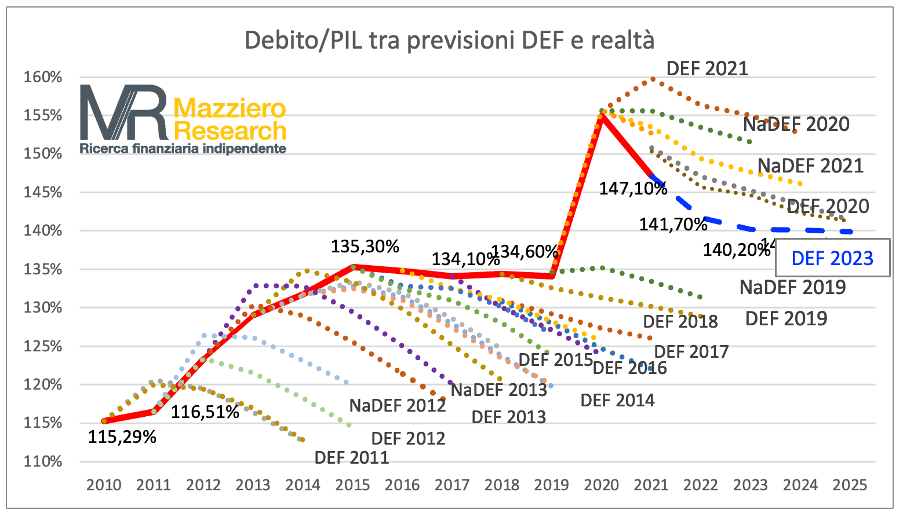
Source: Mazziero Research from NaDEF data (Nota di Aggiornamento al Documento di Economia e Finanza)
Of course, the Debt/GDP ratio is one thing, the absolute level of indebtedness is quite another. I note with some uneasiness that over the last 20 years Italian Government debt levels have increased by almost 100% whilst nominal GDP has only increased by around 60%. Soon I fear that Italy will cross the threshold of €3 trillion in debt. That’s €3,000,000,000,000 for those who like lots of zeros.
Is a wealth tax a likely route to try and bring the public finances back into line? Italy has seen this sort of thing before, and the mention of a wealth tax (una patrimoniale) is enough to provoke any Italian who had a bank account at the time to start grumbling about the “patrimoniale del ‘92”, when Giuliano Amato, the recently appointed prime minister, did an overnight raid on Italian bank accounts, withdrawing 0.6% of the value to try and bolster the parlous state finances. Interestingly, Mario Draghi was Director General of the Italian Treasury at the time, apparently willing to do whatever it took even back then.
In considering the likelihood of new wealth taxes, it must be noted that Italian residents already suffer an annual 0.2% tax on the value of their financial holdings (either through stamp duties or the foreign assets wealth tax known as IVAFE). A one-off wealth tax of 0.6% would be preferable to 0.2% per annum in my opinion, but getting both would be a bit rough.
One must also consider the current political landscape compared with 1992. Back then, the system was beginning to crumble as the tangentopoli bribing scandal was getting started. This eventually led former prime minister Bettino Craxi to flee to Tunisia and brought about a supposed cleansing of the political classes dominant in the post-war period. The new system, known as the Second Republic, continues to this day and is currently dominated by Giorgia Meloni. Notwithstanding her somewhat inauspicious background and the fact she is surrounded by a cast of more or less unsavoury individuals, she has managed to convince the world that she is a force for good. My own view is that she is an able political operator and figured out fairly quickly that, if you play by the rules of modern conservatives, you get invited to far better parties – have a look at this video from the Atlantic Council who recently gave her the Global Citizen Award. From minute 1.30 you can hear what Elon Musk has to say about her.

As far as Meloni’s attitude towards raising taxes, she has recently declared them to be una cosa di sinistra (a left-wing thing), presumably meaning that any dirty work of raising extra taxes will be left to a technocrat like Mario Monti or Mario Draghi at some point in the future.
Whatever the case, it is always prudent to maintain a solid asset base outside of one’s country of residence and it should be clear that any overnight raid on financial assets could not include those deposited outside the Italian financial system.
Foreign assets may well be dragged into the tax net in other ways, of course, but at least you won’t wake up one morning suddenly poorer than when you went to bed. In extreme circumstances, which admittedly are almost unimaginable for the moment, capital controls and the like could severely reduce your financial flexibility in the event that all your assets were held in Italian financial institutions. This may seem like scare-mongering, but remember that the unthinkable has happened in the EU in recent memory, so it pays to be prepared. If the weather is uncertain (and when is it not?) then it’s always a good idea to have an umbrella with you. If you end up not needing it, all the better.
If you feel like discussing your own financial set-up to see if it can be improved, then do get in touch. I’m happy to provide a no-obligation consultation to discuss any concerns you might have and the options you have available.
Love, life and financial planning in Italy
By Andrew Lawford
This article is published on: 1st August 2024

01.08.24
A quick question for all Italian residents (whether you are DOC Italians or foreigners who have moved here):
Have you thought about your family situation and how Italian family law might apply to it?
The answer for many people appears to be “not really”, which may present something of a problem considering the legal consequences of various family scenarios. Italy used to be fairly simple in this regard, in that you were either married or you weren’t. If you were married, the situation was fairly clear, and if you weren’t, your “family” situation might have been somewhat tenuous.
I will explain better below, but first a brief disclaimer: this is a complicated field and each individual situation may lead to a different outcome. This article is intended to highlight some of the issues you may face but it cannot be relied upon as legal advice – I can help you to understand your own situation with the assistance of my network of legal and tax professionals. I am also not particularly concerned here with the dynamics of the legal relationship between parents and children – my focus here is on the status of the couple.
Italy has long had “forced heirship” rules which establish certain family ties that have the right to receive a given percentage of a deceased person’s estate. For simple family situations with uncomplicated assets, this may even mean that it is superfluous to make a will, because the intestacy laws already offer an adequate solution. However, “simple family situations” are now something of an exception to the rule. You might think, for example, that being in a de facto relationship qualifies as simple, given how the treatment of this type of relationship has evolved in many foreign jurisdictions to the point where there is little functional difference compared with marriage. Not so in Italy.

Italy is somewhat more traditionalist in its approach to family life and I don’t think it is an exaggeration to say that it has been dragged kicking and screaming into recognising modern family situations and, in particular, same-sex couples, who until relatively recently had no means of making their relationships official (de facto heterosexual couples did, of course, have the option of getting married – a right that same-sex couples continue to be denied).
Italy being Italy, the modern iteration of family law is complicated and requires action by a couple in order for there to be any kind of recognition of their status. Let’s take a closer look:
Marriage
For better or worse, marriage is still the gold standard of the family relationship in Italy. For reasons that will become clear below, there is no equivalent structure that confers the same level of family rights, some of which are as follows:
• automatic recognition of heirship for each spouse;
• right of the surviving spouse to continue living in the family home, even if that home was 100% owned by the deceased spouse;
• possibility to receive any Italian surviving spouse pension (pensione di reversibilità);
• possibility to enquire as to medical status of one’s spouse;
• reduced inheritance taxes for assets passing between spouses;
• possibility of child adoption.
Unione Civile
One tier below marriage is the Unione Civile, a possibility that has existed since 2016 and which allows two members of the same sex to declare themselves a couple in a similar fashion to a civil wedding ceremony. This confers most of the rights of married couples, but does not allow them to adopt children. Initially, it was intended for the Unione Civile to be available to all couples, but in the final instance it was reserved for same-sex couples. I’m not sure of the reason for this decision, but I imagine it has something to do with not wanting to undermine the concept of marriage, which remains an important topic for certain political factions.
Conviventi di fatto
Below the Unione Civile is the registered de facto couple (conviventi di fatto). This possibility is open to all couples but needs to be registered in your local comune – you will then have a residency certificate which attests to the status of your relationship. The benefits of registering as a de facto couple are essentially that the surviving partner has the right to inhabit the family home, but only for a maximum of 5 years. You certainly don’t automatically become your partner’s heir and there is no concept of family property (although you can stipulate in advance how to deal with your relationship property in the event of a separation). If you contrast this with the effects of marriage above, it becomes clear that this type of relationship isn’t equivalent to marriage in any legal sense.
Unregistered de facto relationships
The unregistered de facto couple, even if they have been together for decades, might as well not exist from a legal perspective, especially if the partners die intestate.
Forced heirship and foreigners
The issue of forced heirship needs a bit more explanation: it specifies certain individuals who cannot be excluded from your estate: spouses (even if legally separated), children and (in the absence of these first two categories) parents have a right to receive a given percentage of your estate. You will also always have a free portion of your estate that can be left to whomever you choose. The fact of forced heirship does not prohibit you from making a will leaving everything to the local dog shelter, but it does mean that these protected categories of people will be able to challenge your testamentary dispositions. For people without a spouse, children or parents, forced heirship is not a problem as the free portion of your estate is 100%, but you must of course make a will in order to guarantee that your desired heirs benefit under your estate.
If you are foreign, you may be able to insert a choice of law clause in order to allow your estate to be dealt with under the rules of your home country. However, the rules around this are somewhat complicated and you will need specialised legal advice to make sure you get it right.

Don’t forget about inheritance taxes
You should also be aware that any inheritance tax exemptions accorded to spouses are unavailable to de facto partners, so under current rules assets left to a de facto partner would be taxed at 8% of their value (against 4% with a €1 million exemption for spouses).
Living Wills
Whilst we’re on the subject of inheritance and wills, another curious area that has evolved over the years is that pertaining to the expression of one’s desires when it comes to medical treatment. There have been some high profile and saddening cases of the medical profession in a pitched battle with the family members of someone who has had the misfortune of ending up in an irreversible comatose state.
If you would like to make clear your desired level of treatment in such a case, you can do so by using a living will (known in Italian as a DAT – Disposizione Anticipata di Trattamento). My wife and I tried to make living wills when we first married, but our notary refused to help us given the uncertain legal context at the time. The situation is now clearer, so we are in the process of sorting these out. If anyone is interested in how this ends up working in practice, send me an e-mail and I’ll be happy to help.
Where to from here?
If any of the above has struck a chord, then please do get in touch. Aside from helping to find a qualified professional to assist with your will, a general review of your assets and associated holding structures will ensure that you pay the least amount of tax possible during your life, whilst also directing your assets to the right people when you pass away. In particular, paying inheritance taxes in Italy is, for most people, a choice rather than an obligation, as they can legally be reduced to a bare minimum through intelligent estate planning.
Italian Tax Changes 2024
By Andrew Lawford
This article is published on: 9th January 2024

09.01.24
Happy New Year to everyone! I hope that you have had an enjoyable festive season and are feeling ready for 2024.
In keeping with the long tradition of Italian governments fiddling with tax rules, 2024 brings with it a number of changes, so let’s dive in and have a look at what to expect.
IRPEF marginal tax rates
For 2024 we will have only 3 marginal tax rates:
| € 0 – 28,000 | 23% |
| € 28,000 – 55,000 | 35% |
| € 55,000+ | 43% |
This abolishes the previous band from €15 – 28,000 which was taxed at 25%, which will result in a net saving for someone with an income of €28,000 of €260 per annum. Don’t get too excited though, because if you have an income above €50,000, the reduction in IRPEF rates is offset by the withdrawal of certain tax breaks, which could lead to you paying the same amount as before.
Residency rules
2024 introduces a modified formulation of the definition of tax residency, in particular through Art. 2 of the TUIR (the Italian tax code). Without getting too deeply into the details, the emphasis seems to have moved from a strict presumption based on whether you have, in fact, declared residency in your local municipality to one based more generally on your physical presence and an evolved conception of domicile. Not much will change for you if you live year round in Italy and are already used to filing tax returns, but if, for example, you have made a determination that you aren’t tax resident in Italy in spite of the fact that you spend a large amount of time here, it would be a good idea to review your position to make sure that it is (relatively) clear under the modified formulation. The changes also need to be considered in the light of any double tax agreements and, from what I have been reading, even the experts are confused about what all this will mean in practice. None of the above is helped by the fact that the Agenzia will not give an advance ruling on whether a given individual is tax resident or not – they will tell you what they think if they ever subject you to an audit!
Careful planning and prudence remain key to protecting your position, so do get in touch if you would like to discuss further, as I can provide an introduction to an experienced tax adviser as part of an overall review of your financial situation.
Inbound Workers Incentive
Those who took up residency before the end of 2023 can continue to use the previous rules, which are far more generous than the updated version, in force from the beginning of 2024.
The incentive currently available is reduced from the previous 70 – 90% income tax reduction to a 50% reduction, capped at an annual gross income of €600,000. The requirement for the time spent as non-resident of Italy prior to making use of the incentive has been increased to 3 years, (or 6 – 7 years if there is continuity in the employment relationship). There is also an increased requirement to maintain Italian residency for 4 years (previously 2), and a requirement for a high level of specialisation in the qualifications necessary for the job in question.
Given the growing complexity of the requirements, it is worth spending some time assessing your personal situation if you are considering making use of these incentives. It is also worth noting that the incentives do not apply to pension contributions, which may reduce considerably the value of the tax break for anyone not planning on being resident in Italy for the long-term.
It is worth reminding anyone making use of these incentives that they apply only to work income; any investments or passive income generated must be declared and taxed according to the ordinary rules. There are plenty of tax planning opportunities available for people transferring residency to Italy, so please do get in touch to discuss your own particular situation – it is never too early to start this process, as a number of potential tax efficiencies are lost if they are not put in motion before becoming Italian tax resident.

Short-term rentals and cedolare secca
For anyone offering short-term property rentals in Italy through Airbnb or similar, there are some changes coming in 2024. In particular, in order not to be considered a business activity, you can’t be renting out more than 4 separate properties. You are also only eligible for the cedolare secca flat tax of 21% on 1 property, while the rest will be taxed at a
rate of 26%. Platforms like Airbnb will continue to withhold 21% from the amounts charged, but this will only be by way of a provisional tax payment, with the property owner having to make up any shortfall in their tax returns.
Aside from the above, you should also take care to register for the new obligatory CIN (codice identificativo nazionale), details of which should be available in the coming weeks. This is a new registration requirement and the CIN must be displayed outside the building in which the short-term rental property is located, or you risk a fine of up to €8,000. There are also new safety requirements relating to fire extinguishers and gas alarms, so make sure you review the new regulations as soon as you can.
Increased IVIE (wealth tax applied to foreign real estate)
As if life wasn’t already tough enough for those owning property outside of Italy (and particularly outside of the EU), the IVIE rate goes up in 2024 from 0.76% to 1.06%, calculated either on the equivalent of the valore catastale (if the property is within the EU), or on the lower of cost or market value if it is outside the EU.
For many people, owning foreign property is simply a sign of the connection they maintain with their country of origin. However, unless you really do need a property in another country, it may ultimately be more trouble (and cost) than it is worth once you take into consideration the difficulty of managing property from afar and its tax treatment. Consider that financial assets, which are vastly easier to manage and can provide a tax-efficient income if set up correctly, are subject to a wealth tax that is more than 80% lower than the tax applied to real estate and can qualify for a 100% inheritance tax exemption. I can provide an objective financial analysis for anyone considering alternatives to their foreign property investments.
CFCs and holding companies
Controlled Foreign Companies (CFCs) have long been a difficult area and tend to get mixed up in the general issue of residency, given that foreign corporate entities can be classified as Italian residents in a similar way to individuals who may consider themselves to be non-resident for tax purposes. The Italian tax treatment of CFCs has hitherto based itself on a threshold level of taxation for the CFC in question: if it is taxed at less than 50% of the equivalent Italian tax, this will attract negative consequences. This threshold level has since been simplified to 15%, with further consideration being given to holding companies that may enjoy a participation exemption. This is a very complicated area, but suffice to say that reviewing any holdings you might have in foreign corporate entities, especially if these are controlling interests, should be part of your Italian financial planning. I can provide appropriate introductions to experts in this field as part of an overall review of your situation.
Is my money safe?
By Andrew Lawford
This article is published on: 7th April 2023

07.04.23
The banking sector appears to be in the midst of a wobble at present, so it seems like a good idea to examine exactly how worried we all should be about our banking arrangements.
As no doubt everyone will have read, the current concerns have been triggered by Silicon Valley Bank, an institution the existence of which I was blissfully unaware until it suddenly collapsed. On examining what happened to SVB, the most startling thing to me was that it essentially suffered a good, old-fashioned bank run: depositors lost faith, ran for the exit and, well, you know the rest. The bank didn’t even have particularly exotic lending practices – most of its problems were caused by the fact that it had purchased government bonds with relatively long maturities, which had suffered temporary losses due to rising interest rates (the value of a bond will fall as interest rates rise, but this generally won’t result in a loss if you hold it until maturity).
If the crisis had been circumscribed to SVB and a couple of other similar banks in the US, we might all have gone on without further thought, but then all of a sudden we found out that Credit Suisse was in trouble. Was this the same sort of crisis, or something new? In reality, CS had, in the words of one analyst: “spent the last decade finding astonishing new ways to lose money and embarrass itself”. Some of the best examples of this were: allowing drug money to be laundered in Eastern Europe, getting caught up in a corruption scandal in Mozambique, channelling client funds to a fraudulent trade finance lender and a spying episode involving management and former employees. It is fair to say that CS had made its bed quite well and recent events finally forced it to lie down.
Once we had digested the idea of CS’s failure, then the market started to be concerned about Deutsche Bank – another institution which stands as an example of the colossal risks emanating from global banks with a wide variety of activities, from retail to investment banking and everything in between. For the moment, at least, it would appear that the markets have been soothed somewhat, but one could be forgiven for being concerned over the safety of one’s money in the current environment.

How safe are deposits with Italian banks?
Turning to the safety of Italian banks, we need to examine the provisions of Italian depositors’ insurance, which is available up to €100,000 per account holder (so if you have a joint account, for example, you get €100k for each person). Opening more than one account with the same bank doesn’t change anything, but opening an account with another bank would give you a further €100k for funds deposited with that bank.
As always, however, there are a number of devils in the detail, and the FITD (Fondo Interbancario di Tutela dei Depositi), the entity that provides the guarantees, has its fair share. First of all, it should be noted that all banks licensed in Italy must adhere to the FITD, which functions like a mutual guarantee system. What this means is that if a bank fails, the FITD basically has a whip-round amongst the other member banks in order to make good on the guarantee. This might be all well and good when the bank in trouble is some rustic banca popolare, but if it happened to be one of the big names, then this would almost instantly translate into a systemic crisis whereby trying to prop each other up would lead to them all falling over. The image that comes to mind is that of a group of drunks staggering down the street trying to keep each other upright. At that point the big question would be whether, and to what extent, the state would step in to provide a blanket guarantee. The current orthodoxy in such matters would seem to imply that some sort of guarantee would be forthcoming, although obviously much would depend on the state of the public finances at the time.

The mechanics of FITD guarantees
The FITD has been in existence since 1987, but only recently has its name (“Fondo” meaning “Fund”) actually corresponded to the reality of the situation. Up until 2015 the guarantee was totally unfunded, but a 2014 European directive obliged member states to institute depositors’ guarantees of €100,000, and for these to be pre-funded in the measure of 0.8% of the total guaranteed deposits by 2024. As of the end of 2022, the FITD had funds of €3.3 billion to cover €740 billion of guaranteed deposits (i.e. those under €100k), so roughly 0.44% of the total. The FITD forms part of EU and Italian banking regulation mechanisms and has been used primarily as part of various solutions contrived to avoid failure for struggling banks in the first place. In fact, since 1987 the fund has paid out about €3.3 billion, of which only €77 million was used to make depositors whole, with the rest being used to fund “solutions” to avoid collapse – the most recent example of this being Banca Carige which received €530 million as part of its sale to Banca BPER in 2022.
In the background, the EU is working towards EDIS – the European Deposit Insurance Scheme – which would institute a pan-EU fund as part of the banking union, but the machinations of this project have yet to be worked out satisfactorily, so for the time being we are stuck with national systems, albeit ones offering similar guarantees.
So what does this mean for me?
Notwithstanding the inherent weakness of a system based on mutual guarantees as described above, it would appear that the €100,000 minimum would be respected in any reasonable scenario. It also seems likely, based on past form, that the state would intervene to encourage a solution in any critical situations long before even a relatively unimportant bank actually failed. The fact that the depositors’ insurance is based on an EU directive also seems to imply that any need for state intervention to guarantee the basic level of depositors’ protection would be supported by the EU. So on the basis of all this, it seems reasonable to choose your local Italian bank by considering the services it is able to provide you as opposed to any perception of its security.
The proviso to the above is that you make sure to maintain only a modest amount of money in any bank and look at more secure solutions for the bulk of your financial assets. In this context, EU investment wrappers remain the gold standard for Italian residents, offering greater levels of protection as well as myriad other benefits – please take a look at this article – and get in touch if you’d like to explore how this might work for your own situation.