
Missing billions, shady finance, body-snatchers and a murder investigation.
Is it a new Netflix series?
No, it’s banking, Italian style…
Tel: +34 93 665 8596 |
info@spectrum-ifa.com |


By Andrew Lawford
This article is published on: 5th March 2026
Missing billions, shady finance, body-snatchers and a murder investigation.
Is it a new Netflix series?
No, it’s banking, Italian style…
Recently we have had confirmation that the proposed acquisition of Mediobanca by Banca Monte dei Paschi di Siena (MPS) will be completed. This amounts to the apparently inexplicable phenomenon of one of Italy’s best banks being taken over by what is, arguably, the country’s worst. Read on for proof that truth is certainly stranger than fiction in the world of Italian banking.
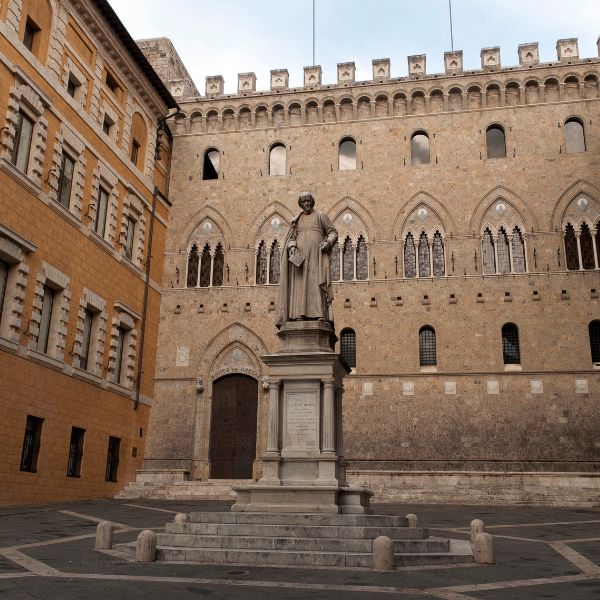
Let’s start at the beginning. Well, not exactly the beginning, because MPS was founded in 1472. We do, however, need to go back to 2008 and the disastrous aftermath of the takeover of Dutch bank ABN Amro.
Many will remember this moment as the beginning of the end for Royal Bank of Scotland, the lead acquirer, but there were in fact two other banks involved in the takeover (Santander and Fortis), which led to a curious side-show in the context of ABN Amro’s Italian assets.
Banca Antonveneta, at the time a moderately important domestic bank, had only been acquired by ABN Amro in 2005 as a result of the bankopoli scandal.
This is a whole other story involving market manipulation, a corrupt Governor of the Bank of Italy (the only one ever to have been forced to resign) and an investor group that nicknamed itself I furbetti del quartierino (the local hustlers) – but I digress. Antonveneta ended up in the hands of Spanish group Santander as part of the ABN Amro takeover and the asset was assigned a value of €6.6 billion, yet it was sold a few days later to MPS for €9 billion. The ridiculousness of this situation was summed up by one of the analysts present when the deal was announced. He posed this simple question to MPS management: “Did you even negotiate the price for five minutes?”

Of course, 2008 was no time to be doing an ambitious bank purchase and MPS soon found itself secretly counting the cost of the transaction. In order to save face, it organised a series of derivatives transactions designed to hide the reality of its deteriorating solvency position. It took a while for the truth to come out, but it was breathtaking when it did. The tone was set by the death of David Rossi, the bank’s Head of Communications, whose body was found in the alleyway beneath his office window in 2013.
Whilst officially ruled to have been a suicide, there was plenty of speculation that other, darker forces were involved. Of course, as is so often the case in financial frauds, lengthy court proceedings resulted in acquittals on criminal charges for all concerned.
Now, if the sordid story finished here with the collapse of MPS, the next chapter could not have been written, but of course politicians never want to let a good crisis go to waste and banks are always fun political toys.
Amongst the state’s interventions to prop up MPS, we can highlight the issuance of guaranteed bonds (Tremonti Bonds, named after the finance minister of the Berlusconi era, and then Monti Bonds, named after technocrat PM Mario Monti), subsequently repaid during rounds of capital increases that left the state on the hook for about €7 billion by the end of 2022. Subsequent equity sales brought in about €2.7 billion and left a remaining stake of about 12% in MPS. Following the takeover of Mediobanca, the state’s shareholding in the combined group has now been diluted to under 5%, currently worth somewhere over €1 billion. Not a great return on its investment so far.
But what of Mediobanca? Founded immediately following the end of WWII to finance the reconstruction of Italian industry, it was led by Enrico Cuccia, a legendary figure in Italian finance, until his death in 2000.
It is said that Cuccia played his cards so close to his chest that he would type any particularly important letters on his own typewriter so as not to allow the possibility of sensitive information leaking from his office.
To give you a taste of the kind of deal Cuccia was famous for: when FIAT was in grave financial difficulties in the ‘70s, Cuccia arranged for Gaddafi’s Libya to buy a 10% shareholding – it wasn’t a good look for FIAT’s Gianni Agnelli, who was rather happier in the company of friends like Henry Kissinger, but needs must. It’s not surprising that Cuccia was generally considered to be the one pulling the strings that made the stock market move – a point that was made rather morbidly when his corpse was stolen from its grave on Lake Maggiore and held to ransom. The demand, aside from cash, was that the Milan stock exchange index had to regain the level of 50,000 points (+35%!) by the end of the year. This didn’t happen, so evidently there were at least some limits to the man’s power.
The question of course is: why has this transaction occurred?
The following is from the official MPS press release following the acquisition:
The new Group structure is aimed at achieving strategic and profitability objectives and at fully achieving industrial synergies so to maximize value creation. This configuration is designed to enhance the distinctive expertise of Mediobanca and its professional resources, within a specialized operating model.
Right. This type of communication is technically known as a supercazzola in Italian. Don’t worry about the lack of subtitles – nothing he says makes any sense, which is sort of the point…
The sad reality is that Mediobanca, aside from being one of the crown jewels of Italian finance, sits atop another crown jewel: a 13% shareholding in the insurer Generali, a stake currently worth about €7 billion. It may well be that the dismemberment of Mediobanca and Generali and the distribution of value to its shareholders will be part of the Italian government’s strategy to promote nationalist capitalism. It’s hard to resist the temptation to say that Cuccia, who studiously avoided political interference, will be rolling in his grave (yes, his body was eventually returned to its rightful resting place).