Tel: +34 93 665 8596 | info@spectrum-ifa.com | LinkedIn Facebook

Viewing posts categorised under: Mondaq

Income tax rates in Italy 2025

By Gareth Horsfall
This article is published on: 7th October 2024

07.10.24
IRPEF scaglioni (income tax bands)

IRPEF
From Jan 1st 2025 the IRPEF scaglioni (income tax bands) will be changing again. The government is following up on its promise at the elections to modernise the taxation system and move to simpler and more ‘interesting’ tax bands.

Giancarlo Giorgetti (Finance Minister) said ‘ We are committed to not only cutting the tax rates and reducing the 3 tax bands, but also realising them from the next tax year [2025]’

So, the current and proposed (but not yet confirmed) IRPEF rates for 2024 and 2025 respectively are as follows:

2024 Tax rate% 2025
€ 0 - 28000 23% 23%
€28000 - 55000 35% 33%
€55000+ 43% Here they will likely leave the rate at 43% but instead increase the band to income over €60000

Now, let’s be honest, I don’t think this is going to affect many of us in any significant way, however, it might mean some savings here and there. So not to be sniffed at!!

But, you might ask why they don’t amend the first income tax bracket to make it more attractive to lower earners?

From submitted tax returns completed in 2023 we learn that 40% of 42 million taxpayers declare less than €15000 per annum in Italy and 70% of all taxpayers pay less than 20% in tax (after deductions). In 2023, the declared average income from calendar year 2022 was €22806. So given the majority of Italy’s income tax take comes from the bottom income tax bracket, it is unlikely that they will start tweaking with that any time soon, in my opinion.

However, all will be revealed in the ‘Legge di Bilancio‘ (Budget) in Jan 2025, as usual!

UK Budget

The UK Budget
The UK autumn budget will be taking place on October 30th this year and there are some interesting changes afoot. As yet, nothing confirmed until the big day, but I attended a couple of online seminars looking at possible tax changes that could turn out to be quite interesting ( positive and negative) for any Brit’s looking to move to Italy and become long-term residents, or those of us who are already here.

Let’s start with the positives:

Inheritance Tax Overhaul
The UK inheritance tax system has always been determined by a UK person’s domicile. This always meant that the UK could wield the right to tax the estate of a UK national, even where they may have lived abroad for many years.

The classic tale regarding this situation is the story about the actor Richard Burton. I have told this story before on my E-zine, but the story goes that he was born in Wales (UK) but got into the movies and became very famous and moved to the USA, earned his money there and transferred his whole life to the US owning no more assets in the UK. On his death the UK, under the domicile rules, reserve the right to tax the estate where there are significant ties back to the UK. In Richard Burton’s case he ‘supposedly’ (I have never researched whether this is true or not, but it’s a good story anyway), wrote in his last will and testament that he wished to be buried in the Welsh cemetery where he grew up. Apparently, this was considered a sufficient tie back to the UK and the UK HMRC taxed his entire worldwide estate. I am not sure if this story is true but it does go to demonstrate the lengths to which the domicile system can come knocking, should the UK tax authorities wish to do so.

However, the talk on the street is that from October 30th the UK will move to a residency based test for inheritance tax purposes. So what does this mean?

In brief, the proposal is to allow any UK national who has lived away from the UK for more than 10 years to be able to have their estate taxed in their country of residence at the time of death (but with the UK government reserving the right to tax the state for a further 10 years should they wish to do so). This presents a HUGE financial planning opportunity for residents of Italy, as I shall discuss below.

If your intention is to live and die in Italy then Italian IHT rates are so low that it could be classed as a fiscal paradise for inheritance tax purposes. I won’t go into details, but just to say that direct line descendants (spouse and kids) all get a €1million allowance before they would pay tax at just 4%. Compared to the UK’s 40% on estate value over £325,000 (plus the possibility of main residence relief), the Italian system is much more attractive.

However, if you have invested assets (not real estate!) which you would like to protect from inheritance tax altogether, then you can potentially invest in an Italian polizza assicurativa (Investment Bond) which protects all assets within it from any inheritance in Italy, so effectively reducing your IHT bill to zero.

What a planning opportunity

I am not sure the UK government had this little tax opportunity in mind when thinking about the change but for UK nationals who are long term residents in Italy and who want to live out the rest of their lives here, this represents a great financial planning opportunity.

And here come the negatives:

Gift Tax

Gifts for Inheritance tax purposes
There is talk of removing the gift tax break known as PET’s (Potentially exempt transfers) where a gift made, after a 7 year period, is no longer considered in the inheritance tax calculation. May they remove this? It might be a good time to discuss with family members, who may want to gift you funds, to do this before October 30th before the rule would likely come into force.

There is also the question of money being paid to a non-resident individual and whether that could attract a UK exit charge (see Potential exit charge for UK nationals section below)

Capital Gains Tax increase
For anyone holding onto UK property assets and thinking of selling them you may want to watch carefully what happens with capital gains tax rates in the UK post 30th October 2024.They are expected to be increased; currently at 18% and 24% for residential property, they are likely to increase and the change be effective immediately!

Remember that as a non-UK resident UK property owner, if you sell the property then you are subject to UK CGT on the proceeds. If you have owned the property before 2015 (when the law came into effect) then the cost (purchase) basis for your property is 6th April 2015. If purchased after then the purchase value in the contract is the cost basis for capital gains tax purposes.

If you have owned the property/ies for more than 5 years then Italy will not deem them speculative and will not tax you on them.

exit tax

Potential exit charge for UK nationals….and maybe UK located assets?
I have to say that this one surprised me, and as of yet I haven’t heard anything more about it, but the jungle drums are beating that there may be a possible exit charge on anyone who becomes UK non-resident.

A tax of this nature is currently applied to UK trusts who become non-UK resident. A deemed disposal value of the assets is made just before the moment of non-residency and a subsequent deemed re-acquisition of the same assets at market value is made for the purposes of calculating the CGT.

Here we are faced with a clear financial planning necessity because if you are invested in tax efficient vehicles (ISA’s) in the UK then it would make sense to cash them in and pay no capital gains tax on them in the UK whilst still a UK resident, and then leave them in cash (no capital gains tax on cash!) whilst you transition over to your new residency in Italy and reinvest from there. However, if a tax is levied on capital rather than assets then it may not be avoided. How the UK HMRC will do this is anyone’s guess but should this be introduced then financial planning before the move for UK resident individuals will be very important.

The bigger question is what they might do with already non-UK resident individuals who have assets still situated in the UK? Tax on transfers overseas?

Whatever law is likely to be announced will probably come into effect from April 6th 2025, so there may be time to plan, but it might be time to look at how to remove some or all of your assets (depending on your circumstances) from the UK and potentially avoiding any exit taxes.

I would repeat that this has come as a bit of a shock, but does not surprise me given the UK’s current economic difficulties. Putting in measures to avoid flight of capital overseas would not surprise me and has been bounded about as an idea in the past by a Conservative government. Will Labour finally follow through with these more draconian measures? We will soon find out.

25% tax fee lump sum pension

Pension tax free lump sums
As anyone with a UK pension will know you are currently eligible to withdraw 25% of the valuation of the pension at age 55 (moving to age 58). The possibility is that this will be reduced to a maximum of £100,000 for all pensions and will likely be effective immediately.

As a reminder to anyone thinking of moving to Italy, it is always better to take the tax free lump sum in the UK before moving to Italy because Italy does not respect this tax break and would tax the whole amount as income. However, in light of this new UK proposal you might want to accelerate your decision to remove your full 25% before October 30th and hold it in cash/deposit, before you make your move to Italy.

Surcharge for non-resident buyers of UK property.
Here we have a tax increase for anyone who may be non-UK resident at the time of buying UK property. The surcharge may increase from 2% to 3%.

At the moment we don’t know any specifics and so I can only relay that which I have heard on 2 different tax seminars specifically on this topic. Some of these proposals may rightly cause some level of immediate concern and others maybe there is the opportunity to wait. At this point, if I hear anything else I will report on it straight away but I imagine that the next time will be Budget day itself.

If you would like to discuss these or any other tax or financial planning related issues in Italy then please don’t hesitate to contact me on gareth.horsfall@spectrum-ifa.com or call / message on +39 3336492356

Always happy to help where I can!

Healthcare in Italy

By Gareth Horsfall
This article is published on: 9th March 2024

09.03.24

You may have seen the interview I did (you can see it again HERE) for Real Expats in Italy channel .

It has taken my name a little bit farther and wider that it had been previously and created a surge in new enquiries and queries, which I am very grateful for. It’s always nice to be introduced to new people and learn more about how people are living in Italy. The more I understand the more I can hopefully pass back to you through this E-zine. Anyway, hence why the E-zine is a bit later than usual.

I was contacted by 2 people in late January to tell me that their local health offices were now asking for the full € 2000 pa. payment to renew their Tessera Sanitaria.   They were not recognising the fact that they were UK citizens covered by the UK / EU withdrawal agreement.  To be fair to the Italian authorities nothing was mentioned in the text stating that there would be an exclusion clause for UK citizens resident pre-Brexit, so it’s no surprise they were asked for the full amount.   I asked some people I know who are still involved in the campaign to protect UK citizens rights post-Brexit and they could only tell me that the issue had been lodged with the UK Embassy, but that they had not heard anything back. I am not sure if that situation has changed but it may just be one of those cases where we just have to learn to live with it.

 On the subject of healthcare in Italy I saw an article in  Sole 24 Ore just this week saying that 5 Italian hospitals were in the Top 100 in the (Western) world, according to NewsWeek.  The highest ranking being Gemelli hospital in Rome at place No 35.   I know everyone has varying experiences of the healthcare service, but most people I talk to especially from the UK and USA say that the healthcare is much better than in their home country.  So hat’s off to Italy for providing such a good health service and one which we all rely on.  If you are interested just click for the article (in Italian):   Sole24Ore
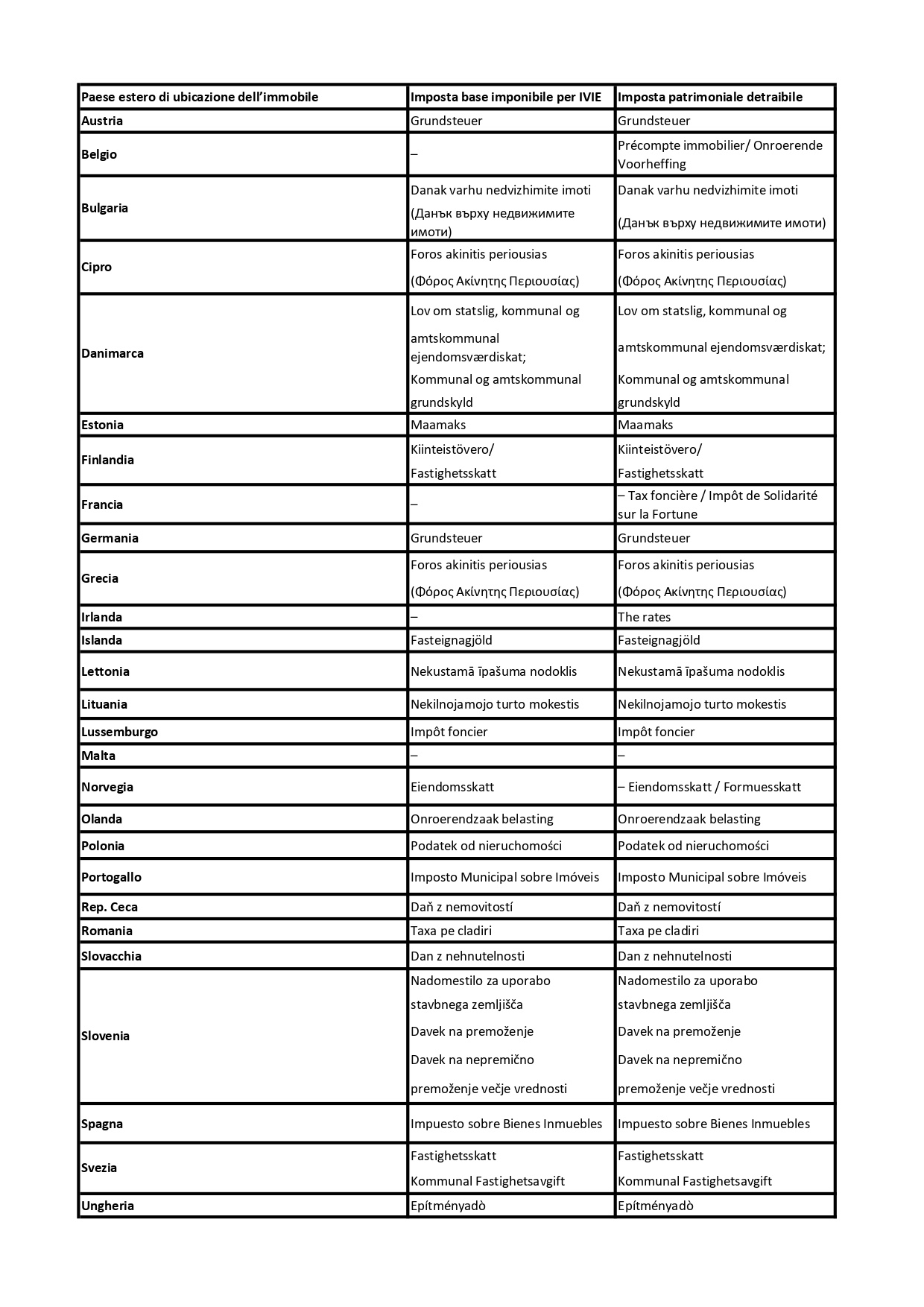
IVAFE
IVAFE: Imposta sulle attività finanziarie all’estero
Increase in wealth tax 2024
In my Oct 2023 E-zine I also pointed out that the wealth tax on assets was going to increase from 0.2% to 0.4% pa if your assets were being managed or held in a privileged tax jurisdiction. The list being as follows:

Alderney; Andorra;  Anguilla;  Antigua e Barbuda; Dutch Antilles; Aruba; Bahama; Bahrein; Barbados; Belize; Bermuda; Brunei; Costa Rica; Dominican Republic; United Arab Emirates, Ecuador; Philippines; Gibraltar; Gibuti; Grenada; Guernsey; Hong Kong; Isle of Man; Cayman Islands; Cook Islands; Marshall Islands ;   Isole Vergini Britanniche; Jersey; Libano; Liberia; Liechtenstein; Macao; Malaysia; Maldive; Maurizio;   Monserrat; Nauru; Niue; Oman; Panama; Polinesia Francese; Monaco; Sark; Seychelles; Singapore; Saint Kitts e Nevis; Saint Lucia; Saint Vincent e Grenadine; Taiwan; Tonga; Turks e Caicos; Tuvalu; Uruguay; Vanuatu; Samoa.

I mention this because a few people have contacted me recently who have had, or are having, an ‘expat’ professional career often working in places like Hong Kong or the United Arab Emirates and have accumulated assets in those jurisdictions; mainly investment portfolios and savings. In addition, it is not unusual for someone working overseas to invest/save in an offshore territory like Jersey or the Isle of Man as a way of retaining assets in a more familiar jurisdiction whilst living abroad. However, a subsequent move to Italy would mean that you would end up paying double the amount of wealth tax, and not only.  In addition, Italy penalises some assets which are not held within the European regulatory framework so you could end up getting a double whammy tax bill when it could quite easily be avoided by re-structuring assets in a more tax efficient manner for Italian life.

UK Self Invested Personal Pensions

For anyone (UK citizen or any other national) who has contributed to a UK SIPP (Self Invested Personal pension) we now have a little more clarity on the tax treatment of the pension account. On 11th January, the Agenzia delle Entrate published an Interpello (opinion on a tax question submitted to them) specifically on the subject of this type of account. You can read the document HERE (interestingly, US retirement accounts (IRA’s) are pretty much the same legal structure as a UK SIPP and so it would make sense that the same logic is applied to them in Italy, as well).

The document pretty much confirms what I have known and been advising clients and commercialisti for some time. The first thing being that the Italian ‘previdenza complementare’ tax regime cannot be applied to these accounts, but equally neither should the wealth tax be applied to this kind of retirement accounts.

If you have any kind of UK personal pension account then I would suggest you take a look at the section RW on your Italian tax return and see if the wealth tax has been applied. The tax will be shown in the box No 15, and it should not be there!   If you find this is the case you need to speak with your commercialista. Instead the box No 20 should appear with an ‘X’, in it which applies the ‘monitoraggio’ status, but not taxed.  Also, do not assume that because wealth tax is not applied that it does not have to be reported…it does.  It’s just that it is monitored as an asset rather than taxed on the fund each year.   You will  normally be subjected to tax when you make a withdrawal from the account. If you are unsure what to look at, then you can always contact me and I can take a look for you.

Tax declaration time is rapidly approaching, commercialisti are starting to be run off their feet and mistakes can be made so if you are invested in a UK personal pension plan (individual or corporate), a SIPP, or a QROP’s, then check your tax return for accuracy and ensure that you are not paying tax that you shouldn’t be paying!

In my next article I will be looking at the subject of the expenses that you can detract from your taxes in Italy, such as medical expenses. So stay tuned for the next edition!

If you have any questions about any of these issues and how they apply to you and your financial situation, or if you think that you might be paying more than need to, then do get in touch and I will be happy to see if I can help you with your plans.

I can be contacted on email: gareth.horsfall@spectrum-ifa.com or on cell: +39 333 6492356

Are there ISAs in Spain?

By Chris Burke
This article is published on: 14th January 2024

14.01.24

When living in Spain it shouldn’t take too long to discover that personal finances work very differently from many other European countries, particularly the UK. Independent advice is hard to find – most people talk to their bank and are told that their main option is to invest in the bank’s own standard products and solutions, which for many people are not suitable or appropriate.

Many people from the UK are used to a more sophisticated way of investing, maximising tax efficiency and mitigation through solutions such as ISAs and pensions. These can greatly reduce the tax you pay making a big difference to the amount of money you end up with, in some cases incredibly so.

Is there a Spanish equivalent of a UK ISA?

In short, there is something very similar. It can greatly reduce the tax you pay as your investment grows and can even be set up for your children to benefit independently.

Are there Spanish equivalents of a private pension in Spain?

Yes, there are, however these are vastly different to in the UK. In the UK you can contribute up to £60,000 per year to a private pension. In Spain you can only contribute €1,500 per year. A self-employed person can contribute an additional €4,250 per year. Very few employers in Spain have their own pension schemes and those that do have a limit of €10,000 per year that can be jointly contributed to.

Reducing the tax on your investments

How does the equivalent of the UK ISA in Spain work?

As your money grows any gain you make is not taxable until you receive this money (achieving compound growth). When you access this money, any gain is offset proportionally against the original investment amount, and as such removing this proportion of the gain. For example, if your investment grows by 50%, any partial withdrawals you make have this portion deducted against the gain you have made. Over the years this can make an incredible difference to the tax you pay, particularly as this investment income falls under Capital Gains tax (savings tax) and not income tax, which can become VERY important when paying tax on your monies (pension income falls under income tax).
As a reminder, the tax rates are:
Capital gains tax ranges from 19-30%, income tax from 24-47%.

Many people use this option for their mid-term and retirement planning because they have some flexibility, are portable should you move elsewhere and are also highly tax efficient and compliant in Spain.

Important note on UK ISA’s

Whilst UK ISAs are tax efficient in the UK (all gains are tax exempt), as a Spanish tax resident this is not the case – any gains that arise in your UK ISA must be declared annually and tax paid on these even if you do not access the money. This makes UK ISAs as a Spanish tax resident very inefficient and why many people look for alternatives.

UK ISA Tip when moving to Spain

Before you become a Spanish tax resident, if you encash your UK ISA you realise any gains that would be taxable when you become a Spanish tax resident. This not only includes any annual gain, but more importantly the gain from inception, which as a Spanish tax resident you would be liable for when you encash.

If you would like any more information regarding any of the above, or to talk through your situation initially and receive expert, fact based advice, don’t hesitate to get in touch with Chris.

Click here to read independent reviews on Chris and his advice.

The Spectrum IFA Group Award for their Technical Articles

By Spectrum IFA
This article is published on: 20th September 2016

20.09.16

Technical knowledge and a deeper understanding of tax, investments, pension and financial planning means a better outcome for our clients and also a more satisfying professional outcome for us. One of the ways we do this is to use a technical articles website called Mondaq for our research. We also contribute to this site by writing articles.

In August 2016, The Spectrum IFA Group was pleased and extremely proud, to have been awarded the ‘Top Communicator Award’ for Spain. Our posts have covered a series of topics such as “Brexit and Tax in Spain“, “Insight into Wealth Management“, “Final Salary Pension Deficits” and more. Our articles had the most reader response of any contributor.

This was no mean feat given that Mondaq publishes thousands of high quality articles each year from thousands of sources!