


The Highly Qualified Professional Visa is designed for non-EU professionals with specialist skills who have been recruited to work in Spain, particularly in high-demand sectors such as technology, engineering, and research.
Viewing posts categorised under: Mondaq
Highly Qualified Professional Visa – Spain
By Barry Davys
This article is published on: 10th December 2025

10.12.25
Key Requirements
- A job offer from a Spanish company approved for “highly qualified” roles, along with suitable qualifications or professional experience.
- Minimum annual salary of €40,100 to demonstrate highly qualified status.
- Visa validity of up to three years, renewable for an additional two years.
- Eligibility to apply for the Beckham Law reduced tax regime.
- Applications can be submitted online in Spain by the employer (with fast-track processing, often within 20 working days) or via the Spanish Consulate in the UK if applying from abroad.

Understanding the Financial Impact of Your Move to Spain
Securing your visa is a major milestone — but it’s equally important to understand how relocating to Spain will affect your finances.
Many applicants ask whether they can join the Beckham Law while on the HQP Visa, and what this could mean for their tax position. While the well-known 24% tax rate on employment income up to €600,000 is widely published, there is another significant benefit that can substantially reduce your tax bill for the entire five-year duration of the scheme.
At The Spectrum IFA Group, our advisers are both professionally qualified and personally experienced in moving to and living in Spain. We help clients understand how to structure their finances efficiently from day one.
Additional Resources
- Case Study: Case Study, How we helped a Spanish Tax Resident couple after their move to Spain
- Why a financial adviser is essential for expats in Spain
- Moving within 12 months? Book a call online at a time that suits you.
HQP Visa not suitable? View other visa options for British nationals.

Working With Trusted Visa Specialists
While we are experts in financial planning, we are not visa specialists. For immigration matters, we work closely with Klev & Vera, a Barcelona-based law firm led by managing partner Anna Klevtsova, who holds degrees in International Law from both the UK and Spain.
Our collaboration ensures clients receive clarity on:
- Which visa type is most appropriate
- Assistance with the application process
- Ongoing matters such as state pension queries
For transparency: we do not receive any commission or fees from these lawyers. Our priority is that clients receive accurate, reputable advice.
The Beckham Law – Key Rules
You may be able to reduce your tax burden by opting to be taxed under the special non-resident tax regime (Beckham Law) if you meet the following conditions:
- You have not been a tax resident in Spain in the last five years.
- You apply for the new Beckham regime within six months of arrival.
- You become resident in Spain (typically by spending 183+ days per year in the country).
- The reduced rate applies for the year of arrival plus five full tax years.
- The first €600,000 of employment income is taxed at 24%.
Employment Criteria for the Beckham Law
You may qualify for the regime under any of the following employment structures:
- New employment in Spain with an entity registered with the Spanish Tax Agency
- Transfer to a Spanish entity while maintaining an existing employment contract
- Remote work from Spain for a foreign employer
- Appointment as a director of a Spanish entity
- Self-employment (“autónomo”) in an entrepreneurial activity
- Highly qualified self-employment providing services to startups
- Self-employment in training, research, development, or innovation activities
Each pathway has specific requirements, so professional tax advice is essential to confirm eligibility before relocating. We work with specialist tax lawyers who can assess your circumstances — and again, we do not receive any form of commission for referring clients.
Digital Nomad Visa Spain
By Barry Davys
This article is published on: 8th December 2025

08.12.25
A residence permit for non-EU remote workers and freelancers who wish to live in Spain while working for companies outside the country.
The eligibility for the Digital Nomad Visa in Spain includes:

- Available to employees of foreign companies, freelancers, or business owners working for clients outside Spain.
- Proof of steady remote income (minimum around €2,200 per month). If bringing your family with you this figure will rise.
- Access to Spain’s public healthcare system and local services once registered. Once the person with the DNV is registered the rest of the family who come to Spain can register and will be covered for health care.
- Apply online from Spain (processing time: about 20 working days) or in person from the UK (around 10 working days).
- Visa valid for one year when issued abroad; residence permit valid for three years if applied from Spain, renewable for two-year periods.
- If you work on a UK payroll, Spain-UK Bilateral Social Security Treaty covers the remote work; if you are an independent contractor, register as a freelancer-autónomo in Spain and pay your social security in Spain.
Your Visa is an important step for your move to Spain. At the same time, it is very important to have an understanding of how your finances will be affected when you move to Spain. For example, can you join the Beckham Law on the Digital Nomad Visa? What will this mean for your financial position? Whilst the 24% tax rate on earnings up to €600,000 pa is the most posted part of the rule on the internet, there is another very important benefit. This second benefit can hugely reduce your tax bill when moving to Spain and for the whole five tax years you are on the scheme,
At The Spectrum IFA Group in Spain, we are familiar with these opportunities both from our professional knowledge and our own experience of all our advisers having made the same move and who now live in Spain.
Case Study, How we helped a Spanish Tax Resident Couple after they moved to Spain
Why a financial adviser is essential for expats living in Spain
The DNV not suitable for you? See all the other available Visas for Spain for British nationals here
Whilst we are experts in our own field, we readily admit we are not experts in Visas. We, therefore, work with Visa lawyers at Klev & Vera, based in Barcelona. The firm is led by managing partner Anna Klevtsova with whom we have worked with for a number of years. Anna has a degree in International Law from the UK and a Masters degree in International Law in Spain.
The result has been clarity for clients moving to Spain on what type of visa is right for them, help with applying for the visa and availability to deal with ongoing matters such as the Spanish state pension.
Non Lucrative Visa Spain
By Barry Davys
This article is published on: 2nd December 2025

02.12.25
A long-term residence permit for non-EU citizens who wish to live in Spain without working.
Popular with retirees and financially independent individuals seeking a new lifestyle in Spain.
Who could benefit from the Non Lucrative Visa (NLV) in Spain?
- Ideal for retirees, early retirees, or financially independent individuals.
- Proof of sufficient financial means ( income around €30,000/year for the main applicant and €8,000 per dependent).
- Requires a private health insurance contracted in Spain.
- Remote working, self employment or continuing to work for your UK employer are all NOT allowed with the NLV
- How to apply for an NLV. Application is submitted in person at the Spanish Consulate in the applicant’s home country (not available from within Spain).
- Processing time of up to two months; visa valid for one year and renewable for two-year periods.
- Eligibility for permanent residency after five years in Spain and Spanish nationality after ten years.

Your Visa is step 1 of your move to Spain.
Also needed is an understanding of how your finances will be affected when you move to Spain. At The Spectrum IFA Group in Spain, we are familiar with these changes both from our professional knowledge and our own experience of all our advisers having made the same move and who now live in Spain.
The Spectrum IFA Group in Spain assists individuals, employees and families moving to Spain with all financial aspects of their move. It starts with what actions are beneficial to take before you come to Spain and what needs to wait until you are resident in Spain. From the vital planning, how to save when in Spain, how to manage your tax on your savings, pensions in Spain and even, how to best manage currency transfers from the UK to Spain.
What is a présent d’usage and how can it be used?
By Victoria Lewis
This article is published on: 27th November 2025

27.11.25
A présent d’usage is a customary gift given on a special occasion and of modest value, in proportion to the donor’s wealth and income.
In plain terms, it’s a gift made for a particular event – like a birthday, wedding, graduation, Christmas, or another significant celebration – and it must not be large enough to affect the donor’s financial situation.
If those two conditions are met, the gift is not subject to gift tax and does not need to be declared.
Legal definition and principles:
French law doesn’t specify a fixed euro amount. Instead, courts and tax authorities judge “modest value” relative to the donor’s means.
Key references:
- Article 852 of the Code civil
- Article 784 of the Code général des impôts (CGI)
- Various rulings of the Cour de cassation (French Supreme Court)
- The tax administration (BOFiP-ENR-DMTG-20-10-20-10 § 10) says that the assessment depends on: “la fortune du donateur et les usages” — the donor’s wealth and customary practice.

Common examples of “présents d’usage”
Event + Typical acceptable gifts (if proportionate)
Birthday or Christmas: A few hundred euros, watch, jewelry, small artwork
Wedding: A few thousand euros if donor is wealthy, smaller if not
Graduation / birth of a child: A symbolic sum or piece of jewelry
Religious events: Usually modest cash or gift
When it stops being a “présent d’usage”:
The gift ceases to qualify and becomes a taxable donation if:
- The value is disproportionate to the donor’s income or assets.
- It’s not linked to a special occasion.
- It’s intended to transfer wealth permanently (not symbolic).
- The donor gives multiple large “presents” that together look like a disguised donation.
If the tax administration audits and decides it’s really a “donation déguisée,” they can requalify it and apply the 60% gift tax (if between non-relatives).
Practical rule of thumb.

French notaires often say:
A gift of no more than 1–2% of the donor’s net worth or a few weeks’ income will usually be accepted as a présent d’usage, provided it’s tied to a genuine occasion.
There’s no official threshold — it’s all about proportion and context.
- Principle
As noted earlier, there’s no fixed ceiling — it depends on whether the gift is modest relative to the donor’s wealth and income and is tied to a special occasion (birthday, wedding, graduation, etc.).
For guidance, notaires and tax authorities often use informal rules of thumb when advising clients.
- Typical “reasonable” range (for €500,000 income)
If the donor earns about €500,000/year and has assets consistent with that income, a gift of roughly 1–2% of annual income would often be viewed as proportionate for a major occasion.
That works out to:
€5,000 to €10,000 for a standard event (birthday, graduation, wedding present, etc.)
Possibly up to €20,000 or so for a very special event (e.g. child’s wedding, milestone anniversary) — but that’s at the high end and should clearly match the occasion.
- Key conditions to stay within “présent d’usage”
To keep it safely tax-free:
Occasion-based: The gift is clearly tied to a socially recognized event (wedding, birthday, graduation, etc.).
Proportionate: It doesn’t change the donor’s lifestyle or deplete assets.
Customary: It’s the kind of thing people of similar means might reasonably give.
Documentation: It’s helpful to note (privately) what the occasion was and the donor’s income level, in case of audit. There’s no need to declare it if it’s truly a présent d’usage.
- When to get advice
If the amount goes well above 2–3% of income (say, >€15,000–€20,000 on €500,000 income) or there’s no special occasion, a notaire or fiscaliste should review it. The tax office could otherwise requalify it as a donation taxable at 60% (for non-relatives).
The UK Autumn Budget
By Barry Davys
This article is published on: 24th November 2025
24.11.25
What you need to know
On 26th November 2025, the Chancellor of the Exchequer, Ms. Rachel Reeves, will present the Autumn Budget to the House of Commons. While some minor changes, like an increase in taxes on spirits, might take effect immediately; most changes won’t be implemented until later.
Despite this, the media will extensively cover the Chancellor’s statement on the day, often without clarifying that the proposed changes won’t take effect right away. You’ll likely see numerous articles, podcasts, webinars, and briefings discussing the Budget, based on the announcements made in Parliament. However, it’s important to be cautious before acting on these updates.
Understanding the Budget Process
The UK Parliamentary Commons Library defines the Budget as follows:
“The Budget is a statement made by the Chancellor to MPs in the House of Commons, presenting the government’s plans for the economy, including changes to taxation and spending.”
This is key because the Budget is just a statement of intent – not a law yet. Before any proposed changes become law, they go through several stages:
- Debates in the House of Commons (over four days).
- Debates in the House of Lords.
- The Finance Bill 2025 is then presented to Parliament.
- If Parliament votes in favor, the Bill becomes an Act of Parliament and the changes become law.
This process means that the initial announcements made in the Budget are still subject to change before they are finalized.

What Should You Do?
If the Budget includes a tax rise on whisky or similar immediate changes, it’s fine to take action before the increase goes into effect. However, for more complex changes (like pension reforms, stamp duty adjustments, income tax rates, and changes to ISAs), it’s wise to wait until the Finance Bill 2025 becomes law.
It’s important to remember that the Budget announcements are only the starting point. During the parliamentary readings of the Bill, amendments can be made—sometimes significant ones. In fact, in 2025, the media suggests there could be notable opposition from even the government’s own MPs, meaning the final law may differ substantially from the initial Budget statement.
Making financial decisions based on the Budget before the Bill is passed into law could lead to costly mistakes that impact your finances for years to come.
What next should you do?
To avoid acting on speculation, it’s best to let the media buzz die down after the Budget. The real, final changes will become clear in the Finance Act 2025, at which point you can make decisions based on confirmed facts.
If you’re living in or moving to Spain, and want advice on how the 2025 UK Budget might impact your finances, feel free to book a consultation at a time that works for you using our online booking system.”
How will artificial Intelligence change your world if you are retired?
By Jeremy Ferguson
This article is published on: 22nd November 2025

22.11.25
Artificial intelligence (AI) is transforming everyday life, but its impact on retired people is often overlooked. If you are still at school and looking towards a career, then the landscape will be changing forever, with many jobs disappearing.
Just as the Industrial revolution replaced the body in the workforce, AI looks like it will be replacing the mind in much of the workforce. It is actually quite a scary thought. However, for those no longer in the workforce, AI is not a threat, quite the opposite, it will be a valuable tool.

AI-powered assistants will have a huge influence in the world of medical research, analysing huge amounts of data in no time at all, helping advance research and the resultant remedies. As a result of all of this, life expectancy and quality of life will both improve.
AI-supported health tools can help monitor vital signs, remind users about medications, and assist with telehealth visits. These innovations will help support independent living by helping retirees manage health concerns and issues more easily and proactively.
With AI, lifelong learning becomes more accessible than ever. Retirees can explore history, languages, technology, creative writing, or any area of curiosity. AI tutors adjust to individual learning styles and answer questions in plain language—without pressure, deadlines, or classrooms. I know a number of people who have subscribed to an AI language school, talking and practising Spanish with a ‘virtual’ person for 15 minutes each day. This can be done whenever suits them, and from the comfort of their own home, rather than being tied to a certain class time each week.
AI tools make it possible to create artwork, write stories, restore old photos, or design family history projects—regardless of technical skill. Many retirees use AI to capture memories, organize family archives, or create meaningful keepsakes for loved ones. Rather than replacing creativity, AI enhances it.
It can also help retirees stay in touch with family and friends by simplifying video calls, drafting messages, translating languages, and explaining new apps. This support can help reduce the feeling of being left behind in a fast-moving digital world.
AI is possibly redefining retirement as a stage filled with new opportunities—for learning, connection, creativity, and independence. For those willing to embrace it, AI offers a more empowered and engaging future.
As with any change, embracing it rather than avoiding it can often be the best way forward.
Living longer and being more active in retirement will mean the pensions and investments we have will need to last longer, so ongoing regular reviews and careful management will become ever more important. This is becoming an ever increasing part of my relationship with clients and if this is something you feel I can help you with, please feel free to get in touch.
UK bank & savings protection
By Victoria Lewis
This article is published on: 21st November 2025

21.11.25
Deposit limit protection increase
From 1 December 2025 the Financial Services Compensation Scheme (FSCS) deposit protection limit will rise to £120,000. This means that if you hold deposits or savings with a UK-authorised bank, building society or credit union and it goes out of business, FSCS will compensate you up to the new limit of £120,000 per eligible person, per authorised firm.

The FSCS also covers temporary high balances, which will also rise from December, of up to £1.4 million. These may occur from major life events, such as selling a home or receiving an inheritance. Temporary high balances are protected for up to six months.
There are some details to be aware of:
- The additional compensation limit is per person, per qualifying life event. For joint accounts with a temporary high balance, each named person benefits from FSCS protection of up to £1.4m.
- The protection begins on the date the money becomes legally transferable to you, or from when it is first credited to your account (or to a solicitor’s client account for onward payment to you). You can move the funds to another account in your name and maintain the protection, but the six-month period would not begin again.
- Proceeds from the sale of second homes or buy-to-let properties are not covered. If your temporary high balance exists because of a real estate transaction, it must relate to your main residence for FSCS protection to apply.
- Compensation is unlimited for temporary high balances that relate to personal injury, disability or incapacity claims.
- FSCS will pay compensation when certain requirements set out by the UK’s financial regulators are met.
Qualifying life events and evidence required
A range of life events could create a temporary high balance in your bank account, including:
- Real estate transactions (property purchase, sale proceeds, equity release – this doesn’t have to be a UK property but must relate to your main residence).
- Benefits payable under an insurance policy.
- Personal injury compensation.
- Disability or incapacity (state benefits).
- Claim for compensation for wrongful conviction.
- Claim for compensation for unfair dismissal.
- Redundancy (voluntary or compulsory).
- Marriage or civil partnership.
- Divorce or dissolution of a civil partnership.
- Benefits payable on retirement.
- Benefits payable on death.
- A claim for compensation in respect of a person’s death.
- Inheritance.
- Proceeds of a deceased’s estate held by a personal representative.
To verify the source of funds for a temporary high balance, the FSCS may ask for evidence which could include (but not be limited to) the following:
- A property sale receipt or agreement.
- A court judgement.
- A will.
- A letter from an insurer regarding an insurance payout.
- A letter from a lawyer, conveyancer, mortgage provider, former employer, or pension trustees.
- Court orders.
- Social security statements.
- Probate / letters of administration.
- Death / marriage certificate.
- Land registry and HMRC records.
This list isn’t exhaustive, and the evidence needed will depend on your individual circumstances. If you provide the relevant supporting evidence and your claim is eligible under FSCS rules, compensation is payable within three months.
Why are the limits being increased now?
The previous protection limit was established in 2017, when the UK was a member of the EU. Following Brexit, regulatory control has returned to the UK, whilst inflation since 2017 has reduced the real value of the original limit. As a result, the FSCS has increased the protection level to ensure it remains equivalent in value to that provided in 2017.
While this increase is welcome, maintaining substantial cash balances in a bank account is generally not advisable over the medium to long term. We would be pleased to advise you on tax-efficient investment options for any surplus deposits you may hold.
Fiscal residency and corresponding tax returns in Italy
By Gareth Horsfall
This article is published on: 20th November 2025

20.11.25
Have you got it right?
In this article we briefly turn our attention the question of registration of residency in Italy and corresponding tax returns.

I have been contacted by a number of people since September who have received letters from the AdE, this would not normally picque much interest for me because the AdE send regular letters out to try and weed out potential errors or omissions from your tax return in fact I have had a few myself over the years.
However this letter was of particular interest because it broached the subject of residency and non declaration of assets, at all, ever.
Over the years I have seen many times where someone has made a tax declaration, but where errors have been made and / or omissions, and the AdE have eventually caught up with the error and the individual concerned has had to correct the error, pay the back taxes and penalties. Fair enough mistakes happen and often through bad advice on the part of the commercialista but one category of people who seems to have evaded the oversight of the AdE were those people who are resident in Italy, and for one reason or another have never made a tax return here. The main reason is because they were badly advised by a commercialista to not ‘enter the system’ or that they were declaring in another country thinking that it wasn’t necessary to do so in Italy.
However, it may look like that particular issue has been uncovered by the AdE, in fact, in a short period of about 5 weeks, I had 6 people contact me, all with very similar situations, relating to not having filed for taxes in Italy and subsequently receiving a letter from the AdE asking them to visit their local AdE office and explain the anomaly.
Whether this is an awakening for the AdE for merely just a blip is anyone’s guess but I suspect they have finally got the right hand speaking with the left hand and they will weed more of these issues out in the near future. It all corresponds nicely with the change in definition of residency from Jan 1st 2024 and so is probably the start of a wider push to make sure that everyone is doing what they should be, whether they know it or not.
So, in short, if you are resident in Italy then it is more than likely that you should be declaring your financial situation for taxes each year, if a commercialista tells you that you shouldn’t or don’t need to file, then you need to question that and not just take their word for it. I would request written, signed confirmation that this is the case. Equally, filing for taxes in another country, thinking that this is sufficient, is generally the wrong thing to do and you may want to explore this further to avoid eventual contact from the AdE.
If you happen to be in this situation and are wondering what steps to take, do not hesitate to get in touch. I have helped many people through this situation in the past, it’s better to address the matter before being picked up by the AdE.

Now, let’s move on to the subject of the UK property market.
“Property is the best investment”
I don’t know how many times I have heard this said to me in my career, which has spanned an era when property investment probably has been one of, if not the best investment to make.
However, everything is cyclical and whilst UK residential property may have been a great investment, that doesn’t mean to say it will be forever. In fact, the UK property market has stalled, at the time of writing, and it remains to be seen whether it is just a pause for breath or part of a longer period of downturn for the UK property market. As I have repeated many times in the past, in times of needs, governments will turn to the real estate market to generate tax revenue because it is has been the go to investment of choice for most people. The UK budget will roll around at the end of this month and we will see what kind of moves Rachel Reeves makes on the UK property market, it is expected that she will tax properties over a certain value, but little is known at this time. (I spoke with an investment manager in London recently who said they are bracing themselves for a ‘brutal’ budget, were his exact words).

However, as usual these are just my musings.
To explain in a bit more detail Rathbones Investment Management recently wrote a great article for a professional publication and I thought to share this with you here.
The UK’s love affair with property investment is apparent across newspapers, daytime TV and social media. An English person’s home may be their castle – they’ve also regarded it as their nest egg (and the same for other Britons). Many have even bought additional castles, such is their ardour for property. Reflecting this, official figures show more than 2.8mn private landlords in the UK.
However, the days of strong returns from residential property are already past. The past decade has seen three pieces of bad news. House price growth has been slower; higher interest rates have squeezed the buy-to-let business model; the regulatory treatment of private landlords has become progressively less favourable.
The economic and policy outlook suggests those headwinds won’t dissipate. From 1980 to 2016, UK house prices rose 6.7% per year in absolute terms, or 3.3% in real terms (after allowing for inflation). Prices in London rose even faster: 8.5% in absolute and 5.0% in real terms. That rate of capital appreciation is considerable – and investors making an income from renting out properties would have made even more.
It’s difficult to compare returns from property exactly with returns from other investments, for various reasons – such as the cost of mending that leaky roof. But taking the crude numbers, the capital appreciation of a portfolio made up of 25% UK equities and 75% international equities would have been only slightly higher at 9.0% per year or 5.5% after inflation.
What drove high house prices?
What lay behind this? One cause is higher wages. As earnings have risen in real terms, households have been able to spend more on housing.
Between 1980 and 1998, the average UK house price rose by 2.6% above inflation per year. So too did the average wage. As result, the house price-to-earnings ratio – the average house price divided by average earnings – was similar in both years, at around 4.3, although it did fluctuate a lot between these two points.
However, since 2000, the ratio has risen to as high as 8 and never fallen below 6. So pay can’t be the whole story behind the price rises.
A fall in interest rates helped sustain higher house prices relative to earnings. Double-digit mortgage rates were the norm in the 1980s and early 1990s. But these dropped to as low as 1–2% by the late 2010s. This shift allowed buyers to borrow a lot more money for any given level of monthly repayment, bidding up house prices.
Other changes to the mortgage market have probably helped push UK house prices higher, by increasing the availability of loans and encouraging property investment. These include the entry of banks into the mortgage market, the introduction of buy-to-let mortgages, and market innovations, such as the government’s Help to Buy scheme.
Moreover, housebuilding has failed to keep pace with population growth over the past fifty years or so. In other words, demand has risen faster than supply.
Productivity, rates and policy
But conditions for house price growth now look much less fertile. After a period of far outstripping inflation, average earnings have grown much more slowly lately. Even if we ignore declining real wages in the early 2010s, they’ve only outpaced inflation by 0.5% a year since 2016. In the long run, real-terms wage growth is closely linked to productivity – companies generally only pay their workers more if they’re getting more from them. But productivity growth has in recent years been low – and we don’t foresee a dramatic improvement anytime soon.
Moreover, mortgage rates have risen in the past few years. The average 2-year fixed-rate 75% loan-to-value mortgage rate has climbed from 1.2% in 2021 to above 4% since 2022, according to the Bank of England. This has pushed up first-time buyers’ repayments. We don’t see a return to the abnormally low interest rate environment of the 2010s.
On top of higher interest rates, unfavourable tax changes and tighter regulation have added to costs. For example, stamp duty on additional properties was hiked in 2016 and again in 2024.
Moreover, the housing supply pipeline is flowing better. Although the government has fallen short of its housebuilding targets for years, the annual net increase in dwellings has crept back up since 2015, returning to above 200,000. On this measure, the housing stock is growing at the fastest rate since the 1960s.
End of the affair
With those fading tailwinds in mind, it’s little surprise that UK house prices have risen by a much more pedestrian 3.7% per year, in absolute terms, since 2016. That’s only about the same as inflation. Over the same period, the portfolio of UK and international equities we mentioned earlier rose by 7.2% a year.
We think this trend will continue. In our view, it may be time for the British to break off their love affair with the housing market and embark on a new one, with a diversified portfolio of financial assets. After all, 10- year UK government bonds offer yields above 4% and there’s a wide selection of high-quality names across the world’s stock markets. It might not be the most romantic of trysts, but we think it’s likely to offer them a better return in the long term.

Are we in an A.I and tech stock bubble?
For those of you who can remember as far back as the year 2000, as an investor, you may remember the investors favoured around the possibilities of the introduction of the internet (I think we were still working on dial-up connection at the time and my phone was probably a Nokia 3310. The world of today’s smart phones was about another 8 years away, when the iPhone first launched). I remember being at a business meeting in Geneva in 2005 and there was talk of being able to call over the internet from your phone in the near future and being able to answer emails more easily on your phone.
Little did we know how far we would come so quickly ! In the year 2000 there was much hype about this future and that fuelled what is now called the ‘tech boom’ in dot com stocks. Inevitably, this created a bubble in dot com stocks and a subsequent crash in the markets when investors realised a lot of the hype was largely based on fresh air and not much substance.
I have been asked quite a few times in the last month or 2, about the possibility of something similar happening in AI and tech stocks today.
It must be said that the circumstances are quite different this time round. Companies are actually profitable in 2025, and A.I will create problems in the employment market, but also deliver productivity gains.
(Interestingly, I saw an article the other day saying that Italian companies who had laid off employees to benefit from cost and productivity gains from the introduction of AI systems, were doing an about face and re-hiring those same workers because they realised that AI was not going to deliver all those gains which they had been promised).
Anyway, rather than writing a long discourse on the topic I asked Chris Saunders of New Horizon Asset Management what he thought, on this short video with my question and his answer. I hope you find it interesting.

IRPEF (income tax) rates set to drop again!
As part of Giorgia Meloni’ s government’s promise to the Italian people, IRPEF ( income tax) rates would be simplified and even reduced with their long term goal of having a much more simplified tax system ( good luck with that Giorgia !).
In the Legge di Bilancio 2026, which is currently being debated in parliament, they have proposed to reduce the second progressive rate of income tax, which currently sits at 35% for gross income between €28001 and €50000pa, to 33%.
Now, as I have often been heard saying, they are just playing around the margins and this kind of tax reduction will hardly have any real impact for most people who might be struggling with higher prices of the last few years and facing a continued erosion of their income. However, it is still something and in line with the promises made by the current sitting government. (At time of writing it does look like this will be approved and implemented from 2026).
Possible increased tax on rental properties?
This is the one that is creating the greatest political friction at the moment and, so what is it?
The proposal is to increase the cedolare secca tax on rental properties from 21% to 26% from 2026.
Cedolare secca 21% is the tax that is paid on rental property income, where selected, and is a kind of forfeit rate. The income from cedolare secca is not taken into account when calculating your other total income subject to income tax (IRPEF) and so is quite attractive for most. There are some disadvantages, which I won’t go into here because in the main the 21% tax rate is the go to option for most. However, it is proposed to bring this up to 26% on rental income (for private renters, rental agencies and rental agencies online).
As per the UK, see above, real estate is a go to cash cow for governments when they are looking to raise revenue and so this move (although likely to be watered down or removed altogether because Forza Italia are not in agreement and will not vote for the proposed change) is something that we will likely see happen more often.
If, as may be intended, it is being introduced to cool the housing market and, especially in the big cities, cool the rental market itself, I am sceptical that it will have an effect at all. Having lived in Rome for the last 20 years and seeing the explosion in the Airbnb apartment for rent, and the constant stream of tourists to occupy those places then I can’t see that an increase of 5% will hurt that much, other than those who have high debt levels to service.
Anyway, it’s something worth watching, in case you have a rental property, or part of property in Italy which you are generating income from.

London’s attractiveness as an International financial centre.
There has long been talk of London being one of the world’s premier financial centres and for some time, I think, it held the No 1 spot for a period as well, however, that would appear to be changing.
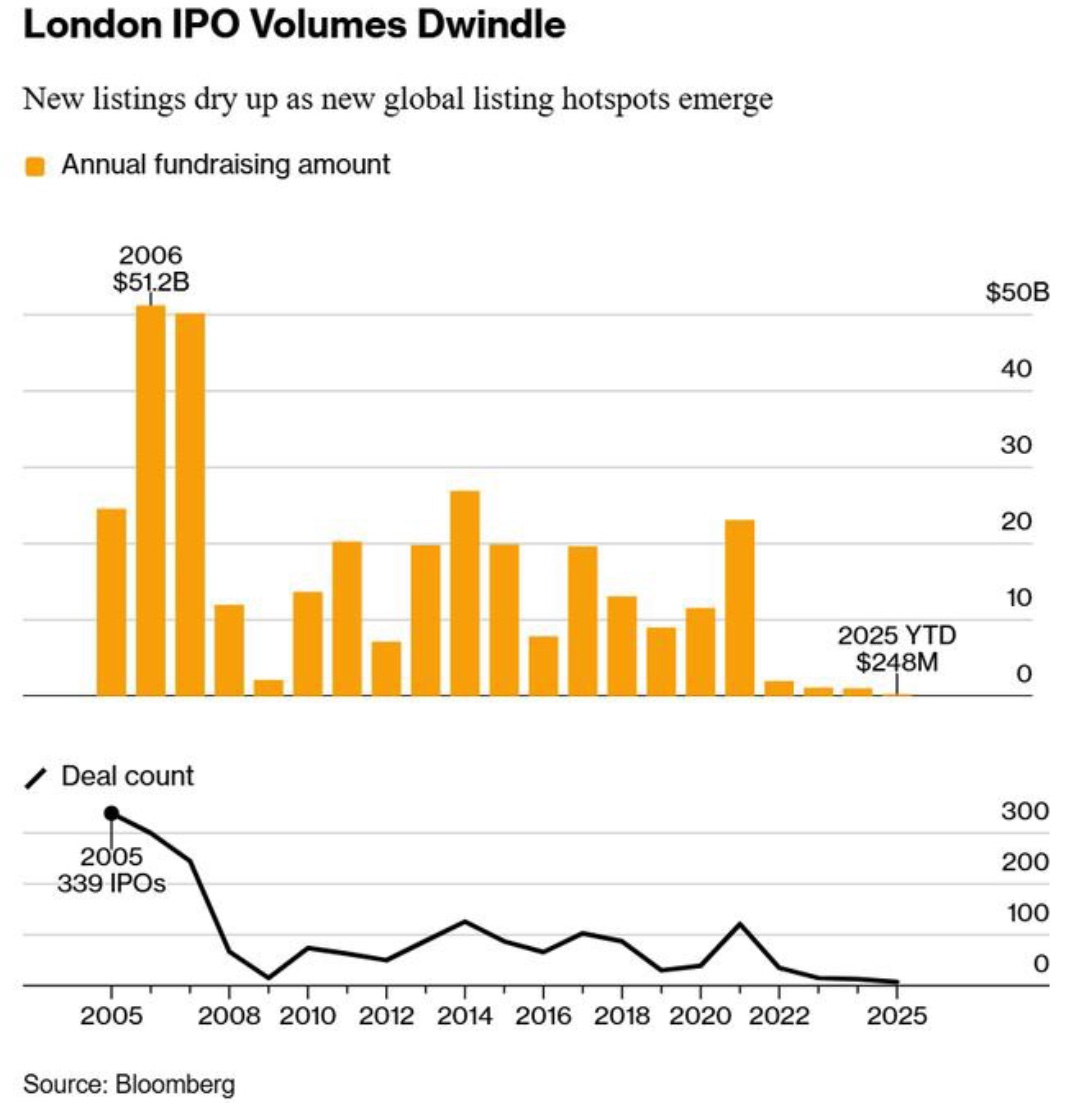
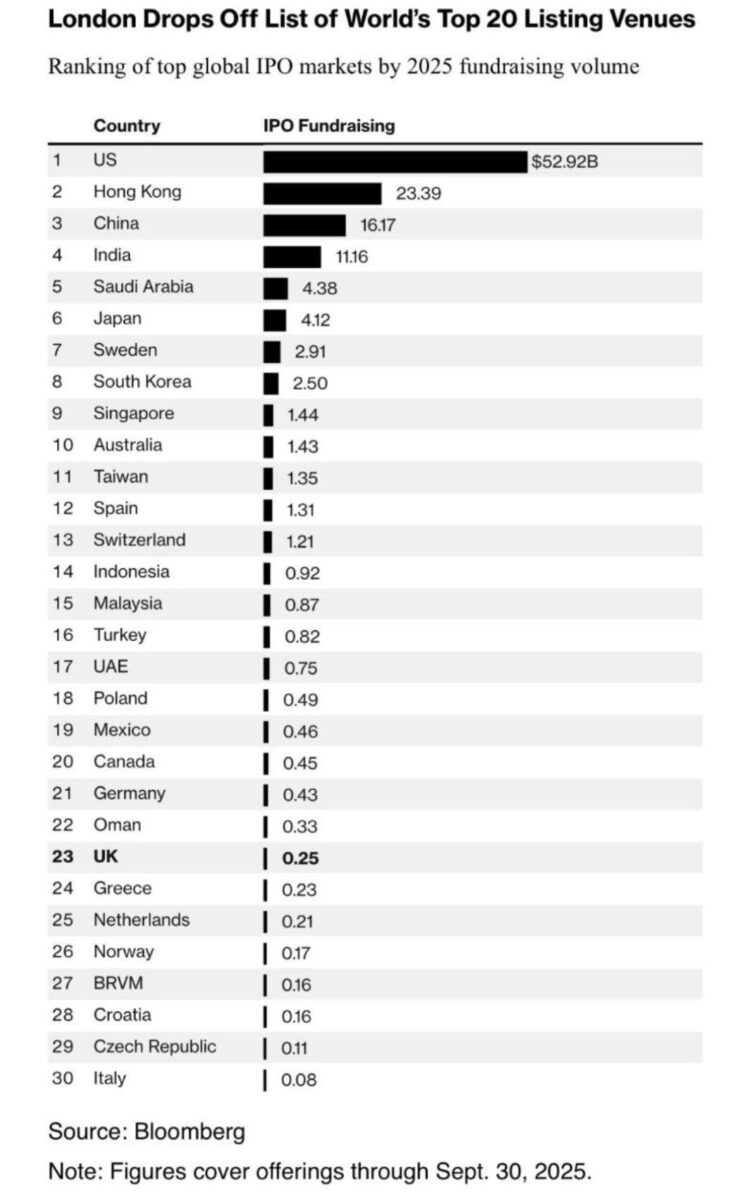
On one of my economist social media feeds, I saw these graphics recently which I thought I would share.
An IPO (Initial Public Offering) is where a private company decides to list on the public stock exchange so that it can raise capital and offer its share to investors. They normally choose to do this when they reach a certain size, as a way of accelerating company growth. In which jurisdiction they do this is important because it can generate a lot of revenue for the financial sector in that country, create jobs and also secures the attractiveness of the financial centre as a place that is deemed safe and secure to list publicly.
London used to be one of the preferred jurisdictions, but as you can see, in 2025, that is no longer the case. London now holds spot No 23 on the list behind some important newer entries, such as Hong Kong, China and India.
What this says about London’s long term future is anyone’s guess but it is interesting information all the same. (Could Brexit have played a part?) . It probably says more about the ever increasing importance of Asian economies and the continued importance of the USA.
AI Stocks Face a Wake-Up Call – What the Sell-Off Really Means
By Chris Burke
This article is published on: 10th November 2025

10.11.25
After months of relentless optimism, AI-linked stocks are taking a sharp hit. The same names that drove markets higher — NVIDIA, Palantir and other AI heavyweights — are now leading the decline.
Here’s what’s happening and what it tells us about the broader market.

The Story Behind the Sell-Off
Valuation Reality Check
Many AI companies are priced for perfection. Investors are questioning whether earnings can truly justify those sky-high expectations.
Even Palantir, which beat forecasts, dropped nearly 8% after results.
Profit-Taking After a Huge Run-Up
The AI trade has been red-hot all year. Some investors are locking in gains and rotating to safer ground — not necessarily abandoning the theme, but taking a breather.
Market Concentration Risk
Tech and AI stocks now make up roughly one-third of the S&P 500. When this sector sneezes, the entire market catches a cold.
Caution from Big Players
Analysts from Morgan Stanley and Goldman Sachs have warned that equities could face a 10–20% pullback — and short sellers like Michael Burry are reportedly betting against the AI trade.

Why It Matters
Short term:
Expect more volatility as valuations adjust and traders test the market’s conviction in AI.
Medium term:
This could be a healthy consolidation — trimming speculative excess without ending the structural AI growth story.
Long term:
The winners will be those turning AI promise into real profits — not just those riding the narrative.
The Takeaway
This isn’t an “AI crash.” It’s a re-rating of expectations.
The key question for investors and industry leaders now:
Are we investing in sustainable innovation — or chasing momentum?
What to Watch Next
- Earnings guidance from major AI players
- Capex trends in cloud and data infrastructure
- Market rotation signals into other sectors
- Interest rate updates and macro data
My view: This pullback is healthy. The market is reminding us that even transformational technologies need time, discipline, and fundamentals to catch up with the hype.
I’m here to help you get organised and take those financial worries away.
If you’d like to discuss any of these topics in more detail or arrange an initial consultation to explore your situation, you can do so here.
You can also read independent reviews of my advice and service here.
Financial update November 2025 | France
By Katriona Murray-Platon
This article is published on: 9th November 2025

09.11.25
Autumn has officially arrived in France. The clocks have gone back, the air is cooler, and whilst grey, rainy days have set in, we can still look forward to the occasional burst of sunshine. November may be one of the shorter months, but before preparations for the end-of-year festivities begin, there are several important matters to keep in mind
Although the taxe d’habitation has become a thing of the past for most French residents, it still applies to owners of second homes in France. Over four million households are liable for either the Taxe d’Habitation sur les Résidences Secondaires (THRS), the Taxe sur les Logements Vacants (TLV), or the Taxe d’Habitation sur les Logements Vacants(THLV).
The Taxe d’Habiation statements should now be available in your online account on impots.gouv.fr, where you will also find the payment details and deadlines.
On 25th October, the French deputies voted to amend the draft finance bill that was proposing to freeze the income tax rates, instead voting in favour of re-establishing indexation in line with inflation which increases current tax bands by 1.1%. Below is a table showing the 2025 thresholds compared with the proposed thresholds for 2026.
| 2025 income tax thresholds | Proposed tax thresholds (increased by 1.1%) for 2026 | Income tax rate |
| Under €11,497 | Under €11,623 | 0% |
| Between €11,498 and €29,315 | Between €11,624 and €29,637 | 11% |
| Between €29,316 and €83,823 | Between €29,638 and €84,745 | 30% |
| Between €83,824 and €180,294 | Between €83,746 and €182,277 | 41% |
| Over €180,295 | Over €182,278 | 45% |
Once the finance law is officially adopted at the end of the year, I will confirm these thresholds.
If you are subject to Wealth Tax on Property (IFI) and the amount due is €300 or less, this must be paid by 17th November by cheque, cash or bank card or by the 22nd November if you pay online. If the amount is more than €300, it must be paid online via the impots.gouv.fr website.
By now, you should have received your income tax statement and paid tax due. If you have discovered any errors or miscalculations, please correct them as soon as possible as after 3rd December 2025 you will no longer be able to submit an amended tax return on the impots.gouv.fr website; any corrections after this date must be submitted in paper form.
If you have a PEL account which was opened between 2011 and 2015, your bank will automatically close it and transfer the funds to another savings account. PELs opened since 1st March 2011 can be held for a maximum of 15 years, whereas the PELs opened before this date can remain open indefinitely. According to the Banque de France, the average balance of a PEL account is €25,017, with around 12% of such accounts exceeding the maximum capital limit of €61,200. These accounts are not term accounts and should only be used if you plan to purchase a property or carry out renovations to your property.
If you do seasonal lettings, you will have received an email from the tax office reminding you that the tax rules have changed in 2025. For “meubles de tourisme non classés” if your income in 2023 and 2024 was more than €15,000 you can no longer stay as micro-BIC. The income that you received will be under the “régime réel” and will require the assistance of an accountant. You should contact your tax office for more information.
Urssaf also sent an email to remind those who earned over €23,000 from their season lettings that they have to pay social security contributions on this income and not social charges like other landlords. Depending on your turnover, you can opt for the micro-social regime at either 21.2% (for meublés de tourisme non classés) or 6% (for meublés de tourisme classés). From 2027, website-based business as Airbnb and Arbitel will take the social contributions directly at source.
If you have any questions on the above or any other matters, please do get in touch. I am available for online meetings or face to face meetings throughout November, so if you have any questions about your finances, please do contact me to arrange a free, no obligation, meeting.