


Well, as you might have expected I have decided to write to you at this particularly fragile moment in world politics, and which has now reverberated around world investment markets. As of Friday last week a sell off started in the equity markets which effectively created a bear market situation around the world for fears of global recession based on the Trump tariffs. (as of today we have seena slight rebound, but more volatility is likely)
When markets turn volatile
By Gareth Horsfall
This article is published on: 10th April 2025

Markets speak in the US
So moving away from my random hypotheses, let’s dwell on markets and the horrible news that our portfolios have fallen in value once again but, before I do, if you have been an investor for years, I would ask you to reflect on just the last 5 years for a moment.
What did you think when a global pandemic hit? Businesses were shut, schools too, everyone was told to stay at home and not interact with each other without a mask on and to stay 6 metres away from others? The markets tanked as a result.
What was your reaction? Maybe we were too distracted by the pandemic to really pay much attention – and rightly so! but what about when Russian invaded Ukraine and it sent global markets into a panic and a global inflation spike, sending us from years of disinflation and near zero interest rates, to an overnight significant rise in prices which to date continues. Did you panic sell off your portfolio?
Probably the answer is no and you did the right thing because markets rebounded (albeit more slowly after the Russia Ukraine war) but they did and the same happened after 2008 Financial Crisis and 2010 Euro crisis: hanging on and riding through the panic was the best thing to do… and it is now!
You might argue ‘It’s different this time’ ; the whole world is changing and markets will never recover. If you think this then I would coach you to read the book, ‘It’s different this time -Eight Centuries of Financial Folly’ by Reinhart and Rogoff. Largely financial markets are governed by human behaviour and that has not changed since time began, or at least over the last 8 centuries according to the data they present.
Please also bear in mind that success for every US President is judged on the US stock market. Most, if not all Americans, have significant assets invested in the US stock market and so it is a sign of health of the US economy and more importantly a measure of the US Presidents success at home ( interestingly, Pres. Trump’s favourability ratings have increased from 48% at election time to 53% now. clearly, he is increasingly approved of in the USA).
After reading so much on this topic and trying to syphon through the almost hourly noise, my view is that he is front loading all the bad news now to get it out of the way. He knows that come the mid-terms in 2026 he needs to have made significant inroads into making good on his promises to the American people and for that reason he is getting the worst out of the way now, whilst he can, after which a flurry of good news will likely follow.

Trump’s strategy
So, moving away from the media hype and screaming economists for a moment, let’s take a look at what Pres. Trump is really trying to achieve.
Pres. Trump watches consumer confidence closer than anything and in order to keep it high he has to achieve 3 goals:
1. Get oil prices lower
Gas at the pump is the beating heart of the America middle class and the Trump administration will go to any lengths to reduce the price of oil at the pumps. (When I was in New York in February the gas at the pump, I calculated, cost €1 a litre!!!!!!! – compare that to the the €1.59 a litre, this morning, that I just paid for diesel. Petrol was €0.20 higher still). So, if this administration can reduce gas prices further that could stimulate a mini economic boom in the US.
Bear in mind that the US is already the worlds largest producer of oil at 40% higher than its nearest competitor ( Saudi Arabia). Pres. Trump has stated clearly that he wants to aim for 100% energy independence and I think they will not just aim for it but do it at any cost.
(It should be noted that I paid €1.59 a litre for diesel this morning. 1 week ago it was €1.67. – Is his strategy working?)
2. Mortgages are the second lever to pull
If he wants the American public to gain confidence in his policies then he needs to give them breathing room economically (i.e. more money in their pockets) and he can then continue to go about reshaping the US economy . (At time of writing, with pressure building on a possible recession, pressure is equally being heaved on Jerome Powell – head of the Federal Reserve, to reduce interest rates). Was the market correction manufactured to some degree, or at least expected, to pressure the Fed to reduce interest rates?
This administration has also openly stated that they will also look to deregulate the banking industry, to release them from overly administrative and bureaucratic procedures and to allow them to get back to banking. This will also assist in bringing interest rates down. (This point I can fully agree with :banking regulation, anti money laundering legislation, source of wealth and origin of wealth obligatory requirements have become, quite frankly , out of control and any simplification in this regard, in my opinion, is warranted).
3. Lastly – the Trump administration will focus on food price inflation
Remember to watch out for the first 100 days of the Pres. Trump term which is often linked to his early successes; the 100th day lands on April the 29th!
So, there you have it, a few thoughts of my own on the Trump administration and why it might not be as bad as it seems.
So, let me turn to the technical for a moment: some data about market volatility.
The data below courtesy of one of our investment management partners, New Horizon Investment Management.
When markets turn volatile, perspective is everything
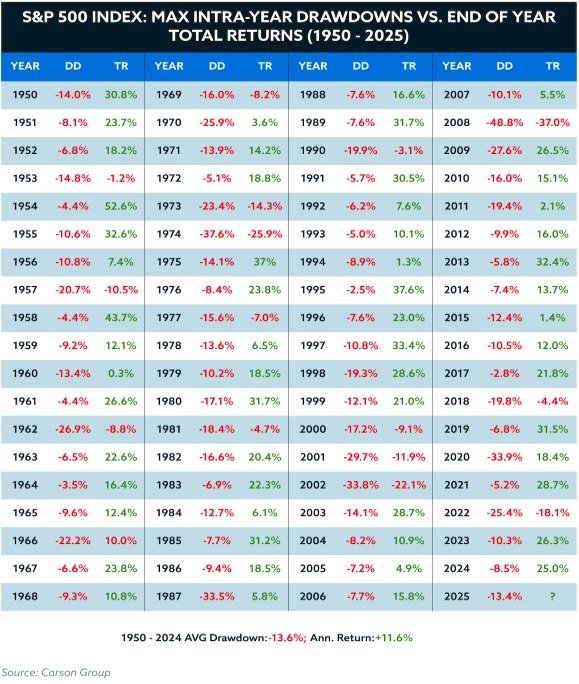
This market volatility feels tumultuous but, of course, we’ve been here before. The table below reveals that after severe drawdowns, the market has often recovered the full decline and finished the year strongly positive.
Years to Note:
- 1970: Market fell -26% from peak to trough… yet ended +3.6%
- 1975: Dropped -14.1%, but closed the year up +37%
- 1987 (Black Monday): Down -33.5% mid-year, still finished +5.8%
- 2009: Deep in the Global Financial Crisis, dropped -27.6%, yet ended +26.5%
- 2020: COVID crash brought a -33.9% drawdown… ended +18.4%
On each occasion, the best course of action would have been to avoid the noise and stay invested.
“History doesn’t repeat itself, but it often rhymes.” – Mark Twain
Whatever happens in the market we have bigger things to worry about!
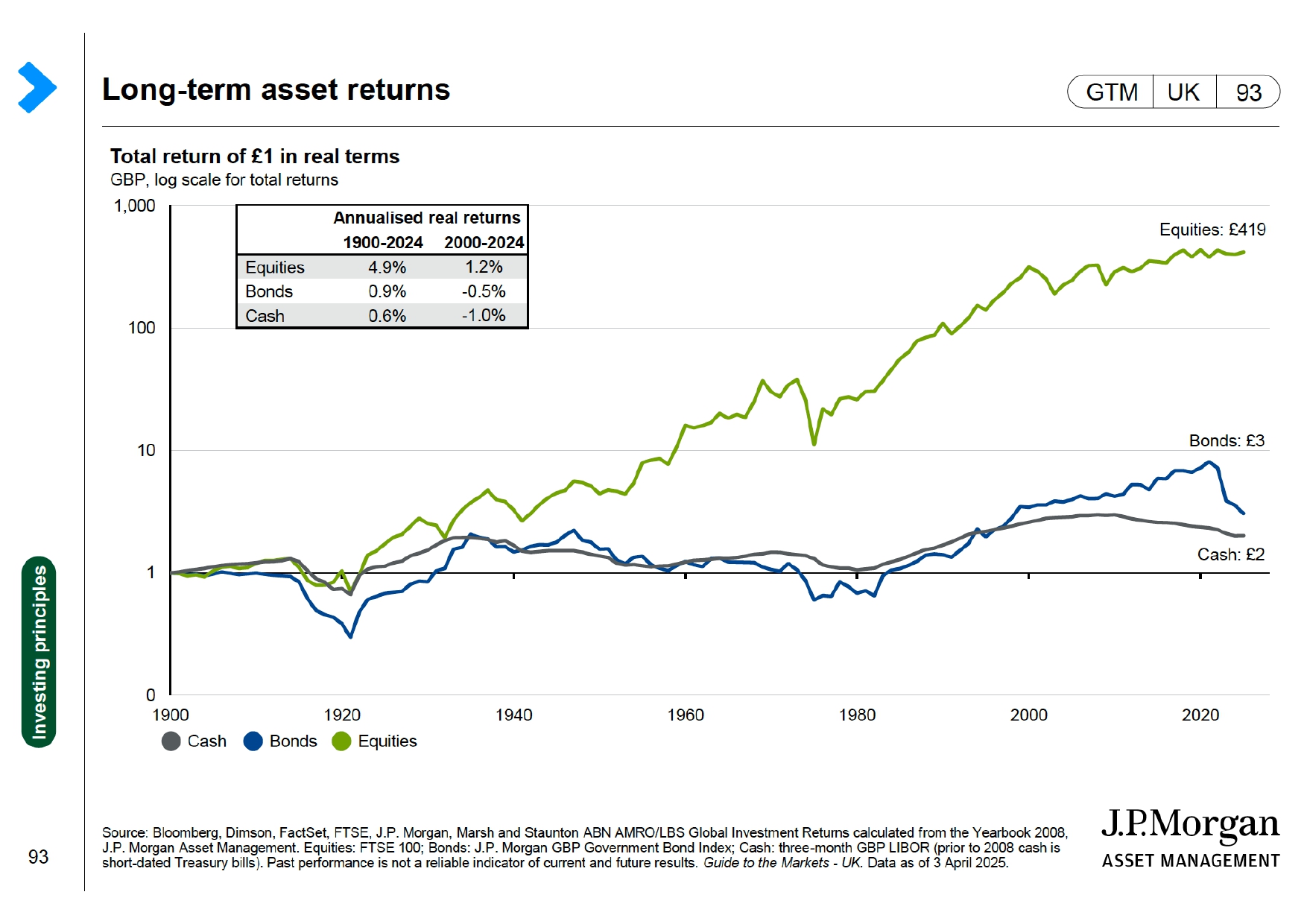
Besides, when markets sell off, why on earth would you not buy into them at these prices? They are at bargain basement prices and as the saying goes ‘fill your boots!’ I had a measly amount of cash available to invest and have taken advantage of these prices.
Let me tell you a couple of my own investment tales:
My first tale which I have written about before was during the financial crisis of 2008 ( which by the way was a many times worse than what we are going through today) and my wife had just sold a house in the UK and we had some cash to invest. I knew I had to invest but I was very nervous because, working at the coal face of what was happening at that time, I knew that things were very serious. However, I also knew the theory of markets and that the best time to buy was in the height of the chaos. I went for it and the next 3 months were tragic and I lost 20% in value on the portfolio. (I never told me wife!) 6 months later the portfolio was up 45% ! It should be noted that I am an adventurous investor profile and so was invested 100% in equity ; it was a wild ride I can tell you but I knew the logic and I just had to be patient. Later we needed that money for something else and had to sell a sizeable portion of it, but it did its job.
My other tale is that at the start of my career as a financial planner I thought I was smarter than the market itself and that I could time my way in. I waited and waited and…. waited for the right entry point, waiting for a decent correction to buy in at the price I deemed to be right. I arrogantly waited 6 years before buying in! (What an idiot!) I can’t even bring myself to calculate the gains that I missed in those 6 years even with the correction that happened.
Lesson: It’s time in the markets, not timing the markets, that counts…
As I said to someone recently “I have made all the mistakes in the books, so you don’t have to!”
Inflation
Finally, let’s talk about inflation. Here I take the words of Charles D Ellis who wrote the book ‘Winning the Losers Game – Timeless strategies for successful investing’.
“For individual investors, inflation has usually been the major problem – not the attention getting daily or cyclical changes in security prices that most investors fret about. The corrosive power of inflation is truly daunting. At 5% inflation the purchasing power of your money is cut in half in less than 15 years and cut in half again in the next 15. At 7% your purchasing power drops to 25 % of its present level in just 21 years- the elapsed time between early retirement at age 61 and age 82, an increasingly normal life expectancy“.
Again, it might be useful to provide some perspective here because the all so surreptitious march of inflation is often upon us when we notice it, by which time it is far too late to do anything about it.
1. The price of my journey to Rome on the autostrada from Orte has increased from €4.50 in 2024 to €4.80 in 2025. That’s a 6.6% increase. I track this price and it has never, in my 20 years in Italy, increased at inflation levels or under. Always above!
2. The water machine in central Amelia, where I go to fill our drinking water bottles was 5 cents for a litre and half, they have just changed the machine and it’s now 5 cents a litre. That’s a 33.3% increase. (It’s hardly breaking the bank but a great example)
3. The news on RAI announced a few nights ago that the price of Colomba Easter cake is up 31% year on year and Easter eggs up 26%.
4. I took my son to KFC 2 weeks ago, reluctantly, and asked for the 4 large pieces of chicken. The last time I went to KFC was about 15 years ago and I remember these 4 huge pieces of chicken. Now, the 4 pieces resembled the size of 4 larger nuggets. Shrink inflation in practice so if you can’t increase your prices, reduce the amount of product. It has the same effect !
OK, I hear you say ‘These are not everyday items’ but they do reflect the general trend of the stealthy march of inflation.
Be under no illusion that this is your main financial enemy and investing is your only tool to protect yourself from it!
Investing requires patience and courage…or a financial adviser who you can ring and let off some steam. Make sure you can tap into any of these things if you get concerned about world events and market volatility!
So, on this happy point let me leave you with this information about the life ahead of you.
Life Expectancy
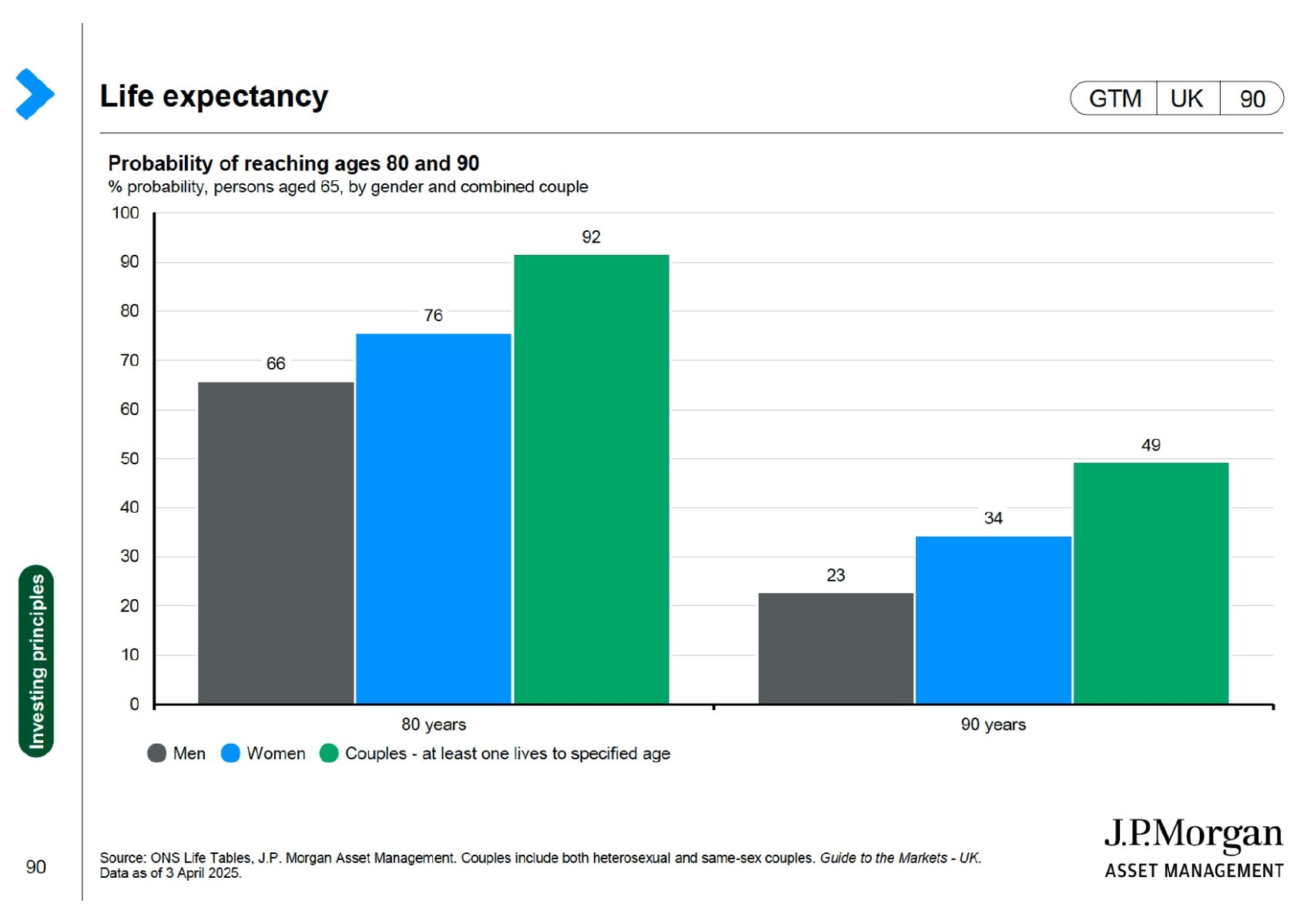
More people needing to finance live beyond 90th birthday
- Ratio of women over age 90 to men was about 2:1 in 2023
- The number of people aged 90+ has doubled over the last 30 years
- The ratio of women over age 90 to men was 2:1 in 2023 compared to 4:1 in the 1980’s. About one in every 100 people is now aged at least 90.
- The odds of living to beyond 90 are high enough that people shouldn’t assume it can’t happen to them. Historically, this has been mainly women but the numbers of men are catching up fast.
- For those who are age 66 this year there is about a one in 3 chance (33%) for men and nearly an evens chance (46%) for women of making it to at least age 90 and if they do get to age 90 there is nearly an even chance they will survive to beyond 9%
The message: Think long term and not Donald Trump term!
If you would like to let off some steam with me or discuss any of what is going on in the world, tax or financial planning related issues in Italy then please don’t hesitate to contact me on: gareth.horsfall@spectrum-ifa.com or call / message on +39 3336492356
Always happy to help where I can!