


As safe as money in the bank
By Spectrum IFA
This article is published on: 24th July 2014
More than a fifth of UK citizens think that the best long-term investment is putting their money in the bank. This is the rather discouraging result of a July survey by Bankrate.
One of its questions was, “For money you wouldn’t need for more than 5 years, which one of the following do you think would be the best way to invest your money?”
- 26% – cash
- 23% – real estate
- 16% – precious metals
- 14% – stock market
- 8% – bonds
That thumping sound you hear is me banging my head on my desk!!
I assume those who opted for cash did so because keeping money in the bank seemed to be the safest choice.
However, for long-term investing, that safety is an illusion. The best and safest place to put your nest egg for the future is not in the bank, but in a well-diversified portfolio with a variety of asset classes. And here’s why:
Savings accounts and CDs are safe places to store relatively small amounts of cash that you expect to need within the next few months. The funds are protected by insurance. You know exactly where your money is, and you can get your hands on it anytime you want.
This short-term safety does not make the bank a good place for the money you will need for retirement or for other needs five years or so into the future. It may seem like safe investing because the amount in your account never goes down. You’re always earning interest. Yet, over time, that interest isn’t enough to keep pace with inflation.
The purchasing power of your money decreases, which means you’re actually losing money. It just doesn’t feel like a loss because you don’t see the loss in its value.
In contrast, the stock market fluctuates. The media constantly reports that it is “up” or “down” as if those day-to-day numbers actually matter. This fosters a perception that investing in the stock market is risky.
Combine that with the scarcity of education about finances and economics, and it’s no wonder that so many people are actually afraid of the stock market and view investing almost as a form of gambling.
Wise long-term investing in the stock market is anything but gambling. Instead of trying to buy and sell a few stocks as their prices go up and down, wise investors neutralize the impact of market fluctuations by owning a vast assortment of assets.
This is accomplished with a two-part strategy.
The first is to invest in mutual funds rather than individual stocks.
The second component is asset class diversification. The mutual funds you invest in will comprise all of the asset classes in proportions or percentages falling in line with your appetite for risk (conservative, moderately conservative, moderate/balanced, fairly aggressive, high risk). Ideally, a diversified portfolio should include at least four asset classes.
By holding small amounts of a great many different companies and asset classes, you spread your risk so broadly that the inevitable fluctuations are small ripples rather than steep gains or losses. As some types of investments decline in value, other types will be gaining value. Over the long term, the entire portfolio grows.
In the long term, investing in this way is usually safer than money in the bank.
Perhaps you are holding too much capital in bank accounts and are beginning to realize you will see no “real growth” thereon. Why not give me a call to arrange a mutually convenient time for us to get together to investigate better ways of having your money grow for you? It does no harm in checking and, who knows, you may come away pleasantly surprised.
“With money in your pocket, you are wise, and you are handsome, and you sing well too.”
Jewish Proverb
The REAL effect of inflation
By Chris Webb
This article is published on: 23rd July 2014

On a day-to-day basis, inflation isn’t necessarily something you spend a lot of time thinking about. However, occasionally, you might find yourself asking – what exactly is inflation? And how does it affect me?.
Inflation is simply a sustained increase in the overall price for goods and services which is measured as an annual percentage increase.
As inflation rises, every pound or euro you own purchases a smaller percentage of these goods or services.
The real value of a pound or euro does not stay constant when there is inflation. When inflation goes up, there is a decline in the purchasing power of your money. For example, if the inflation rate is 2% annually, then theoretically a £100 item will cost £102 in a year’s time and £121.90 in 10 years time.
After inflation, your money can’t buy the same goods it could beforehand.
When inflation is at low levels it is easy to overlook the adverse effect it has on your capital and the income it produces. Regardless of how things look today, the likelihood is that the price of all the goods we buy and services we use will be higher in the future.
Inflation does not reduce the monetary value of your capital, a pound is still a pound and a euro is still a euro, but it reduces the “real” value. It erodes the spending power of your money, potentially affecting your standard of living.
The chart below details the effect of inflation over a 15 year period, 1998 to 2013. It is easy to see that leaving money exposed to inflation risk and not attempting to beat it and achieve higher growth is a no win situation.
Many clients will say that investing is a risk (see my alternative article to risk), and of course there is always an element of risk but leaving your money in a low rate bank account, open to inflation risk, is surely the riskiest option…….you can’t win !!!

If you had left your money open to the effects of inflation between 1998 and 2013 then it would have lost 35% of its purchasing power.
As statistics prove we are living longer now which means that we can look forward to a longer retirement period therefore the impact that inflation will have on your finances needs to become a prime consideration.
Buying property in the UK
By Peter Brooke
This article is published on: 21st July 2014

Many crew like the idea of investing in UK residential real estate, not just Brits. The strong legal system, common language, lending availability (although this has changed somewhat) and large population, make property ownership in the UK an attractive option for growth and income investors alike.
The obvious risks are currency, liquidity and “arms-length management.” If you don’t earn in sterling, then owning a large sterling asset can mean large swings in value due to exchange rate changes. Annual liabilities can change dramatically too, so consider this.
Like property everywhere, it’s a highly illiquid investment. If you want to sell quickly, you may lose a lot of value, and it may still take months to get your money out. Although it’s an excellent part of a portfolio, property needs to be just that and not the entire dossier.
Managing a property (or portfolio of them) in the UK when you are based on a yacht in the Med or Caribbean can be very difficult unless you employ a good agent to manage any works or changes in tenants. This cost needs to be built into the figures as to whether or not to buy.
Having said that, if the rental yield is good (and therefore someone else is going to pay off your mortgage or give you a good income), then UK property can be an excellent choice, especially if you know the market. Big student towns still seem to offer excellent yield opportunities, but management costs tend to be high. The UK market is steady in terms of growth potential, but the Southeast and London are described as a “bubble” risk.
Buying property in the UK:
Be aware of the different types of ownership (freehold and leasehold) when researching property; they can have far-reaching consequences and costs. There will be Stamp Duty Land Tax (SDLT) to pay on the purchase, which is on a sliding scale from zero to seven percent for properties more than £2 million. Be aware of the brackets, as a slightly lower offer could save you thousands in stamp duty. On top of this, you will pay some legal fees for conveyance advice and services.
Borrowing in the UK:
It’s still possible for yacht crew to borrow, but it’s getting a little harder as banks tighten their rules, and the UK government may further legislation to tighten this more. Banks prefer that the property be rented out, as the income can help secure the loan. Interest rates for non-residents, especially yacht crew, also tend to be higher than those for residents. Generally, crew can borrow around 75 percent of the purchase price, and will have to fund the SDLT and legal fees as well. Any rental profit is taxable in the UK, whether you are resident or not, as is capital gains tax and inheritance tax.
There are many considerations when buying property, so good, qualified advice should be sought, especially if it’s part of an overall plan; a mortgage broker should also be able to find the best terms for you.
An Inflationary Tale
By Spectrum IFA
This article is published on: 20th July 2014
An Inflationary Tale
Inflation is a complicated concept. It’s not easy to understand but if ignored, your money will slowly and stealthily reduce. As a teenager growing up in the 70’s I would hear the newscasters talk about inflation and price controls yet could never tell if it was a good or bad thing. Interest rates were going up as were house prices and income. This had to be a good thing I thought but little did I know!. What I learned later in life as I studied inflation is that, like most things, inflation is a double-edged sword. There are winners and there are losers. It is good for some and bad for others. As you read this tale focus on the two main concepts about inflation. Learn what it is and what it means to an investment portfolio.
What Does The Word Inflation Actually Mean?
Type the word “inflation” into a search engine on your computer and you will probably get information informing you that inflation is “A rise in the general level of prices of goods and services in an economy over a period of time. When the general price level rises, each unit of currency buys fewer goods and services. Consequently, inflation reflects an erosion of the buying power of your money – a loss of real value. A chief measure of price inflation is the inflation rate, the annualized percentage change in a general price index (normally the Consumer Price Index) over time.” If you are like me and read the above definition you are thinking blah, blah, blah, blah, blah. So since the objective of this Newsletter is to keep things simple, let’s just translate this to what it means to you as an investor.
I like to think of inflation in terms of what $100 can buy in the future if I don’t invest it today. Let’s say, for example, if I make 0% rate of return on my $100 bill because I either put it under my mattress or buried it in the ground or kept it in a safety deposit box and then a few years later I want to know what it can buy. This is what inflation means to the investor or consumer. What that $100 can buy is called purchasing power and purchasing power is directly proportional to the rate of inflation. The following table shows what $100 un-invested can buy at different inflation rates over different time periods. I call it my “Mattress Investing table” because it teaches us that you can’t put money under your mattress unless you want to guarantee that you will slowly erode the value of your money.
Mattress Investing
(The Loss of Purchasing Power Associated with Not Investing $100.00)
| Inflation Rate | 5 years | 10 years | 15 years | 20 years | 25 years | 30 years |
| 0% | $100 | $100 | $100 | $100 | $100 | $100 |
| 1% | $95.10 | $90.44 | $86.01 | $81.79 | $77.78 | $73.97 |
| 2% | $90.39 | $81.71 | $73.86 | $66.76 | $60.35 | $54.55 |
| 3% | $85.87 | $73.74 | $63.33 | $54.38 | $46.70 | $40.10 |
| 4% | $81.54 | $66.48 | $54.21 | $44.20 | $36.04 | $29.39 |
| 5% | $77.38 | $59.87 | $46.33 | $35.85 | $27.74 | $21.46 |
| 6% | $73.39 | $53.86 | $39.53 | $29.01 | $21.29 | $15.63 |
| 7% | $69.57 | $48.40 | $33.67 | $23.42 | $16.30 | $11.34 |
| 8% | $65.91 | $43.44 | $28.63 | $18.87 | $12.44 | $8.20 |
| 9% | $62.40 | $38.94 | $24.30 | $15.16 | $9.46 | $5.91 |
| 10% | $59.05 | $34.87 | $20.59 | $12.16 | $7.18 | $4.24 |
How should an investor read this table?
Investors should understand that if they keep money in a mattress for 15 years and the inflation rate over 15 years is 5% per year their $100 can only buy $46.33 worth of “Stuff” 15 years later. If inflation were to average 7% for 30 years their $100 could only buy $11.34 worth of “Stuff.” I know it’s silly to think that anyone would keep their money in a mattress but the reason I use the table above is because it illustrates the important concept about inflation which is loss of purchasing power. Inflation in and of itself is meaningless. What matters to people is what inflation causes which is the loss of purchasing power. As an example, when I get in my car to drive I have a rudimentary notion of how the engine functions. People that know me know I’m not mechanically inclined. I do however know how the steering wheel works. To an investor, inflation is the engine while purchasing power is the steering wheel. You can be completely oblivious to how an engine works and still be an excellent driver. So, if you are so inclined you can spend a disproportionate amount of time studying how the engine works or the nuances of inflation or you can learn how to drive and invest your money to combat the loss of purchasing power. How to invest your money to combat inflation is discussed in A Preservation Tale. I’ll give you a little hint—I am not a Gold Bug but if you put a $100 gold coin under your mattress instead of a $100 bill you have a much better chance of preserving purchasing power during inflationary times.
So once again, how should an investor read the Mattress Investing table?
Let’s focus on the 3% inflation rate since that has been a good approximation for so many decades. What this table shows is that if the inflation rate is 3% and you keep your $100 under your mattress, in 5 years it will only buy $85.87 worth of “Stuff.” I like to use the technical term “Stuff” to describe purchasing power!. To investors, the intended use of a $100 bill is to be able to buy “Stuff.” In and of itself the $100 bill is worthless. Its only value is the amount of “Stuff” it can buy. In this case it can only buy $85.87 worth of “Stuff” so the Mattress Investor has lost $14.13 of “Stuff” by keeping it in his mattress or not investing it. When you hear the term Loss of Purchasing Power it means “Stuff” you can’t buy!.
This leads directly to what I consider the minimum objective for investors and one of my maxims.
The purpose of investing should be to at a minimum maintain your purchasing power. I believe you should invest so that you don’t lose your “Stuff.”
Learn
So what can we learn from this tale that puts money in our pocket? Who wins and who loses from inflation? By now it should be clear that at any inflation rate greater than 0% you must make more than 0% on your money in order to maintain purchasing power. Yet when guaranteed interest rates are not accommodative, like they are today and have often been in the past, the investor must invest in non-guaranteed investments to maintain purchasing power. For investors that have read tales such as this one this presents a quandary. They can intelligently ask themselves, if I want a guarantee and guaranteed rates are so low that I can’t preserve purchasing power then I must accept a loss of purchasing power. However, if I want an opportunity to maintain purchasing power I must assume risk. This is the never-ending portfolio management question that is forever on every investor’s mind and will be at every stage of their life. While most investors answer this question by forgoing guaranteed returns in order to not just maintain purchasing power but to potentially increase purchasing power, others do not. There are investors that choose to avoid risk at all cost and are knowingly watching their purchasing power slowly erode.
Unfortunately, the sad circumstance for most risk-averse investors is that they behave as they do out of ignorance or fear and not based on knowledge. Many are willing to invest their money in bank CDs, money market funds and government bonds at below required levels just to keep it guaranteed. The only guarantee they’re getting during most periods is the guarantee of a loss in purchasing power. When and if there is increased inflation these are the people that will also suffer the most.
Warren Buffet
Lastly, I have included a paragraph from a 1977 article written by Warren Buffett for Fortune Magazine on inflation. Inflation was a big deal back then though we tend to dismiss it today since it’s been so low for so long. But I thought the paragraph would be appropriate since it is easy-to-understand writing and he has a unique way of thinking about inflation as a tax. If you think of it the same way you will quickly understand that inflation is a consumer of your capital. We as a society take to the streets if there is so much as a hint of our elected officials raising our taxes. Yet we have no problem when we willingly or out of ignorance tax ourselves by investing in below inflation rate guaranteed investments. The following is taken straight from the article.
“What widows don’t notice”
By Warren Buffet
The arithmetic makes it plain that inflation is a far more devastating tax than anything that has been enacted by our legislatures. The inflation tax has a fantastic ability to simply consume capital. It makes no difference to a widow with her savings in a 5 percent passbook account whether she pays 100 percent income tax on her interest income during a period of zero inflation, or pays no income taxes during years of 5 percent inflation. Either way, she is “taxed” in a manner that leaves her no real income whatsoever. Any money she spends comes right out of capital. She would find outrageous a 120 percent income tax, but doesn’t seem to notice that 6 percent inflation is the economic equivalent.
If you are concerned that your money is not achieving returns equal to or higher than the inflation rate or wish to review your portfolio so as to make sure it is geared to do so, then please do not hesitate to give me a call.
How to Invest – Basic Investing Strategies
By Spectrum IFA
This article is published on: 19th July 2014
Have you applied these when making an investment?
Recently, while talking to an expat who has been living in Barga in Tuscany for many years, he confided in me that he thought he could invest without advice from other professional quarters. However, after seeing some of his investments post no real returns (ie the net return after inflation is factored in), he was in a quandary as he felt he would “lose face” by speaking to a qualified independent financial adviser. And he also added that he had friends living close by who had shared the same experience.
Learning how to invest your money is one of the most important lessons in life. You don’t need to be college educated to start investing. In fact, you don’t even need to be a high school graduate. You just need to have a basic understanding of business and have the confidence to make a plan — consider it a business plan for your life. You can do it.
Why investing can be scary
For many of us, money and investments weren’t discussed at home. These subjects may even be taboo within certain households — quite possibly, in households that don’t have much money or investments.
If your parents or loved-ones were not financially independent, they probably did not give you good financial advice (despite their best intentions). And even if your family is/was well-off, there’s no guarantee that their financial advice makes or made sense to you. Plenty of parents encouraged their kids to buy a house during the peak of the housing bubble, because in their lifetimes, housing prices only ever went up.
The goal of investing
Of course, everyone has different financial goals — and the more you learn, the more confident you’ll be in determining your own path. But here’s a basic financial goal to strive toward:
Over decades of hard work, most people who are about to retire or those who have already retired, would like to make more money than they spend and then invest the difference. By the time they retire, they would like their investments to throw off enough cash — through dividends or interest – so that they can live on this income without having to sell any investments.
Notice the first part of this goal is about hard work. If you’re hoping to take a little bit of money and gamble it into a fortune in the stock market, you can stop reading now, this article isn’t written for you. But if you have worked for a few decades, and want to make sure that you don’t have to work until life’s end, you’ll need to spend less than you make and invest the difference.
Also, you’ll notice that this goal doesn’t recommend selling your investments. Rich people don’t sell-off their assets for spending money — if they did they wouldn’t be rich for long. They stay rich because their assets provide enough cash flow to support their lifestyle. And these cash-producing assets, through careful estate planning, can be passed down from generation to generation.
Enjoying your twilight years by living off your investment income and having something left over for your loved ones or for a charitable organization is something that all investors should aspire to. It may not be possible for everyone, but it’s the right attitude.
What to invest in?
Before you even start to look at this area, it is absolutely imperative that a “proper” financial risk analysis of yourself is carried out. And this does not take the form of much-used generalised risk questionnaires (that would be like you or your wife doing a compatibility quiz in a woman’s magazine!!) No, the emphasis is on the words “proper risk analysis”
Once this has been done you move on to the most important factor in investment planning.
Diversification (or, Spreading the Risk)
Many, many investors are under the impression that if they have, say, a term deposit at bank/institution A, another at B, and a third at C, they are diversifying. They could not be more wrong.
When investing one looks at doing so across what is commonly referred to as Asset Classes. These comprise Cash (very Conservative Risk ie term deposit), Bonds (Moderate Risk), Equities (high risk) and Commercial Property (Moderately Aggressive Risk). Then, taking one’s appetite for risk (from the Risk Profiler), one invests across the Asset Classes accordingly.
The most common investments are mutual funds (unit trusts), insurance investments, bonds and the stock market. This article is not aimed at those with the time, experience, acumen and who can afford losses by direct share purchases.
Unit trusts/Mutual funds can own shares or bonds and with some commercial property exposure on your behalf.
Know the difference between saving and investing
Your investments and your savings are very different things. What if the stock market crashes? If you do not have a cash savings account to cover for emergencies (usually about six months’ income), you would probably have to sell your investments at the worst possible time. Don’t fall into this trap.
Being a successful investor requires money, patience and, just as importantly, confidence. Having confidence to make and stand-by your financial decisions requires education. Never stop learning.
When last did you do a “proper risk” analyser?
What applied five years ago is not going to necessarily be the same today. We are getting older and as the years go by, more often than not we tend to become more conservative. Hence the need to do a refresher where risk is concerned and then use this to analyse your investments in order to ensure the two correspond accordingly. If not, you actually run the danger of investing by default/error which could have a material impact on your life in the not-too-distant future.
If you realise from the above the importance of risk classification and correct diversification, just as you visit your doctor (or should) for an annual check-up, why not give me a call in order to facilitate a meeting where we can ascertain things. As the saying goes “you owe it to yourself!!
‘Risk’ (with an Italian flavour)
“If no one ever took risks, Michelangelo would have painted the Sistine floor”
Neil Simon, Playwright
Risk Tolerance
By Chris Webb
This article is published on: 18th July 2014
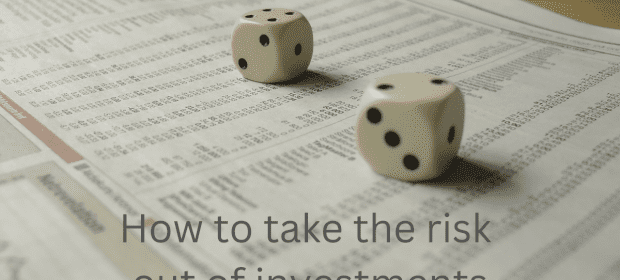
Each and every one of us has our own risk tolerance which should not be ignored when considering making any type of investment. Any good financial planner knows this and they should make the effort to help you determine what your risk tolerance is.
Then, based on this information, they should help you to build a portfolio that is aligned to your level of risk.
Determining one’s risk tolerance is based on several different criteria and there are different ways to look at how you should assess the risk you need to take. Firstly, you need to know how much money you have to invest, what your investment and financial goals are and what time horizon is involved. Then you need to consider the actual risk you are prepared to take.
Due to the emotional aspect of investing, there are various ways to look at it.
Let’s say you plan to retire in ten years and you’ve not saved a single penny/cent towards it. You could view this in two ways:
- You need a higher risk tolerance because you will need to do some aggressive investing in order to reach your financial goal.
- You may consider that as retirement is looming, you do not want to take unnecessary risks. If the markets were to crash it would affect your situation, therefore a more balanced portfolio (lower risk tolerance) would be better suited.
On the other side of the coin, if you are in your early twenties and want to start investing for your retirement now, you could share the same views.
- You should have a higher risk tolerance because you are young enough to ride out any market turmoil, maybe restructuring to a more cautious profile nearer the end goal.
- You should take a lower risk level and be happy with lower gains (potentially) but the end result will achieve what you require. You can afford to watch your money grow slowly over time.
There are more factors to consider in determining your tolerance.
For instance, if you invested in the stock market and you watched the movement of that stock daily and saw that it was dropping slightly, what would you do?
Would you sell out or would you let your money ride? If you have a low tolerance for risk, you would want to sell out… if you have a high tolerance, you would let your money ride and see what happens.
This is not based on what your financial goals are. This tolerance is based on how you feel about your money!
Again, a good Financial Planner should help you determine the level of risk that you are comfortable with and help you choose your investments accordingly.
Your risk tolerance should be based on what your financial goals are and how you feel about the possibility of losing your money. It’s all tied in together, it’s emotional.
Prior to working with any clients I insist on completing a detailed risk tolerance questionnaire. This will tell me exactly what your attitude to risk is and a suitable portfolio can be devised to suit you individually.
If you are interested in investing or saving for the future then get in touch to discuss the opportunities available and, just as importantly, the risks associated.
If you already have an investment portfolio and feel that it was never rated against your own risk tolerance then let me know. I am happy to discuss further and go through the questionnaire to ensure that what you have already done is suited to your circumstances.
This article is for information only and should not be considered as advice.
This article is written by Chris Webb The Spectrum IFA Group
More on risk and investing in different assets
How are you at managing your Finances ?
By Chris Webb
This article is published on: 17th July 2014

As the old saying “Practice Makes Perfect” seems to suggest, we are bound to improve at everything over time. However, there is something about “money” that just appears to get the better of us. Nowadays, we only need to look at the level of debt defaults to see that this is an area where most of us just don’t seem to be making much progress or improvement.
Here are just a few reasons why people, in general, do not successfully manage their finances:
- They have never been able to predict what the market will do next. However, this doesn’t deter them from trying to predict the markets!.
- They’re thrilled that the credit card they’re paying 22% interest on offers 1% cash back!
- They think dollar-cost averaging is boring without realizing that the purpose of investing isn’t to minimize boredom.
- They try to keep up with friends and family without realizing that friends and family are actually in debt.
- They think €1 million is a glamorously large amount of money when, actually, it’s what most people will need as a minimum in retirement!.
- They associate all of their financial successes with skill and all of their financial failures with bad luck.
- Their perception of financial history extends back about five years. This leads them to believe that bonds, for example, are safe and that the average recession is as bad as the recession of 2008.
- They don’t realise that the single most important skill in Finance is control over your emotions.
- They say they’ll take risks when others are fearful but then they seek the foetal position when the market falls by 2%.
- They think they’re too young to start saving for retirement when realistically every day that passes makes compound interest a little less effective.
- Even if their investment is over a period of 20 years, they get stressed when the market has a bad day.
- They size up the potential of investments based on past returns.
- They use a doctor to manage their health, an accountant to manage their taxes, a plumber to fix their plumbing. Then, with no experience in the financial market, they go about their own investments all by themselves.
- They don’t realize that the financial “expert” giving advice on TV doesn’t know their personal circumstances, goals or risk tolerance.
- They think the stock market is too risky because it’s volatile, without realizing that the biggest risk they face isn’t volatility. The biggest risk is not growing their assets sufficiently over the next several decades.
- When planning for retirement, they don’t realize that their life expectancy might be 90 years or more.
- They work so hard trying to make money that they don’t have time to think about or plan their finances, especially for those days when work will no longer take up all their time.
You may read this, identify a few points that relate to your own position and now find yourself asking “What can I do about it though?”
Without doubt the answer to that question is to seek professional advice so speak to a qualified and regulated Financial Planner. They will be able to analyse your position from both an investment and an emotional perspective, ensuring that your plan of action is tailored to you as an individual.
You should expect a detailed consultation process and only after this process has been completed can the correct advice be presented, ensuring you avoid the pitfalls detailed above.
The steps to the consultation process are as follows:
- A full and thorough financial health check on your current and future situation including the completion of a Financial Review questionnaire.
- Identifying areas of strengths and weaknesses in your financial planning and understanding your specific goals.
- Designing a strategy to help ensure your financial aspirations are met. Also reviewing any existing portfolio’s to ensure they are working effectively and efficiently.
- Once your strategy has been finalised, a full financial report based on your Financial Review will be provided to you along with a concise recommendation.
- Ongoing consultations consisting of regular monitoring of your selected strategy and face to face meetings to ensure that your financial goals are achieved.
To explore all of your options and to discuss how this consultation process can benefit you please contact your local Spectrum IFA Group consultant.
An insight into the good things happening with Spanish Tax
By Barry Davys
This article is published on: 16th July 2014

We are pleased to report that there are a number of proposed schemes to reduce the amount of tax paid in Spain. The proposed reductions in tax apply to personal income, corporation and savings (capital gains) taxes. This will reduce the burden of taxes and some schemes, such as the “Beckham” scheme for retired people, if it passes from a proposal into law, will be particularly beneficial.
Yet it is curious that these proposed changes are getting so much press. In some cases, the proposal is simply to reduce tax back to where it was before the crisis. In addition, there are already other schemes which have already passed into law which are very useful for people living in Spain. For example, if you live in Spain but work outside Spain there is an exemption from income tax for the income from that work. The maximum allowance is 60,100€ per annum. Mark Twain’s famous quote “reports of my death was an exaggeration” could also be applied to the “Beckham” scheme. There is still a version of this scheme which can be extremely beneficial for people who wish to sell property outside of Spain.
Then there is the taxation of pensions and investments. In the best case, and I emphasis this is the best case, the taxation on pension income and investment income can be as low as 3.25%. A recent report in the press was highlighting a proposed detrimental change in taxation to dividend income without also mentioning this other rate of investment tax.
During the next 6 months there will be up to 17 changes in tax in Spain. Most of the changes will be beneficial. We work with a number of tax lawyers and specialists and we give clients access to these experts for a reason. Spanish Tax need not be painful, but you do need someone on your side who knows their way around the system.
We recommend a strategy for making the most of the changes by taking the following action:
- Have a review of your Spanish Tax situation to ensure you are compliant.
- See if there are any back taxes you can claim for the last four years
- Use the most appropriate of the new rules when they are passed into law (you can only do this if your affairs are in order).
Are you thinking about starting a pension in France?
By Amanda Johnson
This article is published on: 15th July 2014
I have been working in France for several years and feel I should now be looking at long terms plans & pensions, but don’t know where to start. Can you help me?
There are many people who, like myself, have come to France to work. Once your business is established it is sensible to start to think about your longer terms financial goals:
- At what age would I lie to retire or reduce the number of hours I am working?
- What UK pension can I expect to receive bearing in mind I am no longer paying National Insurance contributions?
- What can I do with any private UK pension pots I have from my time working in the UK?
- How much income do I think I will need once I retire in France?
- What can I do to maximise my income & minimise my tax when I retire?
A free financial consultation will allow us to cover all of the above questions and look at options based on your personal circumstances, which will allow you to best plan ahead. Several small decisions now, can make a great difference to your future quality of life.
There are no consulting fees for providing you with advice or ongoing service. Our Client Charter outlines how we work and what you can expect from us. Please do not hesitate to ask for a copy of this.
Whether you want to register for our newsletter, attend one of our road shows or speak to me directly, please call or email me on the contacts below & I will be glad to help you. We do not charge for reviews, reports or recommendations we provide.
Discussing investment risk
By Spectrum IFA
This article is published on: 11th July 2014

When talking to clients, Financial Advisers are required to consider investment risk. There are many risk profiling tools available for advisers to help understand a client’s attitude to risk but what happens next?
When I joined the industry, understanding risk was much easier than today.
Cash in the bank was considered low risk or even no risk at all. Government Bonds were considered slightly higher up the risk scale and Equities (shares) were higher risk again. Property was not considered risky and gave its name to an English expression, “Safe as Houses”.
In 2008 everything changed. Banks failed, Governments were under financial stress, Stock Markets fell. Do these events mean advisers should tell clients everything is high risk?
Banks are being recapitalised and in the European Union, Governments guarantee the first €100,000 of a bank deposit.
Two caveats to this, the type of account;
- not all accounts carry the guarantee and
- the guarantee is by banking group, not individual bank. If a depositor has money in 2 banks but they are part of the same group, then only €100,000 is protected.
We are all feeling better about the strength and security of banks so that is the good news. What about the deposit rates we are being paid? Is there an inflation risk we should be concerned with? If inflation is running at a rate greater than the deposit interest we are being paid, we are losing money in real terms aren’t we?
We have also seen Countries in financial difficulty and even being bailed out. Is it therefore always sensible to hold Government Bonds? What hap¬pens to bond values if interest rates rise? Is there a risk the value of Bonds would fall.
We have seen volatility in Equity markets with some large companies having financial difficulties. At the same time some companies are doing very well, are cash rich and are paying good dividends. Regulators tell advisers we need to understand our client’s attitude to risk and provide solutions to our clients that match those attitudes. The regulators do not yet tell us which asset class¬es represent high risks or low risks. Is it therefore good advice to tell a cautious investor to leave their money on de¬posit at a bank? Almost certainly not. How do we advise a client who wants no risk and a return in excess of inflation? It’s not an easy job.
Our feeling is that the only advice we can offer is to spread the risk, diversify in terms of asset classes, pay attention to liquidity and fully understand any product or portfolio. Now is certainly not the time to have all one’s eggs in one basket!
This article is for information only and should not be considered as advice.
This article appeared in Trusting #6 and was written by Michael Lohdi, Chairman of The Spectrum IFA Group