

My wife, Chris, and I were having one of those meandering conversations recently— when she said something that’s been sitting with me ever since: “Do you think we’re in a trust recession?” She’s right, and once you start looking for it, you can’t stop seeing it.
The Trust Recession
By Peter Brooke
This article is published on: 14th September 2026
Politicians treating inconvenient facts as just another opinion to argue with. Long-standing science backed issues dismissed despite the evidence of one climate shock after another. Deadly measles cases back to record levels just as trust in real data and expertise has quietly worn away.
Algorithms that don’t show you the truth, but more of whatever you already believe, until “the world is flat” starts to feel like a reasonable position to the person living inside that feed. None of this is exactly hidden any more. It’s just out in the open, and it’s exhausting.

I recently wrote, in The Intelligence Question, about why a human still needs to be in the loop even as AI reshapes financial planning.
It assumed something I want to go back and examine further:
“That you know which human to trust with that loop in the first place.”
Because this “trust recession” isn’t stopping at politics and social media. It’s already sitting inside financial services, quietly, and I’ve watched it play out over the years with clients — smart, successful, careful people who trusted very well-known financial institutions simply because they were well known, and found out later that “well known” isn’t the same as “on your side.”
So this isn’t really a piece about who you trust with your money. It’s about who you trust with your future.
Trust isn’t just a feeling, it’s an equation
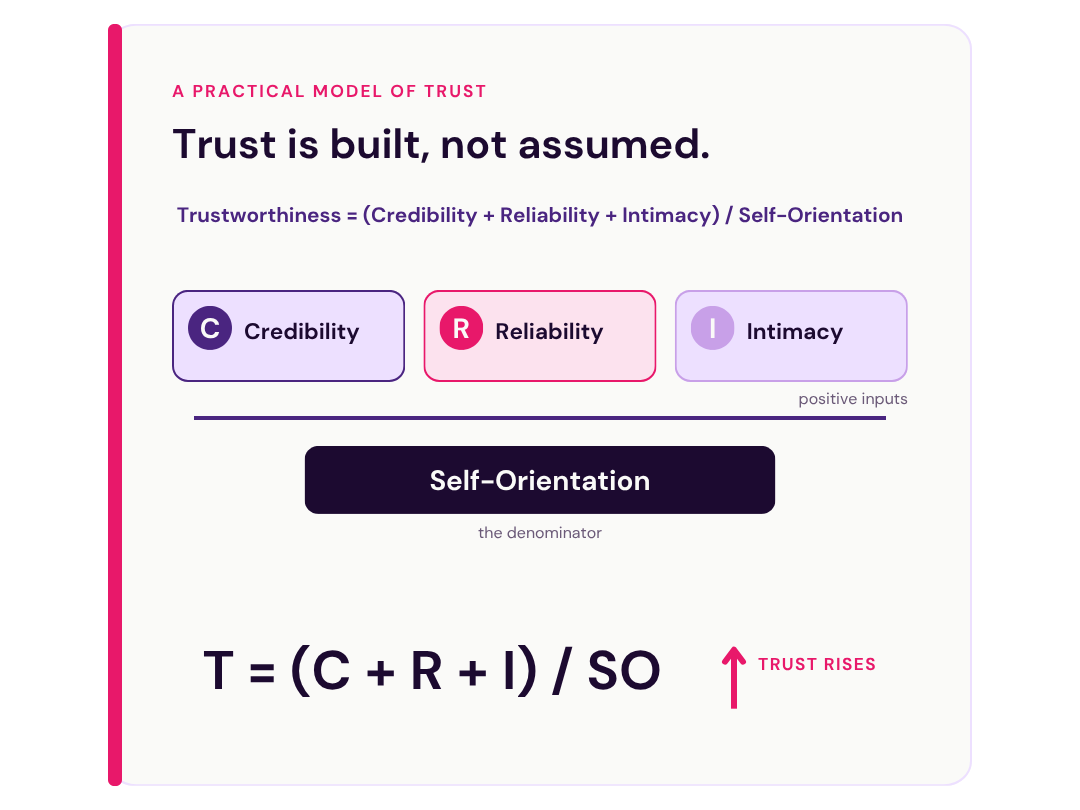
In 2000, in a book called The Trusted Advisor, Charles H. Green and his co-authors put a number on something that usually just feels like instinct. Their formula, still the cornerstone of Trusted Advisor Associates’ work is this:
-
Credibility: can I be believed — do I actually know what I’m talking about?
-
Reliability: do I do what I say I’ll do, when I say I’ll do it?
-
Intimacy: are you comfortable being honest with me, even about the things you don’t tell anyone else?
-
Self-orientation — the one that quietly challenges the other three — is whether I’m doing this for you, or for me.
It’s worth taking that last one seriously: the largest meta-analysis of human trust ever conducted — more than 300 studies, pulled together in 2023 — found transparency to be one of the strongest single predictors of whether someone is seen as trustworthy at all.

At Spectrum, we run this test too, by the way, before any fund manager, platform or provider gets anywhere near your money — regulation, transparency, track record, process!
Same four principles, just pointed at the people and companies we choose to work with.
Credibility: the one where questions matter more than answers
Anyone can claim to be credible — that’s exactly the trouble with a trust recession, self-declared expertise is cheap.
What actually proves it is different: whether you catch the thing nobody thought to ask about. A couple I was introduced to came to me with what looked like a straightforward question about selling a UK property one of them had owned for decades. Buried in the conversation was a detail neither thought was relevant: they’d married in France the year before the sale — which changed which country had the right to tax it, and by how much, eventually worth a six-figure sum in tax savings. Nobody asked me that question; I saw the connection because I’ve spent over twenty years looking out for exactly this kind of thing. That’s not something you can prompt your way into with AI.
Credibility isn’t just about any one story like this — it’s whether that pattern holds up, case after case, including the times I tell you plainly that I don’t know something and need to go and find out.

Reliability: the one I’m still working on
Reliability isn’t glamorous, and if I’m honest, it’s the one of these four I’d most like to get better at. I’m a human, not a system — I can’t promise to be perfect at it and when I do make mistakes I will endeavour to “own them” and put things right as efficiently as possible.
Reliability is the admin done properly and on time: fund switches processed without you having to chase them, withdrawal requests that don’t sit in a drawer, anti-money-laundering checks completed without three reminder emails. No drama, just doing the job properly, every time — and it’s precisely where I’m starting to use things like AI to try and stay on top of an ever-growing to-do list, rather than pretending it doesn’t grow.
What this technology hasn’t reached, and I don’t think it will any time soon, is the human part: knowing that a French wedding mattered to a British tax bill, or simply being the one who picks up the phone.
Intimacy: the one where you tell me things you don’t tell anyone else
I am flattered that clients continue to share things with me — plans, worries, numbers — some they wouldn’t necessarily volunteer to anyone else. I hold to an old adage here: seek first to understand before being understood, a principle I stand by completely. There’s no point building you a plan without the whole picture, and getting there depends on you trusting me enough to hand it over.
It’s also not only about how comfortable someone feels with me personally — it’s whether the systems gathering that information can be trusted too. I use tools like Cash Calc partly because of how seriously they take data security and GDPR, not just because they’re convenient. Trustworthy channels matter as much as a trustworthy person.

Self-orientation: the one where it’s fine to ask if I’m worth it
I run a business — and, happily, I get paid for the work, the same as any other professional you’d trust with something this important. What actually matters isn’t whether I’m paid, it’s how.
What matters is whether it’s transparent and fair on both sides: an explicit commission you’ve signed for, and a fixed annual charge you’ve agreed to, not something buried in small print, or hidden entirely. It’s why we changed our business model to explicit upfront commissions and a fixed annual charge instead: if your pot grows, my income grows with it, and if it doesn’t, so does the pressure on me to fix that. That’s alignment we’re both genuinely invested in, together.
Here’s the part worth sitting with, though: if you don’t actually know how your adviser is paid, that isn’t a neutral score in this equation. It’s close to the worst score. Opacity is exactly where self-interest hides. The client who’s never had a conversation about charges with their adviser or bank hasn’t found a low self-orientation ‘score’ — they’ve simply never been shown the real one.
How it all adds up
None of this means size, track record or reputation don’t matter — they do. Assets under management, years of experience, qualifications, regulatory status: all real, all worth checking. The mistake is treating any one of them as a shortcut — proof enough on its own that you don’t need to look any further. A recognisable name and a marble lobby are just one more thing to weigh, alongside credibility, reliability, intimacy and self-orientation, not a replacement for discounting them.
Here’s the test I actually use, on myself as much as anyone: would I let my grandma be advised by these people? Not are they big enough, not do they look the part — would I trust them with someone I love, and be comfortable with whatever came of it?
That’s not a size question. It’s a transparency question. The institutions and advisers worth your trust are the ones happy to have every part of that looked at closely. The ones that aren’t tend to hide behind the brand instead.

So, where do I score?
I’d genuinely like to know. I’ve put together a short, honest set of questions built around this same equation — follow this link and have a play with it, a couple of minutes at most. Answer anonymously if you’d rather, or put your name to it and be as open as you like — whichever gets you being honest is the right choice.
If you already work with me, I want to know where you’d score me, including anywhere I’m falling short. If you’re not yet a client, use it to think about whoever currently holds that role in your life.
If the answer comes back high, a referral to someone I might be able to help, is always the best compliment you can pay me — though I’d rather earn it than ask for it outright. If it comes back low, I’d rather hear that directly too.
Either way, get in touch — that’s how this actually works.