
Unless you understand this…
Sequencing risk refers to the potentially devastating impact of poor investment returns occurring at the outset of your retirement, rather than later.
Tel: +34 93 665 8596 |
info@spectrum-ifa.com |


By Robin Beven
This article is published on: 15th May 2026
Sequencing risk refers to the potentially devastating impact of poor investment returns occurring at the outset of your retirement, rather than later.
The order in which returns are experienced matters enormously when you are drawing down a portfolio, even if the long-run average return is identical. A retiree who encounters a severe market correction in years one to three faces a fundamentally different outcome to one who experiences the same correction in year fifteen – by which point their portfolio has had years of growth and withdrawals are drawing on a much larger accumulated base.
Consider two retirees, both with £500,000 on day one, both withdrawing £20,000 a year. The first retires in 2000, immediately ahead of the dot-com crash, and sees their portfolio fall sharply just as withdrawals begin. The second retires in 1995, enjoys five years of the bull market, and only then encounters the same crash. Despite facing identical market conditions over the long run, the first retiree may exhaust their funds a decade earlier. The maths is unforgiving: selling units at depressed prices to meet income needs permanently reduces the number of units available to recover in value when markets rebound.

The annual percentage of an initial retirement pot that, historically, could be withdrawn — uprated each year for inflation — without the portfolio being depleted over a given period, typically 30 years. The seminal research by American financial planner William Bengen in 1994 suggested that 4% represented a robust starting point for a balanced portfolio of equities and bonds, a figure subsequently reinforced by the so-called Trinity Study.
However, many UK financial planners now regard 3% to 3.5% as more prudent, given today’s environment of lower expected real returns, elevated valuations, and the uncomfortable reality that many of us will spend 30 to 35 years in retirement rather than the 20 years Bengen originally modelled.
It is worth emphasising that the 4% rule is a historical observation, not a guarantee. A retiree who retired in Japan in 1990, or indeed anyone who has faced a prolonged period of stagnant markets combined with persistent inflation, would have found the rule a poor guide.
The sensible approach is to treat any withdrawal rate as a starting assumption, subject to regular review — reducing spending modestly in years when markets fall, and remaining alert to the compounding danger of drawing too heavily from a portfolio that has not yet had the chance to grow.
The threat nobody warned you about (until it’s too late)
Sequencing Risk and Safe Withdrawal Rates: A Framework for Decumulation
Sequencing risk – formally, sequence-of-returns risk – is the sensitivity of a decumulating portfolio to the temporal distribution of investment returns, as distinct from their arithmetic or geometric mean.
It is a phenomenon that is largely irrelevant during the accumulation phase, where pound-cost averaging actually causes poor early returns to be advantageous, but becomes the dominant risk factor the moment a portfolio transitions to drawdown. The cruel irony is that the retiree has no ability to influence the sequence they are dealt; they can only structure their portfolio and withdrawal strategy to be resilient to adverse outcomes.
The mathematical intuition is straightforward but worth stating precisely. Two portfolios with identical compound annual growth rates over a 30-year period will produce entirely different terminal values – and entirely different probabilities of ruin – if one experiences negative returns in years one to five and the other experiences them in years twenty-five to thirty.
In the latter case, the portfolio has had two decades of compounding on a largely intact capital base; in the former, withdrawals have been funded by the forced crystallisation of losses, permanently impairing the unit count available to participate in any subsequent recovery.
Consider two retirees, each beginning with a £1,000,000 portfolio and withdrawing £40,000 per annum in real terms (a 4% initial withdrawal rate). Both experience an identical set of annual returns over 30 years, but in reverse order — Retiree A receives the poor returns first, Retiree B receives them last.
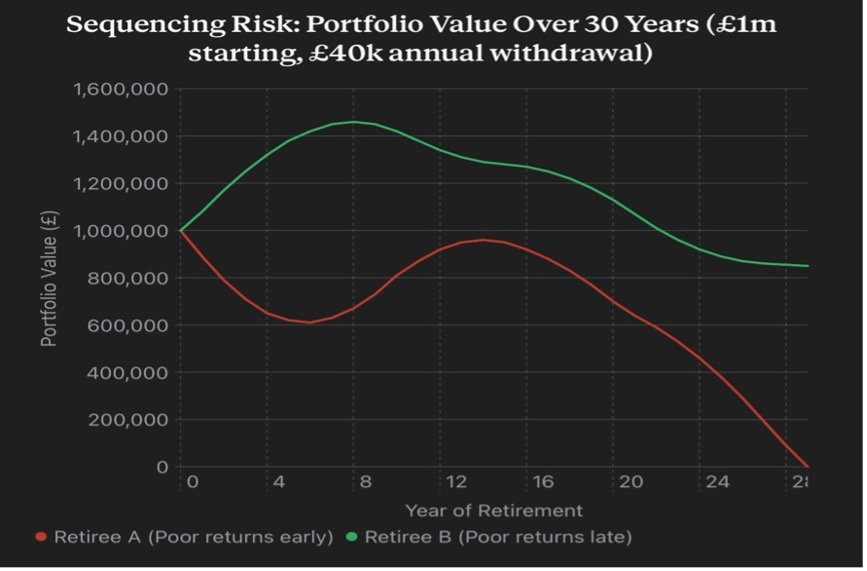
The illustration above captures the essential asymmetry. Retiree A, despite experiencing the same long-run average return as Retiree B, exhausts their portfolio before year 30. Retiree B, buffered by early compounding of the capital base, retains substantial wealth at the same horizon. The returns are identical in aggregate – only their sequence differs.
The safe withdrawal rate (SWR) literature originates principally with William Bengen’s 1994 paper in the Journal of Financial Planning, in which he analysed rolling 30-year historical periods using US equity and bond return data and concluded that a 4% initial withdrawal rate – subsequently inflation-adjusted – had never caused portfolio exhaustion over any historical 30-year window. This figure was later reinforced by Cooley, Hubbard and Walz in the 1998 “Trinity Study,” which introduced the concept of portfolio success rates across varying asset allocations and time horizons.
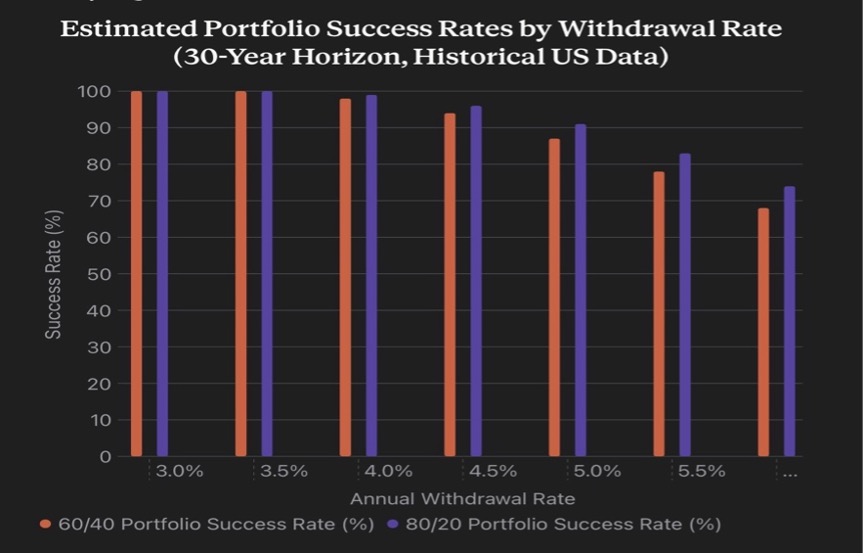
The chart above – based on historical US return data – illustrates the sharp deterioration in success probability as withdrawal rates rise above 4%. It is, however, critical to note the limitations baked into this analysis.
First, it is predicated on US market returns, which have been historically exceptional by global standards; applying the same framework to a UK, European or globally-diversified portfolio has typically produced more conservative SWR estimates in the range of 3.0% to 3.5%.
Second, the 30-year horizon assumption is increasingly anachronistic for a 60-year-old retiree in reasonable health, for whom a 35-year horizon is statistically plausible.
Third, and perhaps most importantly, the original research was conducted in a period characterised by considerably higher structural bond yields than those that prevailed for much of the post-2008 era, though the recent normalisation of rates has partially restored the diversifying and income-generating role of fixed income.
The vulnerability to sequencing risk is not uniform across a retirement. It is most acute in what researchers have termed the “retirement red zone” — broadly, the five years either side of the retirement date. A sustained drawdown during this window, whether from equity market correction, inflationary erosion of real returns, or both simultaneously (as experienced in the 1970s and to some extent in 2022), can set a trajectory from which a portfolio relying on a fixed real withdrawal strategy may never recover.
Several structural responses have been developed to mitigate this exposure. The bucket strategy segments the portfolio into short, medium and long-duration tranches — cash and near-cash to fund the first two to three years of withdrawals, intermediate bonds or diversified income assets for years three to ten, and growth assets for the long tail.
The objective is to ensure that equity exposure need not be liquidated during a downturn to fund immediate income needs, allowing time for recovery. The dynamic withdrawal approach – variants of which include the Guyton-Klinger guardrails model replaces the fixed real withdrawal with a spending rate that is permitted to flex within defined bands in response to portfolio performance, trading spending certainty for a materially improved probability of portfolio survival.
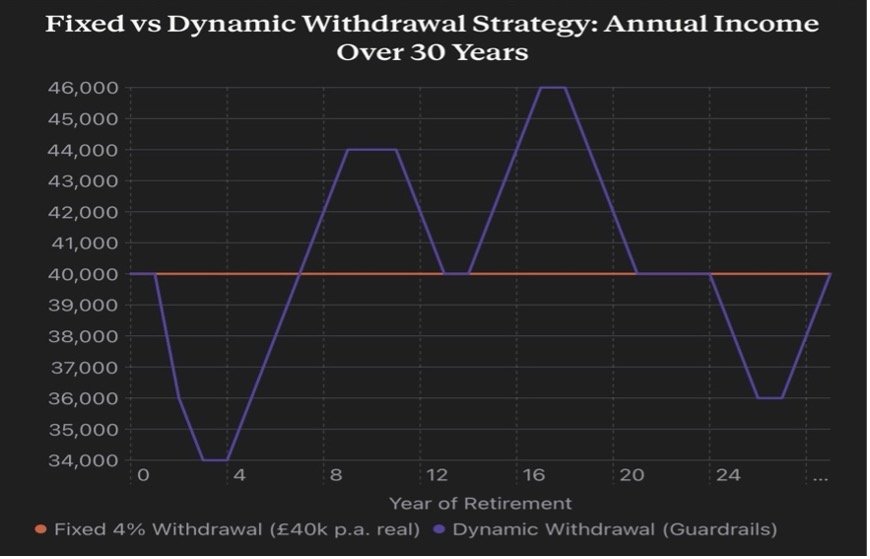
The trade-off illustrated above is fundamental to decumulation planning. The fixed strategy offers spending certainty but accepts the full weight of sequencing risk; the dynamic strategy smooths that risk at the cost of income variability. For retirees with meaningful fixed income floors – UK state pension, company pensions (those receiving final salary pensions), annuity income – the dynamic approach becomes considerably more tolerable, since discretionary spending, rather than essential expenditure, absorbs the adjustment.
The UK context introduces a number of additional variables for expats. The interaction between income from your investments and Self Invested Personal Pensions (known as SIPPs) and the UK State Pension can meaningfully alter the effective withdrawal rate required from the investment or SIPP portfolio in early retirement. Defined benefit pension income, where it exists, operates as a natural hedge against sequencing risk, providing a guaranteed real income floor irrespective of market conditions.
The current environment – characterised by elevated equity valuations, particularly in US markets relative to historic norms, a partial but incomplete recovery in real gilt yields, and persistent uncertainty around long-run inflation – arguably warrants a more conservative baseline withdrawal assumption than the benchmark 4% per annum. The
The Spectrum IFA Group uses cashflow modelling tools that apply “what-if” scenario analysis to assist clients rather than historical sequencing, stress-testing portfolios against a distribution of possible return paths to see that things are on track, rather than solely those observed in the past.
The honest conclusion is that no single withdrawal rate can be “safe” in an absolute sense. What the research provides is a historically-grounded probability distribution of outcomes. The retiree and their adviser should treat any initial withdrawal rate as a base to be revisited annually, with spending adjusted at the margin in response to portfolio performance and revised longevity age assumptions. The goal is not a fixed number, but a resilient and adaptive decumulation framework.