
What’s Really Pushing Up Your Bills
Is it just me, or does every trip to the supermarket cost a little more than the last? Our home insurance went up again this year too. We’re told the cost of living is all about wars and oil, and some of it is.
Tel: +34 93 665 8596 |
info@spectrum-ifa.com |


By Peter Brooke
This article is published on: 24th November 2026
Is it just me, or does every trip to the supermarket cost a little more than the last? Our home insurance went up again this year too. We’re told the cost of living is all about wars and oil, and some of it is.
But this summer I could see the smoke from the Var fires from the motorway. I was lucky, and it never came too close to home, but a couple of clients were evacuated. It got me thinking about how much of what we pay is now down to the weather.
So let’s talk about rising costs, and how the climate is already part of them.
It’s a fair question, and there are three answers.
First, it’s a requirement: since 2022, EU rules have required me to ask every client about their sustainability preferences, so it will come up at your review anyway, and it’s better to know why.
Second, it’s already in your finances: in your bills today, and in your investments and pension tomorrow.
Third, what you do about it is entirely your choice. My job, with Spectrum and our partners, is to do the homework so that whatever you decide, you’re not left behind.
I’m an adviser, not a campaigner. But in October I spent a day at SRI Services Good Money Week in London, a conference on responsible investment, and came away thinking about all of this differently. So bear with me – this is the first of two parts: this one on what’s happening to our costs, and Part 2, in a couple of weeks, on what we can actually do about it.

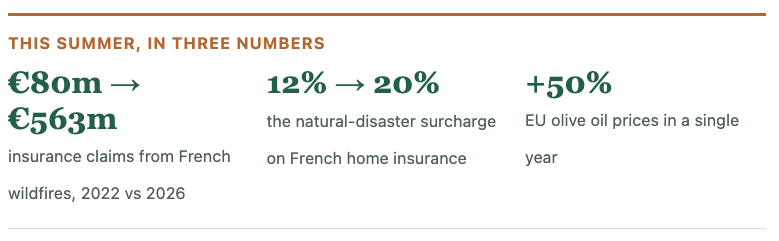
Spain’s drought roughly halved its olive oil harvest, and EU prices rose by around 50% in a year. Lord Deben, who farms himself, summed up his last five harvests for the conference:
“We have been burnt out in two and drowned in the third.”
— Lord Deben
Research for the European Central Bank suggests rising temperatures could add 1 to 3 percentage points a year to food inflation by 2035.
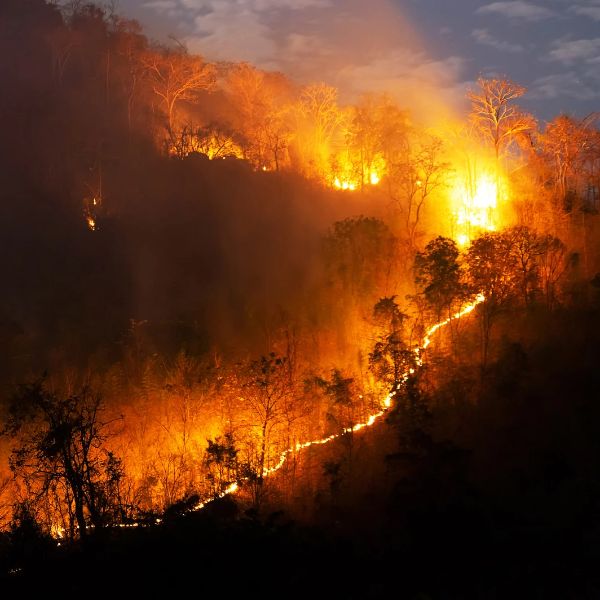
This summer’s fires in the Var, the Gironde and the Landes cost insurers around €563m, against about €80m in 2022. Insurers price risk for a living, and it’s showing up in the envelope on your doormat.
The French natural-disaster surcharge on home insurance rose from 12% to 20% last year, and average home premiums are up by around 13% this year.
“Without insurance there is no finance.” — Mark Manning, LSE
No insurance means no mortgage lending, no business lending, no normal economy.
That was the moment the conference stopped being about the environment and started being about money.
Santé publique France put the health cost of heatwaves in France between 2015 and 2020 at more than €22bn. Health costs always land somewhere, in taxes and in the mutuelle that nearly all of us pay.
Put it all together and more of the cost of living than we realise is the weather.
The slide I keep coming back to from the day was the simplest one: carbon dioxide in the atmosphere over the past 800,000 years.
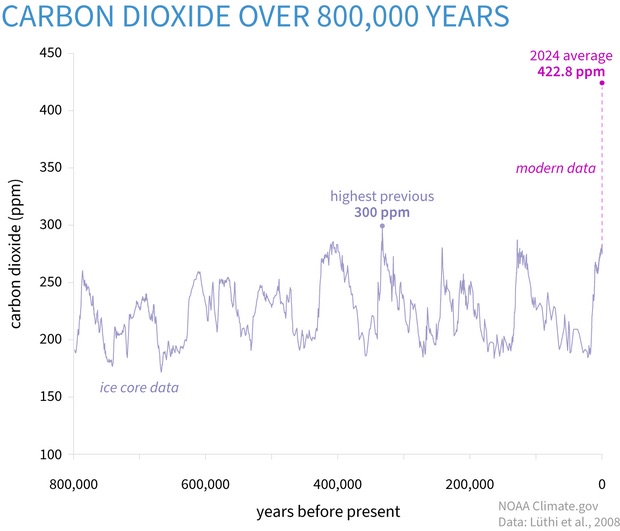
For 800,000 years the line rises and falls with the ice ages, but never goes above about 300 parts per million. Then, in the last 150 years, as we burned more and more coal, oil and gas, it shoots up to around 425. The climate has always changed. It has never changed this fast.
The speakers joined the dots from there…. Carbon dioxide traps heat…. The world is now around 1.4°C warmer than before the industrial age, and heading for 1.5°C for good around 2030…. Warmer air holds roughly 7% more moisture for every degree, so downpours get heavier, and the IPCC expects a once-a-decade heatwave to come about four times as often at 1.5°C.
Valencia’s floods in 2024, which killed more than 220 people, show what that looks like.
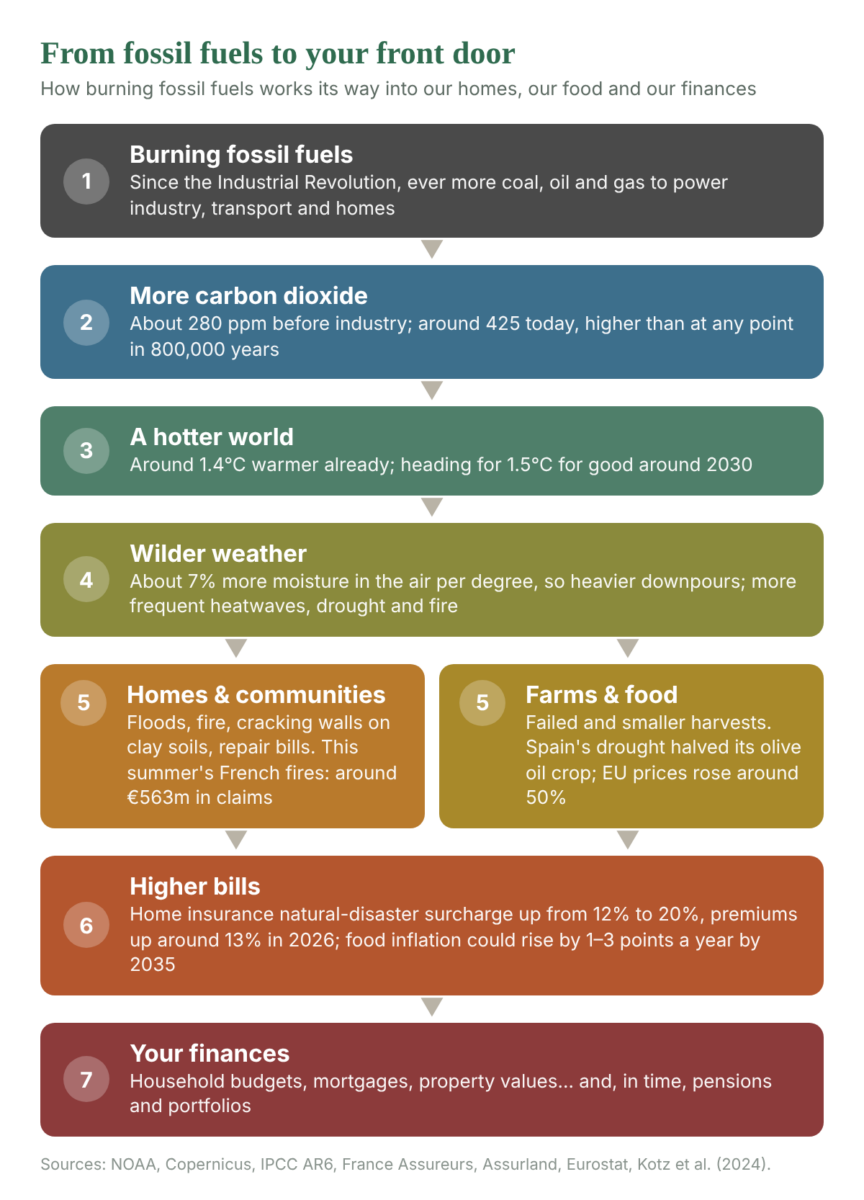
The same forces that push up your bills work their way through the economy. In 2025, weather disasters cost $220bn worldwide, and only about half of that was insured; in Europe it’s closer to a quarter.
The uninsured part lands on households, businesses and governments, which means taxes, property values and, eventually, pensions. Most of the investment portfolios and plans I build run into the 2030s and 2040s, which is exactly the period the actuaries are worried about.
“You can’t have an economy without a society, and a society needs somewhere to live.” — Institute and Faculty of Actuaries
The message from the scientists and actuaries in the room was clear.
Carbon dioxide stays in the atmosphere for centuries, so the job is two-fold:

Before I send Part 2, here are three questions worth a moment over a coffee:
There are no right or wrong answers. But I’d like to hear how this is showing up for you, so hit reply and tell me – or answer this quick survey:
Until next time, Part 2 looks at what resilience means for our homes, our communities and our money, and how we support your decisions.
The short version: your money, your values, your choice.
As always, feel free to get in touch if you have any questions via the usual channels here, or via the contact form below.