


Living in Spain with US (United States) Assets/Ties?
By Chris Burke
This article is published on: 13th October 2026

13.10.26
Since 2010, I have worked with Americans who have built their lives in Spain: US citizens, passport holders and green card holders, many with decades of savings in brokerage accounts, IRAs (Individual Retirement Accounts) and 401(k)s (employer-sponsored retirement plans, named after section 401(k) of the US Internal Revenue Code). The same pattern comes up in almost every first meeting. The portfolio is sound, but the structure around it was designed for someone living in Ohio or Texas, not Barcelona or Valencia.
If your investable assets are $1.3 million or more, that gap deserves attention. The problem is rarely performance. It is usually tax drag, compliance risk and an advisory relationship that no longer fits your circumstances.

The US Person’s Problem: Two Tax Systems, One Portfolio
As a US person, you remain subject to US tax on your worldwide income wherever you live. Once you are Spanish tax resident, Spain taxes you on your worldwide income as well.
The US-Spain tax treaty and the foreign tax credit system are designed to prevent genuine double taxation, but they do not remove the complexity. They simply mean every decision must be tested against both regimes.
Some of the most common issues I see:
- US custodians that cannot, or will not, serve you. Many US brokerages restrict or close accounts once a client’s address moves to Spain. Clients are then left with orphaned accounts or a patchwork of unsuitable alternatives.
- The wrong funds in the wrong place. Most European-domiciled funds and ETFs (Exchange-Traded Funds) are treated by the IRS (Internal Revenue Service, the US tax authority) as Passive Foreign Investment Companies (PFICs), with punitive tax treatment and onerous reporting on Form 8621. Many US persons in Spain hold exactly these products without realising.
- Mismatched gains. Spain calculates gains in euros and the US in dollars. Currency movements can create a taxable gain in one country and a loss, or nothing at all, in the other. Portfolio turnover that looks harmless on a US statement can produce unwelcome Spanish tax bills.
- Retirement accounts that Spain does not treat as the US does. IRAs, 401(k)s and Roth accounts (retirement accounts funded with after-tax money) each need individual analysis. Contribution, growth and withdrawal treatment can differ between the two countries, and getting the sequence of withdrawals wrong can be expensive.

Reporting: Where Good Portfolios Get into Trouble
Compliance is the area where the stakes are highest, because errors can attract penalties well beyond any investment loss.
As a US person resident in Spain, you may need to deal with some or all of the following:
- FBAR (Report of Foreign Bank and Financial Accounts; FinCEN 114, where FinCEN is the Financial Crimes Enforcement Network): required if the combined value of your non-US financial accounts exceeded $10,000 at any point in the year.
- FATCA (Foreign Account Tax Compliance Act) Form 8938: for US persons living abroad, reporting thresholds are higher than for those at home, but still easily exceeded at this level of wealth.
- Form 8621: for each PFIC (Passive Foreign Investment Company) holding, if you have any.
- Your annual US return (Form 1040) with foreign tax credit claims, alongside your Spanish return (Modelo 100).
- Modelo 720: Spain’s declaration of overseas assets above €50,000 per category. Your US accounts count as foreign assets from the Spanish perspective, so a US brokerage account or IRA can bring this obligation into play.
- Spanish Wealth Tax: depending on your region and the size of your estate, this can apply and needs to be considered with your reporting.
The two countries do not use the same forms, deadlines or definitions. A portfolio that is reportable in one place and invisible in the other is a common cause of problems. My role is to make sure your investments are structured so that reporting is straightforward, accurate and repeatable, working alongside your tax preparer rather than replacing them.
A Disciplined, Cross-Border-Aware Investment Approach
For clients at this level, I work with a US wealth manager whose process is built around long-term capital preservation and growth rather than short-term market activity. The philosophy behind the approach is one I find well suited to expatriate families:
• Goals first. The portfolio is designed around what the money has to do: fund your Spanish lifestyle, provide for your spouse, and pass wealth to the next generation. Benchmarks come second.
• Genuine diversification. Portfolios are spread across global markets, asset classes and strategies, with an emphasis on quality and resilience through varying market conditions.
• A long-term, patient mindset. The manager takes a multi-generational view of wealth, which suits clients who think in decades.
• Discretionary, professional management. Day-to-day decisions are made by an experienced investment team within an agreed framework, and you are not left to react to headlines.
• Tax-aware implementation. Holdings are selected and managed with the realities of dual US-Spanish taxation in mind, including fund selection, realisation of gains and currency effects.
• Clear, consistent reporting. You receive transparent statements that support your US and Spanish filings, so your accountant is not reconstructing figures each spring.
My own role is to sit between you, the investment team and your tax advisers. I deal with the Spanish side of the planning, coordinate the compliance workflow, and review your position regularly as your life, the markets and the legislation change.

Is This for You?
My approach is best suited to people who:
- are US citizens, passport holders or green card holders living in Spain,
- hold $1.3 million or more across investment accounts, IRAs and 401(k)s,
- want a single, coordinated strategy rather than a collection of accounts that do not speak to each other, and
- value careful compliance as highly as investment returns.
The First Step
I offer an initial, no-obligation conversation to review your current holdings, your reporting position and your objectives. In most cases I can tell you quickly whether your present arrangements are working well, and where they may be costing you more than you realise.
Click here to read independent reviews on Chris and his advice HERE
You can arrange an initial consultation at a time convenient to you, and to explore your situation click HERE to view my diary.
If you would like any more information regarding any of the above, or to talk through your situation initially and receive expert, fact-based advice, don’t hesitate to get in touch with Chris.
Consistent fund management matters in retirement
By Tom Worthington
This article is published on: 12th October 2026

12.10.26
Your Retirement Shouldn’t Need an Election-Night Swingometer
Why consistent fund management matters when your investments help pay the bills—and you’re still working out which queue you’re supposed to be in
Spectacular investment returns make excellent headlines. Consistent returns tend to receive less attention, rather like the politician who quietly balances the budget and goes home without blaming their predecessor.
Yet when your investments are helping to pay for groceries, electricity, holidays and visits from children who have mysteriously forgotten their wallets, consistency becomes considerably more interesting.
Especially if you have retired abroad, where you may already be managing three bank accounts, two tax advisers and a folder of paperwork substantial enough to qualify as hand luggage.
You moved for a simpler life. You now need an appointment to obtain the password that lets you book the appointment.

For an investor seeking regular income, a disciplined fund manager with a repeatable investment process and a clear approach to risk can play an important role. The objective is to support withdrawals while giving the remaining capital an opportunity to grow.
After all, your electricity supplier is unlikely to accept: “Our fund manager had a difficult quarter, but remains cautiously optimistic.”
You could try saying it in Spanish, but that is unlikely to improve the payment terms.
When a good average disguises a bumpy reality
Imagine two hypothetical investments.
The first returns 7% each year. The second alternates between a gain of 30% and a loss of 14%. Its simple average return is 8%—apparently the better result.
However, invest €300,000 for ten years, reinvest everything, and the outcomes are:
| Investment | Simple average annual return | Value after ten years |
| Steady 7% annually | 7% | €590,145 |
| Alternating +30% and −14% | 8% | €523,999 |
The steadier investment finishes approximately €66,147 ahead.
That is a considerable amount of money. Even after the children discover that your retirement home has a swimming pool and start describing six weeks in August as “popping over”.
These are mathematical illustrations, excluding fees and taxes, rather than forecasts. They demonstrate the difference between averaging percentages and actually compounding money.
In an article published by CFA Institute’s Enterprising Investor, Will Morrison states:
“Holding the arithmetic mean of annual returns equal, a security with lower volatility will have higher compound growth.”
Losses and gains apply to different starting balances. If your investment falls by 20%, it needs to rise by 25% to recover.
Unfortunately, percentages do not negotiate. They are rather like the official who needs your original document: being charming, speaking louder or producing seventeen photocopies of something else will not change the calculation.
There is an important qualification: published compound annual returns already reflect those fluctuations. An investment that actually compounded at 9% has grown more than one compounding at 6% over the same period, assuming no contributions or withdrawals.
Consistency matters, but it does not magically overturn arithmetic. Nor does converting an disappointing pound balance into euros and hoping the larger number will cheer you up.

Taking income changes the calculation
The issue becomes more pressing once withdrawals begin.
During your working life, a market downturn may have been something you could wait out while your salary continued arriving. In retirement, the salary has stopped, but the supermarket has shown remarkably little interest in this development.
A market fall reduces your investment’s value. Taking money out at the same time leaves less capital available to benefit from a recovery. Financial planners call this sequence-of-returns risk: the order in which gains and losses arrive can materially affect the outcome.
As Rob Williams explains in Charles Schwab’s article on the subject:
“When you tap into your portfolio as it’s losing value, you have to sell more investments to raise a set amount of cash.”
Consider €300,000, with €15,000 withdrawn at the end of each year.
If the portfolio falls 20% in year one and rises 30% in year two, it finishes with €277,500 after the withdrawals.
Reverse those returns—up 30%, then down 20%—and it finishes with €285,000.
The same returns. The same total withdrawals. A €7,500 difference because of timing.
Without withdrawals, both would finish at €312,000. Once money is coming out, the journey matters.
It is a little like moving abroad: buying the house, arranging the paperwork and booking the removal van may all be necessary, but doing them in the wrong order can make the experience considerably more expensive.
And unlike your residency appointment, your monthly expenses do not politely disappear when you cannot get a slot.

What a consistent fund manager should deliver
Consistency does not mean an identical return every year. No manager investing in markets can promise that.
Retirement brochures may offer endless sunshine, empty beaches and couples in immaculate linen. Real life includes market falls, dental bills and discovering that the lovely terrace needs waterproofing.
Consistency means discipline in how decisions are made: a clear mandate, sensible diversification, risk limits, attention to liquidity and costs, and an approach that remains understandable when markets become uncomfortable.
For income clients, the manager’s strategy must also fit the withdrawal plan. A fund that pursues maximum growth may be perfectly reasonable for one investor and unsuitable for another who needs money every month.
The adviser’s role is to connect those pieces: spending needs, the manager’s investment approach, accessible reserves and a withdrawal level that can be reviewed as circumstances change.
A good explanation should leave you understanding what you own and why. You should not need the expression you use at the town hall when you have understood the greeting, your surname and absolutely nothing in between.
A steady monthly payment also needs examining. It may include a return of the investor’s own capital.
Receiving 5% a year does not necessarily mean the investment has earned 5%.
A payment schedule can be wonderfully predictable while the capital supporting it quietly shrinks.
Think of the wine rack in your new Spanish home. Taking out a bottle every Friday is a reliable arrangement. It is not evidence that the rack is producing wine.
That is why the questions should extend beyond “What did it return last year?”
How much did it fall during difficult periods? How does it fund distributions? What risks is it taking? What remains after charges?
A manager should be able to explain those answers without sounding like a minister asked where the funding will come from—or a builder explaining why “nearly finished” now requires another deposit.
The investment you can stay with
There is another advantage to a manageable investment journey: investors may be more likely to remain invested.
Morningstar’s Mind the Gap 2025 research carries the memorable subtitle:
“The more investors traded, the less they made.”
Over the ten years ending December 2024, Morningstar estimated that the average dollar invested in US mutual funds and ETFs earned 7.0% annually, compared with the funds’ aggregate return of 8.2%. The difference reflected the timing and size of investors’ purchases and sales. More volatile funds also generally showed larger gaps between fund returns and investor returns.
That does not mean every sale was a mistake, or that volatility alone caused the shortfall. It does reinforce the value of a strategy clients understand and can live with.
Retirement is supposed to give you time for the things you enjoy. If checking your portfolio has replaced checking the weather—and both are ruining breakfast—the level of risk may deserve another conversation.
Moving abroad already provides plenty of opportunities for uncertainty. You may not know whether the letter from the council is a bill, a reminder or an invitation to a local festival.
Your investment strategy should not require the same detective work.
Nor should it depend on a tip from someone you met at the marina who has “done very well in crypto” but always seems to have left his wallet on the boat.
An investment plan loses much of its usefulness if every downturn prompts an emergency meeting at the kitchen table. Particularly when that table was supposed to be reserved for long lunches and the Spanish homework you have been avoiding since March.

Enough growth, with a journey you can afford
There is a balance to strike. Excessive caution can leave a portfolio struggling to keep pace with inflation.
Cash may look reassuringly still while its purchasing power heads quietly towards the exit. The balance on your statement remains familiar; the price of lunch becomes increasingly adventurous.
The cheap glass of wine may have persuaded you to move. Unfortunately, you cannot pay the dentist in favourable comparisons with Surrey.
For clients relying on investment income, consistent fund management deserves a central place in the selection process. It should sit alongside suitable growth potential, reasonable costs and a realistic withdrawal plan.
For those living abroad, the plan also needs to reflect where the money will be spent. If your income is in pounds and your bills arrive in euros, exchange-rate movements add another variable—one your supermarket will not sympathise with, however convincingly you explain what sterling used to buy.
The most useful manager is one whose approach remains disciplined through both good markets and difficult ones, and whose strategy supports the life the client wants to lead.
That life might include travelling, helping family, enjoying long lunches or finally mastering enough Spanish to stop accidentally agreeing to things.
You worked for years to retire somewhere with a better view. You should be able to spend some time looking at it.
Your retirement already has enough uncertainty. Your portfolio does not need to behave like a coalition government.
And you certainly should not need to bring your passport, two utility bills and a translator just to understand it.
Investment values and income can fall as well as rise. Illustrations are hypothetical; past performance does not guarantee future results. Withdrawals may reduce capital.
Further reading
- Michael Kitces: Volatility Drag And Its Impact On (Arithmetic) Investment Returns In Monte Carlo Analysis
- Charles Schwab: What Is Sequence-of-Returns Risk?
- Morningstar: Mind the Gap 2025
- CFA Institute’s Enterprising Investor: The Myth of Volatility Drag — Part 2
Should I Move My Investments Before Moving to Spain?
By Matthew Green
This article is published on: 6th October 2026

06.10.26
You are planning to move to Spain.
You have investments, savings and perhaps pensions that you’ve built up over many years.
So a question often comes up:
Should I change everything before I move?
Should you sell your investments? Move your money? Restructure your portfolio? Close old accounts? Or simply leave everything as it is?
There isn’t one answer that works for everyone.
But there is one important point: the timing of some financial decisions can matter when you are changing tax residence.
Don’t assume everything needs to change
One of the biggest mistakes people can make when moving countries is assuming that all their existing financial arrangements need to be changed immediately.
They don’t.
You may have investments held in the UK, US, Europe or elsewhere and continue to hold them after moving to Spain.
The important question isn’t simply:
“Where is my money?”
It is:
“How will my existing arrangements work once I become resident in Spain?”
That can depend on the type of investment, where it is held, your tax residence, your future plans and how you intend to use the money.

Should I sell my investments before moving?
This is where things can become complicated.
Imagine you have built up a substantial investment portfolio over many years and it has significant unrealised gains.
You could sell everything before moving and start again once you are resident in Spain.
But selling may itself create tax consequences, transaction costs and investment risks.
You may also end up sitting in cash while you decide what to do next.
On the other hand, there may be circumstances where reviewing or restructuring investments before a move makes sense.
The important point is that selling everything simply because you are moving country isn’t automatically the right answer.
The timing should be considered as part of a wider financial plan.
What happens if I leave my investments where they are?
Moving to Spain doesn’t necessarily mean your investments have to be physically moved to Spain.
However, becoming Spanish tax resident can change how your worldwide assets and investment income are treated.
For example, income and gains from investments held outside Spain may still need to be considered under Spanish tax rules, and certain foreign assets can also create reporting obligations depending on the circumstances.
This is why it is important to understand the position before becoming resident rather than discovering the consequences afterwards.
The investment may not need to move.
But your understanding of it probably does.

What about pensions and tax-efficient accounts?
This is another area where people can make decisions too quickly.
You may have accumulated pensions, ISAs, 401(k)s or other tax-efficient arrangements in the country you are leaving.
Their treatment doesn’t necessarily remain the same simply because they were tax-efficient where you previously lived.
That doesn’t mean they should automatically be closed, transferred or sold.
It means you need to understand how they fit into your new circumstances.
In some cases, doing nothing may be perfectly reasonable.
In others, the move may be a good opportunity to review the arrangement.
What about currency?
Currency is another consideration that can easily be overlooked.
If your future life is going to be based in euros, but much of your wealth remains invested in pounds, dollars or another currency, you are potentially introducing currency exposure into your financial plan.
That isn’t necessarily a bad thing.
If you have future income or expenditure in another currency, holding assets in that currency may be perfectly sensible.
But it should be intentional rather than accidental.
A move to Spain is therefore a good opportunity to ask:
What currency will I actually need my money in over the next 5, 10 or 20 years?

What should I review before moving?
Rather than asking whether you should move your investments, I think there are better questions to ask.
Your investments
Are they still suitable for your objectives, timeframe and attitude to risk?
Tax
How could becoming Spanish tax resident affect your investment income and gains?
Existing arrangements
Can your current providers continue to service you once you are resident in Spain?
Currency
Do your investments and future spending requirements match the currencies you will actually use?
Pensions
How do your pensions fit alongside your other investments and future retirement income?
Estate planning
Will your existing arrangements still make sense if you die while living in Spain?
Future plans
Are you planning to stay in Spain permanently, or could you eventually return to your previous country?
Liquidity
How much money will you actually need for the move, property purchase, lifestyle and unexpected costs?
These questions can be far more useful than simply deciding whether to “move” your investments.

The danger of making decisions too early
There is another side to this.
People sometimes make major financial changes because they have heard that something “should” be done before becoming resident in Spain.
But a decision that is appropriate for one person may be completely inappropriate for another.
Selling investments, transferring pensions or restructuring a portfolio can have consequences.
So can doing nothing.
The objective shouldn’t be to make as many changes as possible.
It should be to make the right changes at the right time.
A better way to approach the move
If you’re planning to move to Spain, I would start the financial review before you become resident.
Make a list of your:
- Investments
- Pensions
- Savings
- Property
- Existing tax-efficient arrangements
- Income sources
- Currencies
- Estate-planning arrangements
Then consider how they will work together once your life is based in Spain.
You may decide that some things should change.
You may decide that others are better left exactly where they are.
Either way, you will be making the decision because it fits your circumstances — not simply because you’ve moved country.
Moving to Spain doesn’t mean starting again
Moving abroad is a major life decision.
Your financial arrangements don’t necessarily need to be rebuilt from scratch just because your address has changed.
But changing tax residence can be an important financial planning event, and it is worth understanding the consequences before making irreversible decisions.
Don’t move your investments simply because you’re moving to Spain. But don’t wait until after you’ve moved to discover that the timing of a financial decision mattered.
If you’re planning to move to Spain and are unsure whether your existing investments, pensions and wider financial arrangements are still appropriate, I would be happy to have an initial conversation with you.
At The Spectrum IFA Group, I work with expatriates and internationally mobile individuals moving to or living in Spain, helping them review their investments, pensions and wider financial planning in the context of their new circumstances.
Sometimes the best financial decision is to change something.
Sometimes it is to leave it alone.
The important thing is knowing which applies to you.
French financial update October 2026
By Katriona Murray-Platon
This article is published on: 5th October 2026
05.10.26
After a very long and hot Summer, it looks like Autumn is finally here. With businesses in full swing after the summer, there have been some interesting financial developments.

One of the products we advise our clients to invest in when moving to France is an assurance vie. Its popularity is clear and the amount invested in assurance vies has steadily increased since they were created 40 years ago, reaching € 2162 billion in June 2026 (a 6% increase from last year).
By the end of 2025, over half of French household savings were invested in assurance vies – far more than in savings accounts such as the Livret A or LDDS.
This is hardly surprising given the strict limits of these accounts on both the capital (€22,950 for a Livret A and €12,000 for a LDDS) and the fact that savers can only have one of these accounts each, whereas there is no limit to the number of assurance vies a person can have or on the amount invested. If the assurance vie is set up before age 70, the IHT allowance is €152,500 per beneficiary per policy holder (having multiple assurance vies does not increase this amount). According to a 2025 report from the federation France Assureurs, 46% of savers chose this investment for inheritance planning and 44% as their preferred method of saving money.

Average mortgage rates in France have increased since September, currently sitting at around 3.5% depending on the length of the loan. This is due to the fact that the French state’s 10-year borrowing rate has reached 4.2%, its highest level since 2004, and the rise in inflation which increased to 2.4% in August, from 2.1% in July, and 1.8% in June.
The European Central Bank also increased its rates by 0.25 points on 10th September with more increases expected by the end of the year.
Furnished rental property owners using Airbnb under the micro-BIC regime face tighter margins. For “non classé” properties it will be more difficult to remain under the €15,000 threshold. Under the Le Meur law (and contrary to the other thresholds for other types of rental), this threshold has not been adjusted to take into consideration the rise in inflation. Furthermore, from 13th October AirBnB’s pricing policy will change such that the rate of 15% will be paid by the host (rather than being split with the guest). For example, for a rental at €100 per night, instead of receiving €97, the host will only receive €84,50 whereas the guest will pay €100 instead of €115. AirBnB hosts should therefore adjust their prices ahead of this deadline and be aware of the likely impact on their taxable income. This will not affect those that are already under the ‘reel’ or costs-based system.
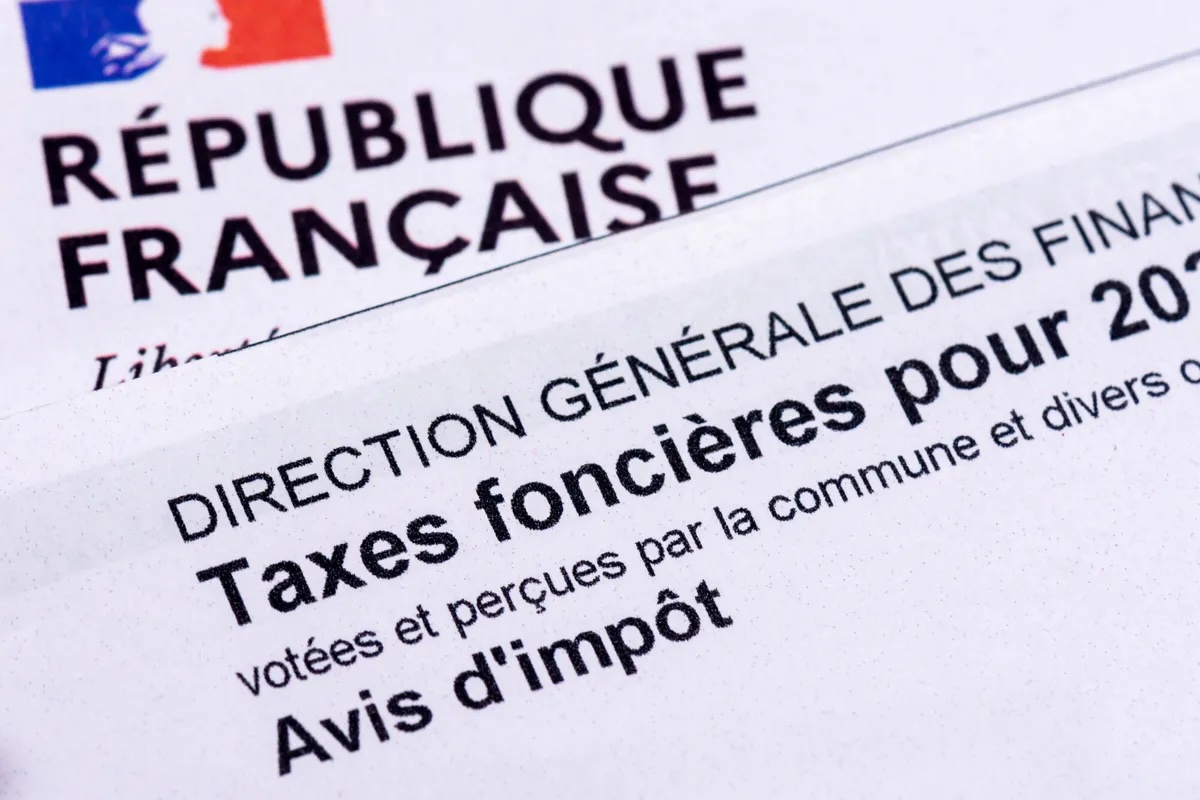
The Taxe Foncière must be paid by 15th October (20th October for online payments). If you pay your Taxe Foncière in one go in October, it will be taken automatically on 15th October.
If you already pay monthly then the payment on 15th October will be the same as the previous payments and the payment on 15th November will be the balance due for any increases.
Taxe Foncière must be paid by the owner of the property as at 1st January. If you have purchased a property during the year, the notaire will have split the amount pro-rata with the seller meaning that the Taxe Foncière bill won’t appear in your account until next year. If you sold a property in 2026, this will be the last time you pay Taxe Foncière for that property.
On a brighter economic note, both the US and Eurozone economies are performing well. In the US the flash composite Purchasing Managers’ Index (PMI) hit 58.4 this month (up from 56.0 in August)—the fastest pace of expansion since 2015 outside of the post-lockdown reopening surge, with both manufacturing and services performing strongly. In Europe, S&P Global’s composite PMI rose to 53.1 in September 2026 (up from 52.0 in August), marking three consecutive months of accelerating business activity and reaching a three-and-a-half-year high. Notably, Germany expanded for a third straight month, and France returned to economic growth for the first time in 10 months. While new orders and employment are rising, inflationary pressures have intensified slightly (with input and output prices rising at their fastest rates in four months), and business confidence remains relatively subdued.
After a quieter summer, it has been wonderful to reconnect with clients and contacts I spoke with earlier in the year. If you would like to discuss your personal financial situation or planning goals, please get in touch to arrange a meeting.
I’ve Become Tax Resident in Spain — What Happens to My Investments?
By Matthew Green
This article is published on: 23rd September 2026
23.09.26
You haven’t sold your investments.
You haven’t moved your investment account.
You may not even have changed anything about the way your money is invested.
So why should becoming tax resident in Spain make any difference?
For many people moving to Spain, this is one of the questions that gets overlooked.
Your investments may still be held in the country you came from, but your tax position may have changed. For Spanish tax residents, Spain generally taxes worldwide income, subject to the specific rules that apply to the individual and any relevant tax treaty.
That means becoming resident in Spain can be a good time to step back and review your investments as a whole.
Does my investment have to move to Spain?
Not necessarily.
Becoming resident in Spain does not automatically mean that every investment you own needs to be transferred to a Spanish bank or investment provider.
You may have investments, savings or other financial assets held in another country and continue to hold them there.
The more important questions are:
- How will the investment be treated for Spanish tax purposes?
- Are there any reporting requirements?
- Can your existing provider continue to service you as a Spanish resident?
- Are the investments still appropriate for your circumstances?
- Are the charges competitive?
- Does the investment fit with your longer-term plans?
The location of an investment and your tax residence are two different things.
What about investments from my home country?
This is where things can become more complicated.
Someone moving to Spain might arrive with a mixture of investments accumulated over many years. They could have shares, investment funds, savings accounts, bonds, pensions or other financial arrangements.
The country in which those assets are held does not necessarily determine how Spain will treat them.
There can also be reporting obligations relating to certain assets held outside Spain. For example, Spain’s Modelo 720 is an information return covering certain foreign accounts, securities, rights, insurance and other assets, subject to the applicable rules and thresholds.
This is one reason why simply leaving everything exactly as it was before moving may not always be the best approach.
Should I sell my investments before becoming Spanish resident?
This is a question I hear regularly.
The temptation can be to think:
“Perhaps I should sell everything before I become resident in Spain and start again.”
But selling investments simply because you are moving country can create its own consequences.
You need to consider the investment itself, potential gains, timing, taxation, transaction costs and what you intend to do with the money afterwards.
There is no universal answer.
For some people, restructuring before or after a move may be worth considering. For others, selling investments could create unnecessary costs or tax consequences.
The important thing is to understand the position before making a major decision.
What about ISAs and other tax-efficient arrangements?
People arriving in Spain often have financial arrangements that were designed around the tax system of their previous country.
An ISA is a good example for someone coming from the UK, but the broader principle applies to people from many different countries.
A tax-efficient investment in one country does not automatically receive the same treatment in another.
That doesn’t necessarily mean it should be closed or sold.
It means its treatment should be understood before making a decision.
What should I review after becoming a Spanish resident?
Rather than looking at each investment separately, I think it is more useful to look at the bigger picture.
For example:
Investments
Are your investments still appropriate for your objectives, timeframe and attitude to risk?
Tax
How are your different sources of investment income and gains treated in Spain?
Currency
If you hold assets in several currencies, does that still make sense now that your life is based in Spain?
Charges
Are you paying for services or investment arrangements that are no longer suitable?
Reporting
Do you have any Spanish reporting requirements relating to assets held overseas?
Retirement
How do your investments fit alongside your pension and other retirement income?
Estate planning
Would your current arrangements still make sense if you died while resident in Spain?
Future plans
Do you intend to remain in Spain permanently, or might you eventually return to your previous country?
These questions can be much more important than simply asking where an investment is held.
Moving country doesn’t necessarily mean moving your investments
One of the biggest mistakes people can make after moving to Spain is assuming that everything needs to be changed immediately.
Sometimes it does.
Sometimes it doesn’t.
The better approach is to understand what you already have, how it is treated now that you are resident in Spain, and whether it still fits the life you are building here.
Your investments may not need to move.
But your financial plan probably deserves to move with you.
If you’ve recently become tax resident in Spain and haven’t reviewed your investments and wider financial arrangements since your move, it may be worth taking a fresh look.
At The Spectrum IFA Group, I work with expatriates and internationally mobile individuals living in Spain, helping them review pensions, investments and wider financial planning in the context of their circumstances in Spain.
If you’re unsure whether your existing investments are still appropriate now that you live in Spain, get in touch and we can discuss your circumstances and whether a review would be worthwhile.
Retiring to the Costa Del Sol
By Jeremy Ferguson
This article is published on: 22nd September 2026

22.09.26
Every year, thousands of Britons make the decision to swap grey skies for blue horizons and build a new life on Spain’s Costa del Sol, and it is for much more than just the sunshine.
It’s also about the quality of life, financial freedom, family life, health, and making retirement the best chapter of life rather than simply the last. Recent research continues to show Spain is comfortably the number one destination for British retirees, attracting more than twice the interest of Portugal, and significantly more than France or Italy.
When I am dealing with clients and their plans to move here, I have noticed something interesting, in that people rarely move because of one particular reason, but often when asked, the overriding reason tends to be because everything simply ‘feels much better’.

Better weather tends to equal a better lifestyle, and with that fact in mind the Costa del Sol enjoys over 320 days of sunshine every year, meaning more mornings on the golf course, walks along the beach, outdoor cafés throughout winter, and a lifestyle that naturally encourages people to simply spend more time outside.
As a result of this it is easy to see why people say they feel their heath has improved since they moved here. People tend to walk more, socialise more, relax more, all of which tend to lead to feeling generally less stressed. All of this combined typically means people finally slow down enough to fully enjoy the wealth they’ve spent decades creating.
For many British retirees, the financial benefits are just as attractive as the climate, with recent comparisons showing that overall living costs in Spain are around 32% lower than the UK, equating to almost £400 per month less spent. Groceries, household costs, restaurants and leisure activities are all significantly cheaper.
This doesn’t simply mean spending less, it often means living better, eating out more frequently, a healthier diet, swimming in the pool you didn’t have before, all of which define quality of life.
It’s not all plain sailing though, as moving countries also creates one of the biggest financial transitions many people will ever make, with a different tax system to adjust to, pension rules changing, Investment tax changing, as well as inheritance planning being different. Therefore the strategies that worked perfectly in Britain, can often become inefficient, or even expensive, once you’re a Spanish tax resident.
I get asked all sorts of questions, is my UK pension in the right place? am I paying unnecessary tax on my investments? do I need a Spanish will? how should I pass wealth to my children? should I keep my UK bank accounts? These are all very typical.
With none of these decisions being sensibly made in isolation, I have experienced all of these questions. With many client scenarios being very similar, explaining real life examples can go a long way to helping clients understand and become comfortable with what they need to do.
The whole point of a move to Spain is achieve a better quality life, with less stress, so if I can help you achieve some of that, then you know where I am.
Revolut – it’s now an Italian bank
By Gareth Horsfall
This article is published on: 17th September 2026

17.09.26
Save money on charges
I have to tell you about ‘una scoperta’ recently. I have been an account holder at Revolut bank for a year or so now. Revolut being the online bank but did not have a national presence anywhere other than the UK (I think) Well, that all changed recently and it opened a full Italian online banking operation (plus a number of other European fully operational online banks). I converted to the Italian bank when notified.
This is not the interesting part. The better news is that over the summer I had another one of those bills to pay to a comune, or a multa or something and I was moaning, again, at the fact that you always have to pay about €1.50 to some entity somewhere, or worse €1.95 in the post office or in the tabaccheria, even when I am spending the time to input the payment myself online. This annoys me so much! In fact, I get quite furious about it. Banca Intesa charges me €1 every time I make a bonifico from my business account. I see red every time. I mean why, when I am entering the data myself on my phone and spending my time to enter the bonifico ONLINE should I have to pay €1 to the bank?
Well, the fantastic news is that I discovered, (through an AI search, ironically) that Revolut does not charge those pesky bank charges, neither for bonifici nor bill payments, nor comune payments, nor Agenzia delle Entrate payments. I think that this could save me in the region of about €100 a year, approximately.
And besides the cost savings the Revolut app is fantastic and much easier to use than any other Italian banking app I have. So, I am a convert. I hope they use this as disruption to the Italian banking sector and bring some positive change because, quite frankly, the time is up for charging to send payments in Italy! When disruption makes companies more competitive and treats clients better than before, this is my kind of capitalism. (I just hope they don’t fall in line with the other Italian banks, over time)
The death of original content – The AI takeover
By Gareth Horsfall
This article is published on: 16th September 2026

16.09.26
Over the summer I have been seeing alot written about AI, most of which I take with a pinch of salt, but one headline that appeared in my inbox was the following:
Bot and AI overtake human-generated web traffic for the first time; we are in the age of the “Dead Internet”
According to data from Cloudflare, automated bot and AI agent traffic has surpassed human-generated web traffic for the first time in history, with 57.4% per cent of requests to websites it hosts being automated bot requests, while only 42.6% originate from human users. Matthew Prince, co-founder and CEO of Cloudflare, expressed surprise at the speed of the transition from human-generated to computer-program-generated content. He expected this would happen towards the end of 2027.
This, for me at least, is alarming. Not because automated AI generated content will surpass human generated content, I think that was almost inevitable but because AI models are all fishing in the same pond. I don’t know enough about how well AI can generate new creative ‘original’ ideas, but I am almost certain that it will never surpass the human capability to create and innovate, therefore it does leave you wondering to what extent the information we are getting from Chatgpt or Claude, or any other open source AI model, is just recycled from the same information which AI put there in the first place. I am sure the more technologically advanced amongst you may be able to educate me on this point, but unlikey to convince me that the loss of original human generated content is not just a loss for us all, but also very dangerous when looking to make important decisions based on information which for all intents and purposes can be wrong. The level of error in AI generated search results, for example, is something that worries investors in its longer term application.
(Please remember that my Ezine’s are human generated and researched (using minimal AI input)!
We must adapt
Having said all this above, we have no choice but to adapt. Here is a good point to tell you a personal story about my own family name history. I have written about this before but it is good to remind you of it, given the context.
My name is Horsfall!
For those of you who are familiar with industrial revolution history in the UK, you may be award of the Luddites. In Huddersfield, where I am from, they were a group of people who worked in the textile industry and who were involved in the finishing of cloth by hand. The introduction of machinery, which both streamlined the operation and made it much quicker, put their jobs and livelihoods at risk and as a result they organised themselves into groups who went around the mills destroying machinery. In 1812, a man named William Horsfall (a direct line ancestor), a mill owner himself, and a vocal opponent of the Luddites, was also an advocate of installing machinery in his factories, to modernise, streamline and introduce efficiencies and greater productivity. On his horse, coming back from the market one Tuesday morning, he was shot and killed by the Luddites. This culminated in the death of the Luddites movement because the police immediately swooped in to avoid similar occurrences happening. However, the term ‘a Luddite’ became synonymous with people who are opposed to technology, automation and modern working methods. (If you want to see the full family story you can click HERE)
Personally, I don’t like AI in it’s present form (although I recognise it’s application in business to make things easier), but I know it’s here to stay and as Jensen Huang CEO of Nvidia recently said:
“You are not going to lose your job to AI, but you are going to lose your job to someone using AI”
Here are a couple of interesting slides about AI, courtesy of our friends at Evelyn Partners Investment Management
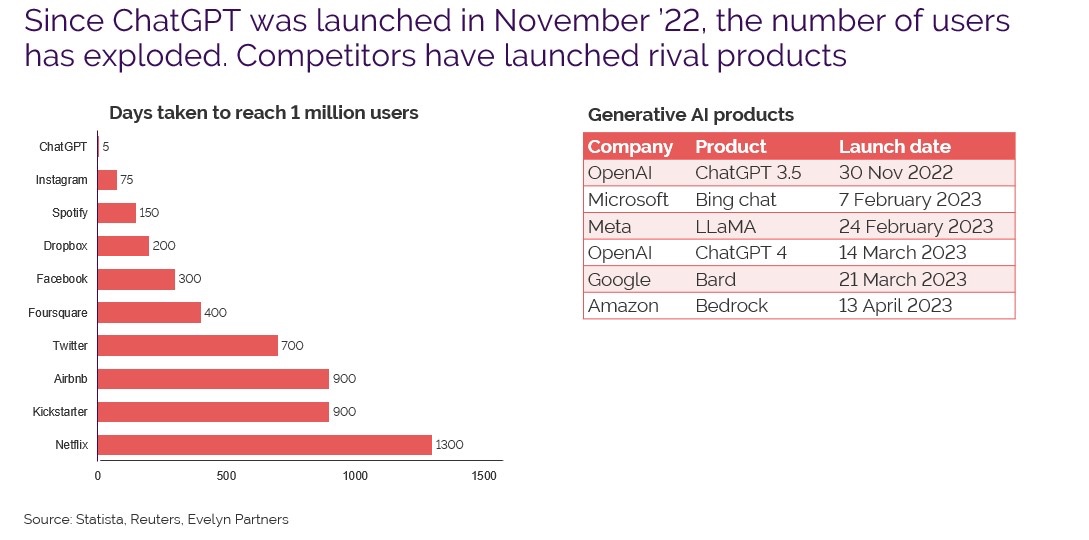
Jobs will change, but not be lost.
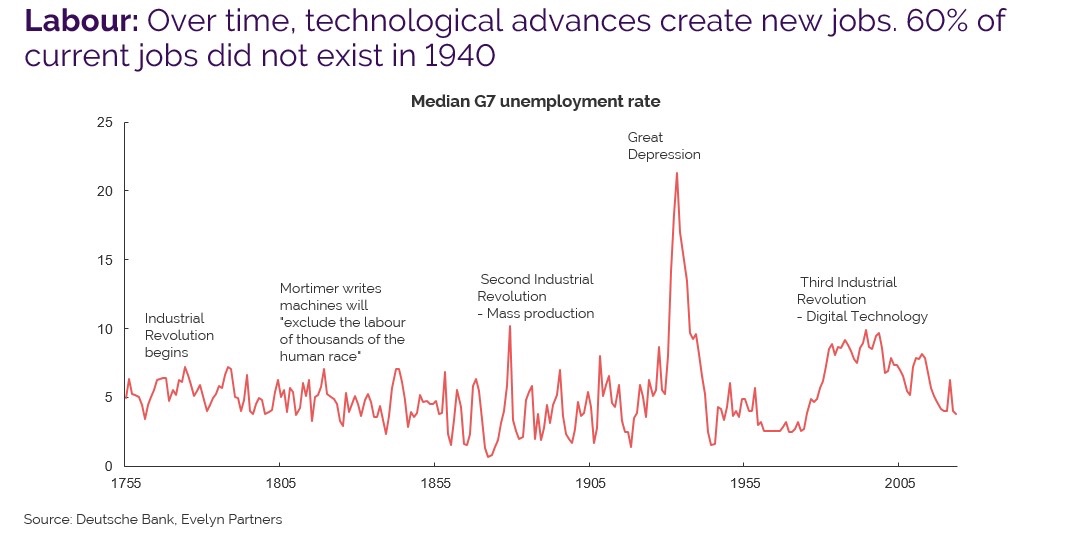
This slide particularly interests me because it goes to show the power of human ingenuity. As we can see, apart from the great depression, unemployment levels have largely hovered around the 5% mark since the 1700’s, over which time we have seen the introduction of so many new technologies – in no particular order: the train, car, aeroplane, the telephone, machines in factories, the radio, TV, the washing machine, going into space, the cell phone, computers, the internet, and now AI.
Influencing
I think one of the best examples of this human adaption is the job of the influencer. 10 years ago, internet influencers never existed. Yet now, people are making millions from online ad revenue, quite often it is completely useless content, but which creates the clickbait required to generate income. It is also becoming a life saver for certain sectors, such as farmers, to sell direct to the public instead of through distributors or to supermarkets. The internet and now AI has, in a way, democratised the world of work in professions which, previously, had been reserved for a select few. Now, more opportunites are available to the masses.
I have noticed this myself because in my efforts to understand the world of the land a little bit more, I have done a lot of research online and come across many people who have created Youtube or TickTok channels, producing short videos on the things they do on their land and the methods they use. One development I have noticed is that when these influencers seem to reach a critical mass of followers, subscribers and likes, then they suddenly start appearing with tools sponsored by certain companies and they start writing books for sale. It is well known that generating revenue through subscribers, followers etc is not going to a create a big and reliable long term income stream, but ancilliary product and services, sponsors and driving traffic through your website, seems to be the way to go.
Influencers – a job also at risk of AI
However, the influencer space may also be a ‘job’ under threat, with the rise in automated traffic, as explained above, this presents challenges to their economic model. Bots do not click on ads, which raises questions about how content creators can generate revenue in an increasingly bot-dominated landscape. As a potential solution they could charge bots for access to digital users’ content. Like every other employment, it will have to adapt to a rapidly changing future.
What the jobless numbers can tell us about the growth in AI
I will finish my section on AI with this, because it really puts into context why AI, robotics and automation are going to play an increasingly large part in our lives.
At the beginning of August new jobless claims were announced in the USA. New filings for unemployment benefits dropped to 187,000 for the week ending July 18 — a nearly 57-year low, and a much bigger drop than economists expected. This is probably not a cyclical blip. It’s demographics finally showing up in the data. Birth rates across the developed world — the U.S., Europe, Japan, China, South Korea — have been falling for decades, and it’s finally catching up. Fewer young workers are entering the work force every year than are retiring from it. This is basically a structural worker shortage, and jobless claims sitting near six-decade lows is exactly what you’d expect that shortage to look like on paper: a “low-hire, low-fire” economy where employers are desperate to hold onto the workers they already have. (I think about our friends in N.Italy who run a number of bars and they can never find trained staff and spend most of their time interviewing, hiring and firing. It has become their biggest headache). However, a labor shortage this bad can’t be solved through immigration, fast-enough, to mitgate your way out of a birth-rate collapse, and you definitely can’t train workers who don’t exist.
The only option left is productivity — which means robotics, automation, and AI aren’t optional anymore. They’re the only way to keep the economy growing when the number of available humans is shrinking. That’s why capital is pouring into automation and AI — this is not an passing fad, this is the innovation cycle!
Is this an investment opportunity?
Many of you have quoted me headlines that there is an AI bubble just waiting to burst and that a market crash will be lead by over speculated AI stocks. There is probably some truth in the fact that there are companies out there who have overly inflated valuations due to the hype around AI. However, the question is whether a revaluation of these stocks alone would be enough to generate a full market crash, or maybe a correction.
Major innovation cycles have never been cheap, and they’ve never been non-inflationary. Every prior boom — the 1970s energy and productivity shock and others — was accompanied by a commodity repricing. Building new infrastructure and new machines at scale means real demand for real materials.
Put it all together: a demographic worker shortage forcing an automation super-cycle, requiring a huge amount of hard assets (commodities) to build it all out. The smart money has already moved away from the speculative AI firms who may see a revaluation sometime soon, into the resource based companies who are going to be building the infrastructure to take us into this innovation era.
Artificial Intelligence: Opportunity, Risk, and a Question Bigger Than Markets
By Andrew Lawford
This article is published on: 16th September 2026

16.09.26
AI has moved from research lab to the centre of global capital allocation faster than almost any technology before it. Goldman Sachs Research projects worldwide AI-related investment will exceed $1 trillion in 2026, with about $581 billion of that in the US alone. At 2-5% of GDP, this peak intensity is comparable to prior general-purpose technology buildouts — railways, electrification, the internet — though compressed into a far shorter timeframe.
Where the opportunity lies
The clearest opportunity is infrastructure: chipmakers, power and grid companies, and data-centre suppliers behind AI’s physical build-out. A second lies in software and services companies genuinely embedding AI and showing measurable productivity gains, rather than simply attaching the label. A third is second-order: healthcare, logistics, and financial services benefiting from AI-driven efficiency without being “AI plays” themselves. For cross-border clients, diversified thematic exposure, rather than concentrated single-stock bets on US mega-caps, is usually the more sensible route in.
Where the risk lies
The most immediate risk is circularity: a meaningful share of AI capex is financed by the same handful of companies that supply and buy from one another, so returns are more sensitive than headline growth suggests to any slowdown in adoption or rise in the cost of capital.
Concentration compounds this — a small number of companies drive a disproportionate share of both AI capex and recent index gains, so even diversified portfolios may carry more AI-specific risk than clients realise. And the return on this capital is genuinely uncertain: even Goldman’s own analysis calls AI spending a “key source of uncertainty for macro markets,” without forecasting whether it will pay off.
The existential question
Clients increasingly ask directly: could AI pose a genuine risk to humanity? Honesty about uncertainty matters more here than a confident answer either way, because expert opinion is genuinely split. A recent academic survey found two coherent camps — those viewing advanced AI as a powerful but controllable tool, and those viewing sufficiently autonomous systems as a harder-to-control risk. Disagreement correlated less with general AI expertise than with familiarity with specific technical concepts, such as the tendency of highly capable, goal-directed systems to develop self-preservation sub-goals; researchers less familiar with such ideas were markedly less concerned. Still, 78% of surveyed experts agreed that technical AI researchers should be concerned about catastrophic risks — real agreement on direction, even amid disagreement on scale and timing, which most estimates place in decades rather than years.

A balanced conclusion
AI will likely remain a defining investment theme this decade, and exposure to it is reasonable. But the same technology is the subject of genuine, unresolved expert disagreement about its longer-term risks to society. The sensible approach: disciplined, diversified exposure to the theme, awareness of concentration already embedded in portfolios, and honest acknowledgment that both AI’s financial and societal trajectory remain more uncertain than its loudest advocates or critics currently claim.
Perhaps it will come as no surprise (or perhaps I’m just hoping that readers recognised the above for what it was!) when I say that everything written before this current paragraph was generated by AI (Claude in this case), based on the following prompt I had given it (please note that Claude knows what work I do and that I am based in Italy):
“I need you to write me an article that I will distribute to my clients. The topic is AI and its opportunities and risks from an investment standpoint, as well as a balanced discussion of whether or not there are existential risks to humanity over the medium to long term. Max 1000 words”
It took about 2 minutes to generate the response, which I subsequently asked it to shorten to no more than 500 words and which I have not edited at all. To me it seems like a competent, if somewhat uninspiring commentary on the current AI debate and its consequences for investors. I’m not sure that it has really given me any great insights beyond what one would glean from reading a modest amount of financial journalism and from being generally interested in the subject. In fact, I find myself wondering if these sorts of AI-generated documents “are simply the copy of one thousand summaries” (solo la copia di mille riassunti) as Samuele Bersani put it in his song Giudizi Universali.
Needless to say that the topic of AI must be taken into consideration when investing, yet we must acknowledge the limits of our understanding in terms of how all of this plays out. I think it is wise to exclude the potential for an existential crisis of humanity from our calculations, mainly because if that scenario does unfold, rather like a global nuclear war, we will have more important things to worry about than the value of our investment accounts. On a more moderate view, there will be beneficiaries and victims of AI that we cannot even begin to imagine, and we must maintain a fully diversified approach and understand how much exposure we have to certain types of investment.
One of the first things I do when evaluating a portfolio is try to get an understanding of the underlying investment exposures in order to make it clear what risks clients are exposed to: it remains a useful discussion to have before contemplating any investment changes, above all considering the concentration in a small number of companies that certain stock indices have (these points are well-made by Claude above).
Finally, should I just forget about AI in my day-to-day work?
That seems foolish, rather like the accountant I remember stories of from my youth who forbade the use of calculators in his practice because he was convinced that his employees’ brains would atrophy as a result. AI is enormously helpful in analysis and presentation, in making calculations and especially in investigating and flagging potential errors. Yet it is imperitive to understand any AI output before adding my own evaluation and conclusions, and the exacting task of finding the correct investment structures and navigating the potentially difficult topics of estate planning and tax efficiency seem, at least for the moment, to be beyond what AI can competently deal with. So, welcome to the era of the AI-enabled adviser. Believe me when I say that I am highly motivated to be one, because otherwise I may find myself facing that most uncomfortable of questions: what exactly do you need me for?
I have Moved to Spain – What Should I Do With My UK Pension?
By Matthew Green
This article is published on: 15th September 2026

15.09.26
Moving to Spain is exciting. Your pension, however, probably wasn’t designed with the move in mind.
For many people, a UK pension is one of their largest assets. So, after becoming resident in Spain, it is natural to ask whether the pension should now be transferred to a Spanish or international arrangement.
But there is an important question to ask first:
Does it actually need to move?
The answer isn’t necessarily yes.
Do I need to transfer my UK pension?
Moving to Spain does not automatically mean that your UK pension needs to be transferred overseas.
Depending on your circumstances, you may be able to leave your pension in the UK and continue to manage it from Spain. In some cases, that may be the most appropriate option.
Before considering a transfer, it is important to understand what you already have, including:
- The type and value of your pension
- The investments and charges
- Any guarantees or valuable benefits
- When you can access the pension
- How you expect to use it in retirement
- Whether you may eventually return to the UK
A transfer should therefore be a financial planning decision, rather than simply a consequence of moving country.

What happens to the tax?
Becoming Spanish tax resident can change the way your pension income is treated.
The UK and Spain have a double taxation agreement, and the precise treatment depends on the type of pension and your circumstances. Private pensions and government-service pensions can also be treated differently.
This is why simply looking at where your pension provider is based isn’t enough.
Your tax residency, the type of pension and how you intend to take the benefits all need to be considered together.
What about my UK State Pension?
Your UK State Pension can generally continue to be paid while you live in Spain, subject to the relevant rules.
But your State Pension is only one part of your retirement income.
Your wider retirement plan might also include workplace pensions, personal pensions, SIPPs, investments, property or cash savings.
The important question is therefore not just:
“What will my pension pay me?”
but:
“How will all my sources of retirement income work together?”
Should I transfer my pension overseas?
This is where it is particularly important not to rush.
Certain overseas pension transfers can be subject to a 25% overseas transfer charge, depending on the circumstances, although exemptions and allowances can apply.
There can also be valuable benefits or guarantees attached to an existing pension that could be lost following a transfer.
So rather than asking:
“Can I transfer my pension?”
the better question is:
“What would I gain by transferring, and what could I potentially lose?”

What should I review?
Even if you decide not to transfer your pension, moving to Spain is a good reason to review your overall retirement arrangements.
Consider:
- Is the investment strategy still appropriate?
- Are the charges reasonable?
- Is the level of risk suitable?
- How will the pension provide the income you need?
- How does it fit with your other investments?
- What happens if you eventually return to the UK?
- Have your retirement plans changed since moving to Spain?
These questions become particularly important as you approach retirement.
So, what should I do?
If you’ve recently moved to Spain with a UK pension, I wouldn’t start by asking which provider you should transfer to.
I’d start by understanding what you already have and how it fits into your new life in Spain.
For some people, the best decision may be to leave their UK pension exactly where it is. For others, a review may identify opportunities to improve the investment strategy, charges, flexibility or overall retirement plan.
Moving to Spain doesn’t automatically mean your pension needs to move. But your financial plan probably deserves to move with you.
Have you reviewed your pension since moving to Spain?
If you’ve recently become resident in Spain and haven’t reviewed your UK pension and wider retirement planning, I would be happy to have an initial conversation with you.
At The Spectrum IFA Group, I work with expatriates living in Spain to review their pensions, investments and retirement plans, taking into account their circumstances in both the UK and Spain.
If you’re unsure whether your existing pension arrangements are still right for you, get in touch and we can discuss your situation and whether a review would be worthwhile.