


One of the questions I am asked regularly is how income from property held overseas is taxed in Italy. Many people wonder whether rental income is exempt from Italian tax because tax has already been paid abroad, and whether it is treated in the same way as rental income from Italian property.
Viewing posts from: November 2000
Rental Income from Properties Overseas and How to Declare It in Italy
By Gareth Horsfall
This article is published on: 29th April 2026

29.04.26
To be absolutely clear, if you are an Italian tax resident, you must declare and pay Italian tax on the net profit from rental income on properties held overseas. The arrangement is reciprocal: if you were resident in another country and owned rental property in Italy, you would also be required to declare that income there.
Italian tax law states that the net profit, after allowable expenses, from property overseas must be declared in your annual Italian tax return. This net profit is added to your other income for the year and taxed at your applicable income tax rate. In addition to income tax, IVIE — the tax on foreign real estate — applies. IVIE is calculated as a percentage (currently 1.06% [2026]) of the property’s value (purchase value if outside the EU and cadastrale value equivalent if inside the EU) as defined by the rules of the country where the property is located. Even if tax has been paid in the country of origin, you are still required to declare the income in Italy, and annual declarations must be made regardless of foreign tax paid.

There is, however, a legitimate way to reduce your Italian tax liability. If the rental income is declared in the country of origin and all allowable expenses are deducted there, then only the resulting net profit needs to be declared in Italy. This can be advantageous because some countries allow a wider range of deductible expenses than Italy. In certain cases, it may even be advisable to file a tax return in the country of origin, even if that country no longer requires you to do so, simply to document expenses clearly and establish the net profit figure. By doing this, you provide the Italian authorities with evidence of your expense deductions, and the net profit declared in Italy may be significantly reduced, sometimes even to zero.
It is important to understand that all rental income from overseas property must be declared in Italy if you are an Italian tax resident, and what you declare is the net income after expenses rather than the gross amount. The net figure is then added to your other income and taxed at your applicable IRPEF rate. IVIE also applies to foreign property, and declaring the income and expenses in the country of origin can help reduce the taxable amount in Italy. Lower expenses result in a higher net profit and therefore higher Italian tax, while higher expenses reduce the net profit and may lower your Italian tax liability.
Depending on your goals, owning property overseas can work in different ways. If you have high expenses, the property may function well as a long‑term capital appreciation investment with little taxable income. If you have low expenses and high net income, particularly if you rely on the rental income in retirement, you may find yourself taxed at higher IRPEF rates in Italy.
Have you got an old Italian bank account?
By Gareth Horsfall
This article is published on: 28th April 2026

28.04.26
During the course of my many conversations, one particular issue comes up all too frequently, and I felt I just had to write about it.
What am I talking about? I am referring to the basic bank accounts that people use in Italy — those accounts that were probably set up when you first moved here, perhaps because the person you were buying a house from suggested opening an account at the same branch to make life easier, or because you were referred to the local bank simply because “everyone uses it”, or because someone knew someone who could open an account for you even before you were officially resident.
Unfortunately, many of us are still being charged extremely high bank fees for very little service. Some of the traditional banks remain among the most expensive, and yet they are still widely used by foreigners who opened their accounts years ago and never revisited the issue. I continue to meet people who are paying unnecessary quarterly fees, high commissions on simple transfers, and additional charges for cash withdrawals or currency conversions. In some cases, the total annual cost can be surprisingly high.

The problem is that many people assume that changing bank accounts in Italy is too much hassle, or that “they are all the same”, or that banking back home is better so they simply tolerate the situation.
But this is no longer the case. Italian banks — especially online banks — have become far more competitive, and there are now excellent options available that offer modern services at very low cost.
Personally, I use two banks: one for personal use and one for business. My personal account is with Fineco, which remains one of the most efficient and user‑friendly online banks in Italy. It is fully digital, easy to use, and offers a very good app. Customer service is responsive, and the account has no standard maintenance fees if you meet basic usage conditions. Withdrawals from cash machines across Italy are free, and domestic transfers cost nothing. For basic banking, it works extremely well.
My business account is with Banca Intesa Sanpaolo, which is part of a larger national network. I chose this because, as a business account, I occasionally need to speak with the bank director, but otherwise I operate everything online. The monthly fee is modest, and transfers are inexpensive. It is more costly than my personal account, but that is to be expected for business banking.
There are also several other personal banking options in Italy that offer low‑cost or zero‑cost accounts, especially if you are comfortable with online banking. CheBanca!, ING, Hello Bank, Widiba, and N26, Revolut, and Wise all offer modern apps, free withdrawals, and free domestic transfers. Comparison websites make it easy to check current offers and see how much you could save by switching.
My simple message is this: pay some attention to your bank account in Italy if you have not done so for some time. It is not difficult to change accounts anymore, and with even basic Italian you can manage the process without problems. You could be making significant savings simply by switching to a more modern and cost‑effective bank. If someone is paying hundreds of euros a year in unnecessary fees, then it is certainly worth reviewing.
Take a moment to look at your recent bank statements and see what charges you are paying. Then compare them with what is available today. You may be surprised at how much you could save.
Tax deductions and detractions in Italy
By Gareth Horsfall
This article is published on: 23rd April 2026
23.04.26
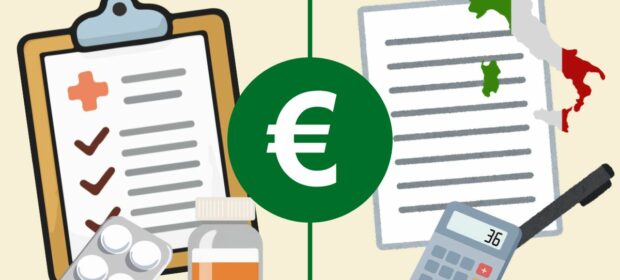
Spese Detraibili e Deducibili in Italia
Italy does not have a system of taxation with a tax free allowance system and therefore tax is paid from the very first Euro.
However, Italy does allow a number of tax deductible and detractable expenditures from taxable income.
Firstly, what is the difference between a tax deduction and a detractable expense?
- Deductible expenses (oneri deducibili)reduce your taxable income, meaning you pay tax on a lower income.
- Detractable expenses(oneri detraibili) give you a direct reduction in the tax you owe – usually a 19% tax credit on the value of item you are claiming, unless otherwise specified.
Both are valuable, and knowing the difference helps you understand how the savings work.
Healthcare expenses (19%)
Without a doubt the most common category is healthcare expenses (detractable at 19%)
What you can claim is as follows:
- Pharmacy receipts (scontrini parlanti) showing the name of the medicine and your tax code (codice fiscale)
- Doctor visits (GPs and specialists)
- Surgeries and hospital stays (private and public)
- Diagnostic tests, X-rays, and blood work
- Dental care (e.g., orthodontics, if medically necessary
- Physiotherapy and rehabilitation
- Medical devices (e.g., glasses, hearing aids, prosthetics)
There is a ‘franchigia’ (excess) related to these expenses, which means that it is only the accumulated expenses over €129.11 which are considered eligible.
If your total health expenses are below this amount then you cannot detract from tax. (Equally, you cannot claim this credit if the expense is covered by insurance.
To give an example……if my total expenses are €800 during the year, then the calculation is €800 – €129,11 = €670,89, on which I apply the 19% tax credit = €127,47 tax credit.
It may not seem much but a few years ago I had to have some urgent dental care which cost €10,000. It was not covered by insurance and so I had to pay myself. That year I had a tax credit of €1875,46. Every little helps!
When you go to the farmacia make sure you present your codice fiscale to the pharmacist and they will normally tell you whether it is an item that qualifies or not.
** FARMACIA AND HEALTH EXPENSES ARE NOW REGISTERED AUTOMATICALLY ON THE AGENZIA DELLE ENETRATE (TAX AUTHORITY) WEBSITE. YOU CAN ACCESS THE WEBSITE AND CHECK THEM YOURSELF, HOWEVER THERE ARE OCCASIONS WHEN THEY DON’T APPEAR SO MAKE SURE YOU KEEP YOUR RECEIPTS AND GIVE THEM TO YOUR COMMERCIALISTA / FISCALISTA (ACCOUNTANT) WHEN YOU FILE YOUR RETURNS **
Home renovations and energy efficiency (various rates from 36% to 50%)
This is by far and away the next biggest category for gaining tax credits.
The key incentives for home improvements are as follows: (at at 2026)
- Bonus Ristrutturazioni(Renovation Bonus) – 50% for general home upgrades
- Ecobonus– 50–65% for energy-saving improvements (e.g., insulation, windows, solar panels)
On your ‘Prima Casa’ (first home) you can claim a 50% tax credit up to a maximum spend of €96000, spread over 10 years.(at time of writing)
On your second home or property (other than Prima Casa) it is a 36% on a maxi spend of €96000 spread over 10 years.
(excluding boilers which burn fossil fuels.)
- Sismabonus – 50% on Prima Casa for 2025 then 36% for 2026/27 for work related to protection against sismic risks. 30% from 2026/27.
- Bonus mobili (e grande elettrodomestici) – tax credit of 50% on spend of up to €5000 on electrical appliances and furniture that are linked to renovations.
- Nuovo contributo per elettrodomestici ad alta efficienza – 30% up to €100 discount on electrical domestic appliance purchases, outside renovation works
- Green Bonus – 36% on garden and green area improvements.
Insurance premiums
This is a category which people often fail to utilise because there are some questions over whether foreign insurance premiums paid can be deducted in an Italian tax return.
For policies that qualify as Life insurance, accident (both max €530) and long-term care insurance (LTC) – (€1291)
They must qualify (even if issued outside Italy) under the following conditions:
- Policy must be with an EU or EEA-authorized insurer(i.e. the company must be licensed to operate in the EU/EEA under EU regulations).
- The policy must cover eligible risks: life, accidents, disability, or Long Term Care
- The beneficiary must be the taxpayer or close family(not a third party like a bank).
- The contract must not be speculative(e.g., pure investment policies are excluded unless they include real coverage of life or disability).
I enter my life policies issued in the UK years ago, before Brexit, and which cover me throughout the EU and were issued whilst the UK was still in the EU. I principally have life insurance contracts with Legal and General and provide cover across the EU. The other alternative is to take out Italian equivalent policies especially for things like health insurance. It’s worth getting a quote from one of the bigger insurance providers such as Generali (or Genertel, their online offering) Allianz, Zurich, Groupama, Unipol Sai, Banca Intesa, Reale etc
Other categories include:
Donations (19-30%)
donations to recognised NGO’s, religious institutions or universities.
Mortgage interest (19%)
You can deduct interest on mortgages for your first home (prima casa) up to a cap of €4,000 per year.
Education expenses (19%)
- Kindergarten through university tuition (both public and private, up to limits)
- School meals and after-school program
- University housing (if located outside the student’s home province)
Max annual deduction for private schools may vary by level and region, with a cap around €800 per child.
Rental deductions
If you rent your main home, you may claim a tax credit based on your income and contract type.
For example: Ordinary rental contracts (contratto 4+4), Student housing and transfers for work (if you’ve moved for employment reasons)
The credit varies depending on income, age, and contract type (e.g., up to €495.80 or more).
Family related deductions and credits
Dependent children and other family members, alimony and maintenance payments (deductible), Nursery/kindergarten costs (detraction up to €632 per child)
Disabled persons (LEGGE 104/1992 BENEFITS)
Special deductions and detractions for people with disabilities or their caregivers, including: 19% for adapted vehicles (with limits), full deduction of medical devices, assistance costs, etc.
Sport and Youth activities (19%)
Up to €210 per child under 18 for gym, swimming, dance classes, etc. Applies to recognized sports facilities and clubs.
Rendita catastale in Italy
By Gareth Horsfall
This article is published on: 21st April 2026

21.04.26
What is it and how does it affect your life in Italy?
I admit it. I have been confused for years about the rendita catastale. I have never been entirely sure about its role in the Italian economy or how it benefits the individual or the system as a whole. Until now. A recent deep dive into some economic analysis finally made the penny drop.
Which taxes are calculated using the ‘rendita catastale’?
IMU – (Imposta Municipale Propria) – The tax on second + properties and houses, which are considered luxury properties (Class A/1, A/8, A/9)
Imposta di registro, Ipotecaria e Catastale – the taxes when buying and selling property (not market value!)
Imposta di successione e donazione – the value of property is calculated using the rendita catastale for the purposes of inheritance tax. https://spectrum-ifa.com/how-can-i-save-on-inheritance-tax-in-italy
Why is it important?
The rendita catastale represents the amount of “theoretical rent” that a householder pays to him or herself as a measure of economic consumption. It is an imputed figure — a notional income — that reflects the benefit you receive simply by living in a property you own. In other words, if a householder owns their home outright, with no mortgage or debt, then that person is considered both a consumer and an investor of the invisible rent money they would have received had they been renting out a similar property. This money is assumed to be spent, reinvested, or otherwise circulated back into the economy.
Economists consider this a growing financial benefit that property owners enjoy from not having to pay rent. It is a silent contribution to economic activity, even though no cash actually changes hands. And in a country like Italy, where home ownership is culturally and economically significant, this imputed value plays a surprisingly large role.
During the financial crisis 2008/9, the Italian economy shrank dramatically. GDP fell, unemployment rose, and many sectors contracted sharply. Yet property, proportionately, made up more of the gross domestic product. The weighting of property in Italian GDP increased despite falling house prices and fewer transactions. That gives you an idea of how severe the declines were in other parts of the economy. Even when the market was weak, the imputed value of housing — the rendita catastale — continued to represent a stable and substantial component of national wealth.
This helps explain why successive governments treat property taxation so delicately. When the financial benefit from housing takes up a larger proportion of a property owner’s economic position, it becomes politically sensitive. It is no coincidence that governments have repeatedly adjusted or abolished taxes on the prima casa, recognising that Italian homeowners’ spending habits are more important to the domestic economy than the behaviour of foreign buyers. Italy’s economic engine is fuelled by its own residents, and the majority of them live in homes they own.

The Italian economy relies heavily on home ownership. Simply by residing in debt‑free housing, paying no rent, living in family homes, or paying below‑market rents, Italians contribute a significant share to national GDP through this imputed rental value. In a country where more than seventy percent of the population live in owned residences, this contribution is not only substantial but essential. It has grown over time, rising as a share of GDP, and continues to act as a stabilising force even when other sectors fluctuate.
Understanding the rendita catastale also helps explain why property taxation in Italy often feels disconnected from market reality. The cadastral values used for tax purposes are based on an old system that does not reflect current market prices. Yet these values continue to underpin calculations for IMU, taxes on buying and selling properties, inheritance tax, and other assessments. The system persists because it provides predictable revenue for the state and a predictable burden for homeowners, even if it bears little resemblance to actual property values.
There have been discussions for years about reforming the cadastral system, modernising valuations, and aligning them more closely with market prices. But such reforms would have enormous political and economic consequences. Updating cadastral values would instantly increase the taxable base for millions of households, and no government has been willing to take that risk. So the rendita catastale remains, outdated but deeply embedded, shaping everything from tax bills to inheritance planning.
What becomes clear is that the rendita catastale is not just a quirky Italian administrative concept. It is a structural pillar of the economy, a silent indicator of wealth, and a key reason why property taxation is handled with such caution. It reflects the reality that Italians’ relationship with property is not merely financial but cultural, generational, and deeply tied to economic stability.
And now that you finally understand it, you can see why it matters — not just to economists, but to anyone living, buying, inheriting, or planning their financial future in Italy, including us.
How can I save on inheritance tax in Italy?
By Gareth Horsfall
This article is published on: 21st April 2026

21.04.26
You may not be aware, but from an inheritance tax point of view, Italy is actually considered more like a fiscal paradise. After you have picked yourself up off the floor because I just called Italy a “fiscal paradise”, you might want to read on. If your estate, or part of it, is likely to be subject to Italian inheritance tax on your death, then the current rules may interest you.
Italian inheritance tax law dates back to the Napoleonic period.
It requires parents, on death, to leave a major proportion of their wealth to their children instead of just their spouse. This system of forced heirship still exists today and continues to shape how estates are distributed in Italy.
Italy’s inheritance tax works as follows:
If the estate is passed to your spouse or relatives in a direct line, such as children, they are required to pay 4% on the value of the inheritance that exceeds one million euro per beneficiary. Brothers and sisters must pay 6% with an allowance of one hundred thousand euro each. Other relatives must pay 6% or 8% depending on the degree of relationship, but without any allowance. Non‑relatives pay 8% with no allowance.
However, there is a term called ‘eredi legittimi’ meaning that only certain relatives have an absolute right to the share of your estate on your death. These are your children and, spouse. If you don’t leave any children then your parents and brothers and sisters have a legal right to a share in your estate and only in the event that there are none of the above, would your other relatives up to the 6th degree have a legal right to a percentage of your estate.
For foreigners (non- Italians) living in Italy at the time of death they have a right to nominate the law of their home country as a way to distribute the assets from your estate on death, instead of being forced to adopt the Italian forced succession rules. (If you are from the UK, this could create significant IHT planning opportunities). It mean you are taxable in your home country (depending on the IHT rules there) but simply means you may be able to distribute your assets according to a last will and testament, if that is your choice. One exception does apply, where you have spouse of children who are resident in Italy at the time of your death, and in this https://spectrum-ifa.com/rendita-catastale-in-italy/ case, they may be legally entitled to their fair share of your estate regardless of your will. If you are in any doubt it is always best to consult a legal professional to discuss the options.
Despite Italy having a large number of people who are subject to inheritance tax each year, the tax collection is relatively small. This is due to the high allowances and also the fact that succession for a property is based on the valore catastale, not the market value. The cadastral value is often significantly lower than the real value, which reduces the taxable amount.
There has been periodic political discussion about increasing inheritance tax in Italy, but as of 2026 no changes have been implemented. The current system remains one of the most generous in Europe, especially for spouses and children. However, this does not mean that planning is unnecessary. On the contrary, understanding how your assets are treated under Italian succession law can make a significant difference to what your heirs ultimately receive. The new UK Statutory Resident rules https://spectrum-ifa.com/new-uk-inheritance-tax-rules/ for inheritance tax mean that many more UK nationals living in Italy may be able to avoid UK and Italian IHT altogether with some clever planning.
As part of any inheritance tax or succession planning that you may undertake, you may want to look at ways in which you can hold assets in a more tax‑efficient manner. The polizza assicurativa — or life assurance bond — meets exactly that criteria. Any money that you hold in one of these tax‑efficient accounts is completely free from Italian inheritance tax and is kept outside of the estate when the value is calculated. This can be particularly useful for those who wish to leave assets to beneficiaries who are not in the direct line, or who wish to avoid the constraints of forced heirship within the limits permitted by law. It is also outside the Italian equivalent of probate (successione) and so will not get potentially tied up for any length of time in administration or legal affairs, potentially saving thousands in legal fees as well.
The not‑so‑good news is that if the majority of your estate is in your property, this cannot be placed inside the tax‑protective structure. However, any other invested or investable assets can be, generally from around €250,000 upwards. One of the great advantages is that there is no upper limit to contributions. You can protect a large part of your estate from Italian inheritance tax easily and with maximum flexibility to access the capital and any income from it during your lifetime.
Five lessons learned from the building bonus system in Italy
By Gareth Horsfall
This article is published on: 21st April 2026

21.04.26
If you are buying a house in Italy and are intending on benefitting from the system of detractions and deductions for the costs of building and renovating your property, then here are 5 things which we learned in our home restoration.
- All payments must be made by traceable means i.e bonifico (bank transfer) or credit card payment. No trace, no bonus!
- If paying by bonifico (bank transfer) then you need to pay by using the ‘bonifico per agevolazione fiscale’ option with your bank and NOT the ‘bonifico ordinario’ option. It asks for more information, such as the partitia IVA of the company / person you have worked with and this is needed for the bonus.
- If you employ single workmen working alone then you don’t need an authorisation (SCIA or CIA) from the local authority but if they are a ‘dita edilizia’ (this can include even 2 people working together as a construction company) then you may need to have a ‘piano di sicurezza’ from an architect who will need to draw that up and provide you with the necessary numbers/reference codes. No ‘piano di sicurezza’ no bonus! (Our’s cost around €1000!)
- Your workmen can apply for 10% IVA (VAT) on purchased items, but this is not necessarily a given. Our commercialista recommended that we signed a document ‘richiesta di applicazione dell’IVA ad aliquota ridotta’ for each workman / company so they would be authorised to apply for it as the materials would fall under the approved renovation works. Obviously, the Agenzia delle Entrate have the right to investigate these events in the future and so we did the maximum possible to avoid future problems. Documents should be kept for 10 years.
- Try and employ local workmen or businesses which operate in the area, because if you have problems in the future you want to be able to get hold of them quickly and easily.
THE folder – are you prepared?
By Gareth Horsfall
This article is published on: 8th April 2026

08.04.26
Living in a foreign country is never easy, but have you thought how complicated it would be for your family if you die suddenly?
(Apologies for the subject matter around Easter, but if you are anything like me, I like to try and organise my annual tax paperwork for the commercialista around this time and so it is also a good moment to think about putting parts of your financial paperwork in order)
This article is one which I prepared years ago and have been sending out infrequently because on my travels and in the conversations I have, it is ever apparent that most people do not have all their financial paperwork in order in case anything happens to them.
Ensuring that your papers are in order in the event of your sudden death is incredibly important when living in another country. It will provide you with peace of mind that your loved ones will not have too much difficulty in administering your estate, and your family will be thankful that you did it for them.
The big problem is that we often have documents spread across multiple locations: the office, a house in another country, with family members and in that old box that no-one dares look in.
The purpose of this article is to outline a proven way of organizing your affairs to reduce stress on the family in the event of your death.

So what is ‘THE’ folder?
It is a single file (digital or physical) where you keep all of your important personal and financial information together. It allows easy access to these documents in the event that you are no longer around to deal with these things. It is really important to have it in place where one family member takes the lead on the family finances (as I do in our household). That includes paying bills, managing accounts and storing documents.
Is it worth the effort?
Well, I think it is worth the effort. I did mine a while ago and it gives me peace of mind more than anything else. I also told a few people about its location and left a note of who my wife should contact in the event of my death.. A time of loss can be stressful enough without having to try and piece the financial affairs together.
Preparing ‘THE’ folder is much more than avoiding stress as well. If you leave behind an administrative nightmare you could also delay access to the inheritors’ funds and potentially cost a small fortune in legal fees.

To give you an example of this, the UK Department of Work and Pensions estimate that there is currently more than £400 million sitting in unclaimed pension pots in the UK.
Approximately 1 in 7 Americans are estimated to have unclaimed property, such as forgotten bank accounts, insurance proceeds, or unclaimed inheritances
Which is best…..physical or digital?
This comes down to personal preference. It can be done by either creating an electronic file that survivors can access in the event of death. This file can then be stored on your main computer, in the cloud or on an external hard drive. Alternatively you can use a physical folder to keep all of the important information together.
For what it’s worth, I decided to do both when building mine because my wife prefers paper and so is happier with hard copies of everything. I prefer digital. I have also shared the digital folder with some trusted family members.
So what should go in ‘THE’ folder?
Birth, marriage and divorce
- Personal birth certificate
- Marriage licence
- Divorce papers
- Birth certificate/adoption papers for minor children
- Certificato di residenza (although it only has a 6 month validity, it might be worth while keeping a copy in there, where you are listed as being at your current address)
- Stato di Famiglia document
You can download free copies of your Italian documents, and copies with the ‘bollo’ (for €16) from the Italian national register website, here: https://www.anagrafenazionale.interno.it/ You will need to access it with your SPID or CIE.
Life insurance and retirement
- Life insurance policy documents (including beneficiary nomination forms)
- Details of any employer death in service benefits
- Personal pension documents
- Employer pension details
- Annuity documents
- Details of any entitlement to state pensions and in which country they derive.
Bank accounts
- List of bank accounts with account numbers, login details, passwords etc
- Details of any credit cards
- Details of safety deposit boxes
Assets
- Property, land and cemetery deeds
- Timeshare ownership
- Proof of loans made
- Vehicle ownership documents or rental agreements.
- Stock certificates, brokerage accounts, investment platform details, online investment account details
- Details of holdings of premium bonds, government bonds, investment bonds
- Partnership and corporate operating/ownership agreements (including offshore companies)
Liabilities
- Mortgage details
- Proof of debts owed
Details of gifts
- Dates and amounts/values (potentially helpful when calculating any inheritance tax liability)
Gifts which have been made many years ago can be hard to track down and so it’s important that when you make a gift to a family member or anyone else, that you keep a copy of the bank statement showing the amount paid, on what date and to whom.
If you made a larger gift, in Italy, then it will likely have been made through a notaio and so paperwork should be available. Keep these documents safe.
Income sources
- Make a listing of all your sources of income, especially ones that your family might not know too much about
- Employer details
- A copy of your most recent tax return or accounts.
Your historical Italian tax returns are all available to view and download on the Agenzia delle Entrate website under the section ‘Cassetto Fiscale’, which you can access with your SPID or CiE.
Monthly expenses
(so they can be maintained if necessary or cancelled if not. Essentially list the fixed costs which would need to continue after death)
- Utilities
- Insurance
- Rent/mortgage
- Loans
- Subscriptions/memberships
Email and social media account details
Essentials
- Will / testament + details of the legal firm that helped create it
- Living will details.
Did you know that you can write a ‘Testamento Biologico’ in Italy which will allow someone or more than one person to make medical decisions on your behalf (e.g life support and organ donation rather than day to day medical decisions) and this form can be lodged with your comune.
- Instruction letter/s
- Trust documents
- Burial/cremation wishes
Contact details
- List of names and contact numbers for: Financial adviser, doctor, lawyer/solicitor, accountant, insurance broker,
How often should ‘THE’ folder be reviewed?
Firstly, it is sensible to note the date that it was last reviewed so that anyone using it has an idea of how up-to-date the details are.
Going forward, reviewing the file on an annual basis should be sufficient.

Online passwords
I think it’s safe to say that this is the most problematic part of the whole process because we have so many passwords nowadays and need to change them all the time.
f you are not comfortable keeping these in your hard copy folder, consider using a password management program. A password manager allows you to save all account usernames and passwords in one place. They are then protected using one master key. There are a number of them available. Don’t forget to leave note of how to access the password manager though!
This may, however, be a step too far for you given the data breaches that seem to happen often and I appreciate that and if you are not comfortable in using such an app then its important to have a physical record some where that can be accessed in the event of your death.
PHONE PASSWORDS
This may seem like common sense but our lives now revolve around our phones and so ensuring that you leave details of not just your password to access the phone / PIN or line drawing shape, but also the PIN or access codes when the phone has been switched off AND your PUK code in the event that they get blocked out. If you use fingerprint authentication then you may also want to ensure that you leave open another access possibility, such as the PIN so that the phone can be opened without the need for your fingerprint, when that is no longer possible.
COMPUTER PASSWORDS
As per the above, do the same for your computer.
SPID and CIE
It’s probably worth a note about your SPID (Sistema Pubblico di identità digitale) and / or your CIE ( carta d’identità abilitata). These are digital identities accessed via apps and are now arguably some of the most important phone apps to access important financial and legal information held by the Italian state and therefore ensuring that you leave details of your passwords to access the apps could help your beneficiaries resolve estate issues without needing to engage or financial professionals to communicate with the various agencies on your behalf and at great cost.
And finally…
Get started…….don’t delay!!! It might seem like a huge task but getting started and putting some paperwork together is better than doing nothing. You can always go back to it at a later date and add more until it is finished. Don’t leave it until it’s too late!
Lastly, be sure to tell someone about it. There is little point going to the effort of creating such a folder if no one knows of its existence / where to find it.
Crude awakening in the Middle East
By Gareth Horsfall
This article is published on: 4th March 2026

04.03.26
I wanted to communicate some information regarding what is going on in the Middle East with some information from Evelyn Partners ( one of our asset management partners) in an email newsletter to all advisers, which provides perspective regarding investments. If you have any questions or thoughts, do not hesitate to get in touch and fingers crossed this situation does not last long!
Crude awakening in the Middle East
Escalating tensions in the Middle East have brought renewed market volatility and lifted oil prices, but diversified portfolios offer resilience in periods of uncertainty
What has happened?
Over the weekend, tensions between the US, Israel and Iran escalated materially. Israeli strikes have reportedly targeted Iranian nuclear facilities, while the US has signaled a broader objective that may extend beyond deterrence towards regime change. Iran has responded with attacks affecting parts of the Gulf region, including strikes impacting areas in the UAE, Qatar, Bahrain and Kuwait, as well as Israel.
This marks a significant shift from prior contained flare-ups. Financial markets are responding to the risk of further escalation.
Initial market reaction
Three key price moves frame the immediate response:
- Brent crude oil is up roughly 10%, to around $80 per barrel.
- S&P 500 futures are modestly down approximately 1.5%.
- Gold is up around 2.5%, reflecting demand for traditional safe havens.
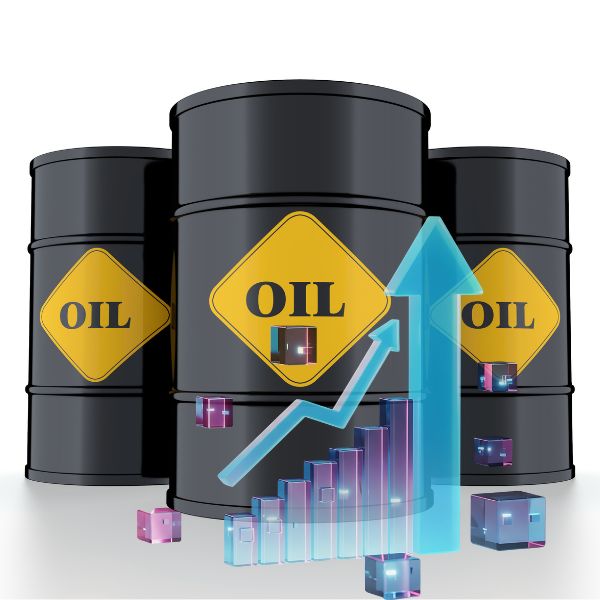
The move in oil is central.
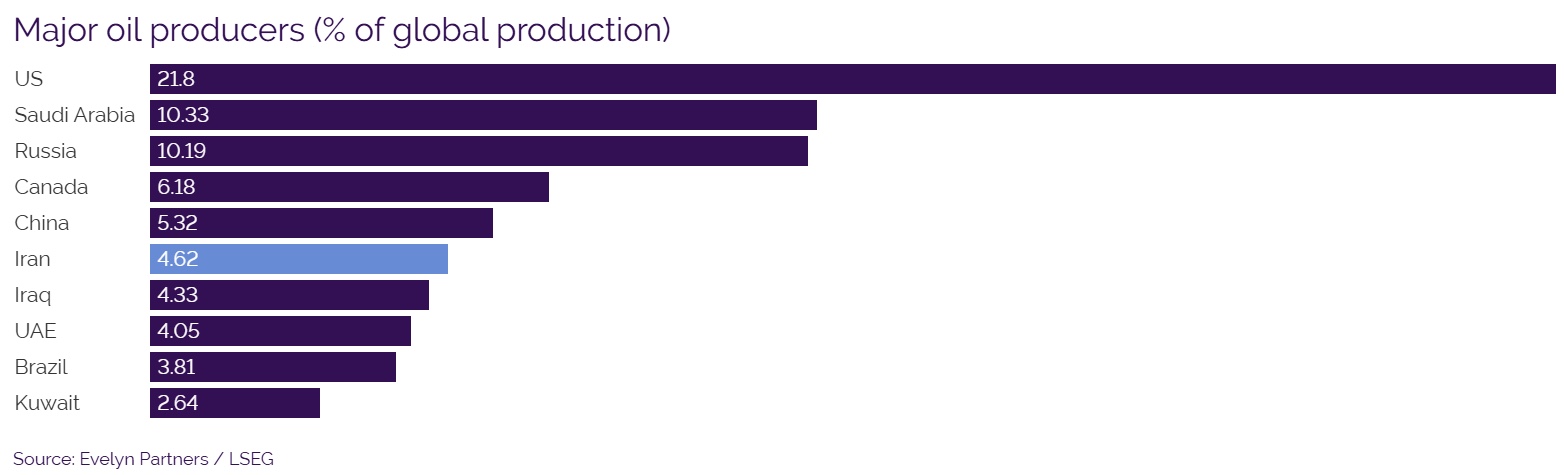
Iran is a major exporter, and critically, more than 80% of Iranian oil exports go to China. Iran is also strategically important to China’s Belt and Road initiative, is a member of BRICS, and plays a role in facilitating trade outside Western sanction frameworks.
In that context, this is not just a regional issue; it intersects with broader US – China strategic dynamics. Should the US gain greater leverage over oil flows coming out of both Iran and Venezuela, it would provide Washington with a significant bargaining chip ahead of the upcoming summit between Presidents Trump and Xi of China.
Paradoxically, such leverage could also deter China from blockading or invading Taiwan, a far larger systemic risk to global markets given Taiwan’s dominance in producing advanced semiconductors.
Key risks to watch
The primary “tail risk” remains disruption to the Strait of Hormuz, through which roughly a fifth of global oil supply passes. At present, while there are signs of disruption – including higher shipping insurance costs and some tanker hesitancy – the Strait remains open and traffic continues. A full closure or mining of the waterway would represent a far more severe shock to energy markets and global growth.
There is also the risk of broader attacks on regional energy infrastructure or US-linked assets across the Gulf, as most of the key oil infrastructure sits within short-range missile range of Iran. However, at this stage, markets are pricing heightened uncertainty rather than a sustained supply shock.
It is also worth noting that global oil inventories have been rising, which provides a partial buffer against near-term supply disruption. That does not eliminate risk, but it may dampen the impact unless escalation becomes materially worse.
Equities have softened modestly, but earnings growth remains the dominant driver of equity markets. Corporate Earnings Per Share momentum has so far offset geopolitical and tariff concerns this year, and we are not seeing signs of systemic stress or disorderly market functioning.
Portfolio implications
Periods like this are uncomfortable, but they are not unfamiliar. We have seen similar episodes – most recently during prior Israel–Iran tensions and in the 2022 energy shock.
History shows that while oil and gold often react sharply, diversified portfolios tend to prove resilient.
Across asset classes, we are seeing natural offsets:
- Energy prices rise, supporting oil and gas equities.
- Gold acts as a multi-use hedge during geopolitical stress.
- Inflation-linked bonds, such as TIPS, provide protection should higher crude feed into inflation expectations.
Within equities, exposure to energy producers can help offset broader market weakness linked to rising oil prices. In fixed income, inflation-linked bonds could benefit from rising inflation expectations. Alternatives such as gold continue to demonstrate their value during energy shocks, as seen in previous episodes including 2022.
Investment strategies are designed with periods like this in mind. They are constructed to withstand geopolitical shocks, inflation pressures and bouts of market volatility, while remaining fully liquid and aligned with clients’ long-term objectives and risk profiles.
Looking ahead
We expect markets to remain volatile in the days ahead. News flow may be intense and, at times, sensational. It is important to distinguish between media tone and market fundamentals.
At this stage, this is not a systemic market event. We are not seeing disorderly trading conditions or liquidity stress.Remain vigilant and ready to adjust portfolio positioning should fundamentals materially change.
For now, the appropriate stance is calm, disciplined and long term. Periods of geopolitical tension are unsettling, but diversified portfolios are designed to navigate precisely these environments. We will continue to monitor developments closely and keep clients informed with measured, evidence-based updates as the week progresses.
I know these are not easy time and so if you have any questions, or would just like to send me some comments then feel free to do so. I am always interested to hear your thoughts on these matters.
Financial updates – February 2026 – Italy
By Gareth Horsfall
This article is published on: 20th February 2026
20.02.26
In this Ezine I will summarise the discussions and news from our annual event which took place in Monaco this year.

As you may know my newsletters are not AI generated and for this reason they take me a little time to summarise the information, and also find the time to do so. I hope that you appreciate the fact that you are not being sent existing information which has been trawled out of the internet-o-sphere, but rather real, new and original content. (AI was a big story on the conference actually, so I will be touching on this a bit further down.

Interest rate cuts – Tax cuts – Lower energy costs – Deregulation
One interesting thing that occurred before I went on the conference, in fact just a few days before, was that a handful of people contacted me to say that they wanted to sell out of US based assets because they didn’t like the activities of Donald Trump and the current US administration. My advice at this time was:
We need to separate the political from the investment!
It is always good to be reminded that the US stock market is valued (USD 67-69 trillion) at more than the rest of the worlds stockmarkets cumulatively (USD 55 to 60 trillion). So no matter what we think about the politics in the US at the moment, to exclude ourselves from the US stockmarket would be akin to investment suicide. We can make investment choices based on sustainable and ethical choices (and we offer these services as well for our clients) but some of the best research, technological innovation and new creative thinking comes from the US and so it still retains it’s spot as one of the best, if not THE best places for an investor.
To further explain the importance of the US market, it was explained at the conference, that should just 1% of the total value of the US stockmarket be moved at any one time, it would hardly move the markets in the US at all. That same amount would be the equivalent of the entire German stockmarket (which includes all the big names we know such as Volkswagen, Basf, Siemens, SAP, Mercedes Benz and many more) and would have a tremendous impact on the German stockmarket and in Europe, just to give context on how important the US is for our portfolios.
Saying all this, I appreciate that the Trump administration may still be a little too much to bare for some people, and so here is my summary of what is going on there:
DRIVING THE US DOLLAR LOWER
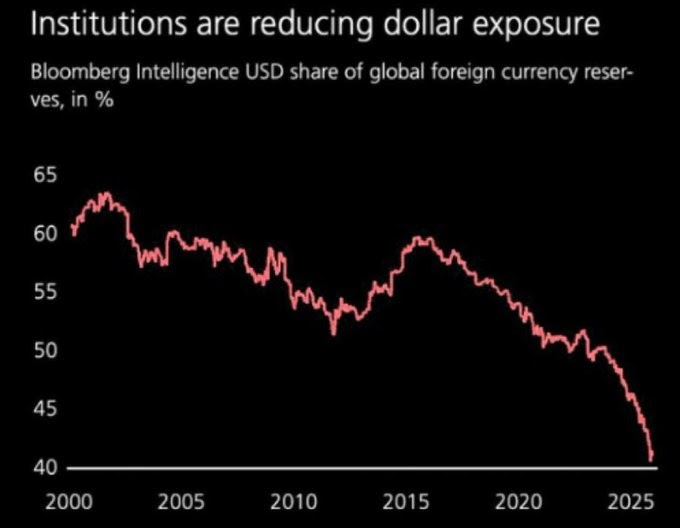
If the U.S. economy is about 30% of global GDP, then should its currency, being that it is the reserve one, account for 35%-40% of global reserves and not 50% or 60%?
It is now pretty evident that the Trump administration is aiming to push the US Dollar lower against other currencies…but why?
The old globalisation game where the US outsourced everything and let China build the factories is effectively over. The idea that cheap imports were free trade and you don’t pay the price for destroying your industrial base is something which needs to be re-addressed as many economists on both the left and right side of politics, agree. To some extent Beijing also started weaponizing supply chains, particularly in rare earths such as lithium, cobalt and graphite, because they have an almost 90% control over these rare earths, both in mining and refining. The Trump administration is aiming to protect US interests and rebuild American industry from the ground up.
Tariffs are back—and they’re not going anywhere. They have largely turned out to be a negotiating stick and strategically aimed at specific goods rather than blanket punishment, to protect US domestic producers and force companies to bring manufacturing back to the US. As DT has said: “if you want access to the world’s largest consumer market, build in the US” Produce there and employ Americans.
A WEAKER DOLLAR IS PART OF THE PLAN
Not a collapse, but more than likely a deliberate, controlled depreciation to make U.S. exports competitive again and make imports more expensive. (2026 may see a further USD decline when the new Fed Chairman Kevin Walsh is put in place, and then it could stabilize)
Cheap foreign goods have flooded the US market (and Europe) for decades because the dollar was probably too strong. A weaker dollar rewards domestic production, boosts manufacturing margins, and will hopefully brings jobs back to places that have been forgotten for years! (If this strategy works then you can be assured that Europe wil adopt the same approach, no matter how much they hate to admit it!)
PROJECT VAULT
This could be one of the most significant decisions made by any US administration for decades. Project Vault is a $12 billion strategic plan to stockpile critical minerals, the equivalent of a Petro Reserve for the AI and defense age. The US is building a preferential trading bloc with price floors, adjustable tariffs, and enforceable rules to crush China’s predatory pricing and market flooding.
The winners will be the ones who control the physical economy—the mines, refineries, smelters and processing plants. Critical minerals and rare earth security.
Without them, nothing modern works. Jet engines. Hypersonic missiles. Wind turbines. Electric motors. Drones. Smartphones. AI data centers. Defense systems. EVs. Nothing.
And here are some examples:
Niobium—an irreplaceable steel strengthener. Adds toughness, corrosion resistance, and high-temperature performance to superalloys
(Brazil controls ~90% of global supply. The U.S. imports 100%. Zero domestic production. One mine in Canada which given the fractious nature of current US / Canada relations, the US considers this a national security nightmare)
Neodymium (Nd) and Praseodymium (Pr)—the magnetic rare earths that power permanent magnets, the strongest magnets ever made.
(Essential for EV traction motors, wind turbine generators, missile guidance, radar, precision-guided munitions, and high-performance robotics)
CHINA CONTROLS CIRCA 90% OF REFINING AND 93% OF MAGNET PRODUCTION AND 60% OF THE REFINED SILVER MARKET.
IF RELATIONS SOUR FURTHER, THEN BEIJING WITH JUST ONE PHONE CALL, COULD PARALYZE WESTERN DEFENSE AND CLEAN ENERGY SUPPLY CHAINS
And so, in a nutshell, that is what the Trump administration would appear to be doing geopolitically. (I won’t mention any US domestic issues that are….well….. questionable).
My hunch is that you will see Europe follow suit. Europe appears to have woken up (c/o D.T) to the fact that it needs to protect itself and can no longer rely on the US Military Industrial Complex. Re-arming Europe seems to be the EU leaders first objective, but if they then see progress with this economically nationalistic kind of behaviour in the US then I would say that they will start to walk a similar path, even though the EU is quite protectionist by nature anyway. It may mean that you need to stock up on TEMU goods now, whilst the prices are still low!
I have probably dedicated more time here to the Trump administration than I had wanted to, but it is clearly on alot of minds and so was worthy of a few lines.
However, on our conference we did discuss other investment matters, which arguably are not quite as important as what is happening in the US administration, but also warrant some time being spent on them.

THE GREENLAND DEBATE
These conferences are always interesting to get perspective on certain matters and the issue of Greenland was brought to light as follows:
From 1951 to 2004 the US had the right to place US bases in Greenland without any permission required.
From 2004 this power was taken away when Greenland gained sovereignty and fell under the supervision of Denmark.
Now, the pre-1951 agreement is being re-negotiated, and although not a ‘free to do what you wish’, the US will certainly have the possibility to expand its military presence. Was the whole ‘buying Greenland fiasco’ just a ruse to restablish this agreement?
THE AI BUBBLE
At the 2025 conference alot was made of AI and how it would be changing the world, putting people out of work and taking over our world. Just one year on and the view from the asset managers was almost completely the opposite, but also that it is not going anywhere soon.
However, an AI bubble (like the tech bubble of 2000), it would not seem to be. AI is already helping businesses to improve productivity but not by firing staff. There is no evidence of this and the companies running AI models themselves, are already profitable. In addition the Big tech companies are cash rich. It is more likely that AI integration will more of a messy technological shift, than a huge damaging effect and it’s very unlikely that AI stocks will be the cause of a global recession, or mass unemployment no matter what you read online.
Net income from Tech + comms services companies has grown from 23.1% in the year 2000 to 35.3% in 2025
HOWEVER, AI IS NOT LIVING UP TO EXPECTATIONS
A term was used: ‘Crap in – Crap out’.
What is being found is that the AI we know: ChatGPT, Google Gemini etc cannot be relied upon for accurate results.
Search results are based on the data that is out in the internet-o sphere. If that data is flawed then it has no way of knowing how to fact check it and hence it will produce inaccurate results. (In fact caught out ChatGPT on 3 occasions, when I knew its results were incorrect. I now use Google Gemini, which appears to be better). There is also a HUGE amount of internet fraud and scam and the culprits are using the internet to deliberately put out content which furthers their devious means. So, how can we rely on such a system? Markets are worried about the inability to overcome this problem and about a lack of innovation in AI. If we are all fishing in the same pool of information and being provided the same results then innovation and creativity grinds to a halt, and that is not good for businesses who are looking to find an competitive edge and / or increase productivity.

THE STRENGTH OF AI
But, AI probably has a more focussed strength in it’s ability to gather, organise and analyse large data sets. Private data is the real gem! It’s what you can’t see rather than already public data. I may have mentioned in my Ezine last year the example of the Lancet medical publication in the UK, which has archives going back 203 years. It is almost unimaginable that human beings would be able to reference a tiny fraction of that information, whereas they are already using AI tools to organise data and information in their business and to make it available to a much wider and much more targeted audience. Data is the new gold! Loyalty card data would be a perfect example of data which can be privately exploited by companies looking to gain a competitive edge with the use of AI tools.
AI POWER
The strange thing with AI is that the people who are probably going to make money from it are not the people directly running AI tools, but more likely the periphery businesses that are needed to keep it running: energy providers and data centres being good examples: see images below to give you an idea of just how many resources are going to have to go into running and maintaining these centres.

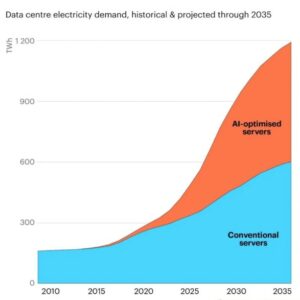
Could nuclear and renewables be the winners long term?
TWO MORE ITEMS
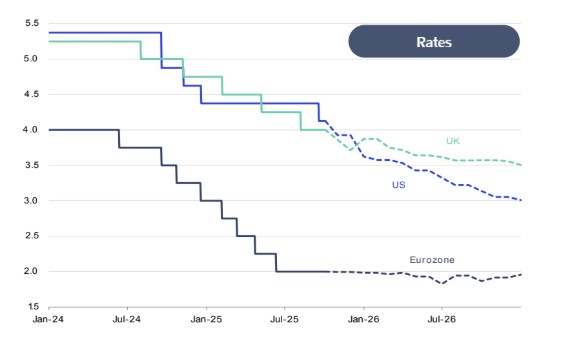
INTEREST RATES: don’t expect rates on your cash to be rising anytime soon. If you are sat with the majority of your assets in cash, then you should really be thinking about the long term implications of inflation on these monies. This is exactly the scenario that governments wanted to see. Low interest rates (which keep government benefit payments down and debt repayments low) but an inflationary economy. They pay their debts down quicker amd erode them away, and we feel the pinch. You can see the interest rate trend in the chart below.
OIL
Given the US’s influence over the world’s major oil producers (Venezuela, Saudia Arabia, Iran and Canada) , it is likely that there will be a glut of oil in the next 5 years. This will most likely push prices down. This is certainly what the D.T administration wants. Energy prices and inflation should fall which could be good for US stocks in particular. The wider US market could benefit greatly.
I hope you have enjoyed this content! Once again apologies for the time taken to get it you. Unfortunately I don’t even think AI is sophisticated enough…yet…to decipher my scribbles and handwriting when note taking.
As always, if you have any questions, or would just like to send me some comments on what you have read here, then feel free to do so. I am always interested to hear your thoughts on these matters.
Equally, if you would like to follow up individually on anything then you can do so on gareth.horsfall@spectrum-ifa.com or message / call me on +39 333 649 2356
The unusual aspects of taxation in Italy?
By Gareth Horsfall
This article is published on: 5th February 2026

05.02.26
We are a team of fully regulated financial advisers working across Europe, with a strong presence in Italy since 2010. Our focus is on helping expatriates, and returning Italians from abroad, who are residents or want to become residents in Italy.
- Needing a professional to help you – Unless your financial affairs are really simple then you will likely need a professional to help you complete your tax return. Self declaring is complicated due to the codes used to complete the forms and so might not be worth your while due to the risks of getting it wrong. That being said you can get info online as to how to complete your tax return which is helpful.
- Reddito diverso e reddito di capitale – If you have investments in something like Exchange Traded Funds, for example, the income and capital gains are treated as one type of income (reddito di capitale) and the losses as another (reddito diverso). You can’t offset one from the other even though they derive from the same asset.
- Wealth taxes – Many countries do not have wealth taxes. Italy introduced them in 2014 when Mario Monti was Prime Minister. At the time politically, Italy was under the spotlight for its mounting debt and so wealth taxes were introduced as a way to generate more revenue for the country. Also, it harmonised the fact that taxes were paid on domestic assets but not on assets held abroad, at the time and so capital flight was rampant to evade taxes.
- Wealth tax on property – If you have a property outside the EU, then the wealth tax is calculated on the purchase value. This may seem strange but the market value is largely subjective depending on market supply and demand and would be difficult to determine. The purchase price is documented in the purchase contract and so is a definitive sum which reference can be made to.
- Choosing your tax rate – You can choose to have your investment income and/or gains taxed at your lowest rate of income tax IRPEF (23%), if available, or the standard flat rate on investment income (26%). This comes in useful if your total income is low and you can use up your first band of income tax. Otherwise, it’s normally better to go with the standard flat tax rate. You can also deduct certain expenses from the IRPEF choice, which can lower the rate even more. This is not possible on the standard rate.
- There are no personal allowances or nil rate tax bands for personal income. You start paying tax on Euro No 1. If you are in retirement and in receipt of a pension/ retirement income, you may get an age-related credit, depending on your income, otherwise you can deduct some expenses such as some building costs, vets bills, pharmacy expenses and doctors bills, which can reduce your income tax bill further.